Introduction
In our previous lessons, we've focused on controlling the flow of information to the reader. We analyzed dramatic irony (giving the reader more knowledge than the character) and the techniques of teasing versus withholding (giving the reader less). These are powerful tools, but they all depend on a stable and predictable narrative foundation: a controlled Point of View (POV).
When that control wavers, the carefully constructed information gaps you've engineered can collapse, confusing the reader and breaking immersion. Today, we will address a critical failure mode in POV management. Your learning outcome is to identify and correct instances of 'head-hopping' where POV shifts unintentionally within a scene.
Think of head-hopping as a bug in your narrative code. It occurs when the "camera" of the story, which should be locked to one character's perspective, suddenly jumps into another character's mind without a clear structural break. Our goal is to learn how to debug this error.
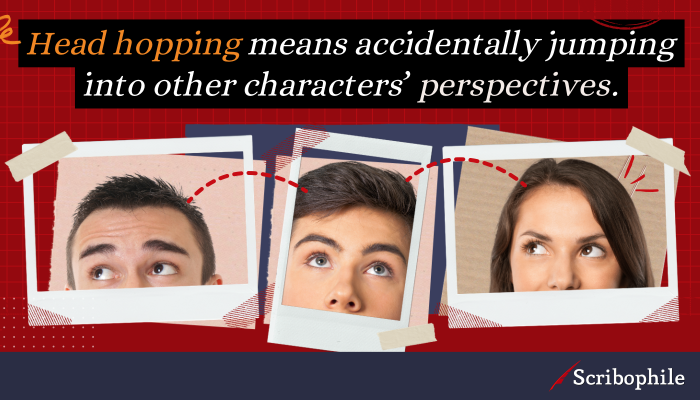
1. Defining the Error: What is Head-Hopping?
From a mechanical standpoint, head-hopping is an unauthorized access violation. In a scene written from a close first-person or third-person limited POV, the narrative is restricted to the internal state (thoughts, feelings, direct sensations) of one character. Head-hopping occurs when the narration accesses the internal state of a different character within that same scene.
The following video provides a concise definition and explains the primary problems it causes.
Head Hopping: How to Use It & When Not To (Writing Advice)
Let's start with a formal definition of head-hopping and the reasons why it's considered a technical flaw in most narrative contexts.
Watch the segment from 01:13 to 03:05. Focus on the definition of head-hopping and its three main dangers: creating confusion, exhausting the reader, and reducing mystery/tension.
As the video explains, this unplanned shift in perspective is problematic because:
- It disorients the reader. Readers are trained to expect a consistent POV until a formal break (like a new chapter or a scene break indicated by
***). A sudden shift is jarring. - It diminishes tension and mystery. Part of the engagement in a story comes from not knowing what other characters are thinking. Revealing everyone's thoughts eliminates subtext and suspense.
This issue primarily occurs in third-person writing, as first-person ("I") naturally locks the perspective. The error is most common in what is intended to be third-person limited POV.
2. Diagnostic Test: Identifying Head-Hopping
To correct an error, you must first be able to reliably detect it. The key diagnostic question is: "Does the narrator have access to information that is impossible for the current POV character to know?" Specifically, this means direct access to another character's thoughts or internal physical sensations.
The following article provides an exceptionally clear set of side-by-side examples that will help you calibrate your detection skills.
What Makes Omniscient POV Different from Head-Hopping?
This article by author Jami Gold uses a single scenario to demonstrate four different POV modes, including a perfect example of head-hopping. The comparison makes the error immediately obvious.
Read the section titled 'Examples of POV and Voice' and the analysis that follows it. Pay close attention to the 'Head-hopping' example and the explanation for why it's faulty: the narration starts in the woman's deep third-person voice and then jumps into the man's head to reveal his internal motivation.
Let's break down the logic from the article's example:
- Line 1 (Her POV):
She didn’t know what to say.(Valid: Her internal state). - Line 2 (Her POV):
How the heck was she supposed to react when her ex called out of the blue to tell her he’s dying?(Valid: Her internal thoughts, her voice). - Line 3 (His POV - The Hop):
He coughed a couple times and then a couple more, just to stretch out the interruption and make her squirm.(Error: She can see him cough, but she cannot know his intent was to "make her squirm." This is information from inside his head).
The error is the leap from observable action (coughing) to un-observable intent.
Now, let's look at another set of examples that further clarifies this.
Storyville: What is Head-Hopping and Why Should You ...
The article from LitReactor provides another excellent before-and-after demonstration. 'EXAMPLE TWO' is a clear case of head-hopping, while 'EXAMPLE THREE' shows the corrected version.
Read 'EXAMPLE TWO' and 'EXAMPLE THREE'. In Example Two, identify the exact phrases that constitute head-hopping. Then, in Example Three, analyze how those very phrases were rewritten to convey similar information without leaving the protagonist's (Raymond's) perspective.
In "EXAMPLE TWO," the hops are:
Natalie joins him, worried about the stakes at hand.(We are inside Natalie's head, feeling her worry).Jacob their leader sneers and makes a mental note to follow the girl home another day...(We are inside Jacob's head, hearing his thoughts)....as Natalie says a silent prayer...(A silent prayer is, by definition, internal and unknowable to an outside observer).
Now that we can reliably identify the error, let's move on to the correction protocol.
3. The Correction Protocol: From Internal State to External Observation
Fixing head-hopping is a systematic process of converting unknowable internal information into observable external cues. The goal is not to lose the information entirely, but to filter it through the senses and interpretations of the single, consistent POV character.
The Protocol:
- Isolate the sentence that contains the head-hop.
- Identify the piece of information being conveyed (e.g., "Character X is nervous").
- Brainstorm an observable action, expression, or line of dialogue that implies this internal state (e.g., Character X wrings their hands, their voice cracks, they glance at the exit).
- Rewrite the sentence to describe that external cue from the POV character's perspective.
This video demonstrates this exact process.
Head Hopping: How to Use It & When Not To (Writing Advice)
Let's watch a practical demonstration of this correction protocol. Writer Brandon McNulty takes a sentence with a head-hop and revises it on the spot.
Watch from 03:48 to 05:11. Notice how the internal sensation 'his stomach tightened' is converted into the visual cue 'he pressed a shaky hand against his stomach.'
The change is from ...his stomach tightened. (an internal sensation only he can feel) to ...he pressed a shaky hand against his stomach. (an external action the "I" narrator can see). The information conveyed (he's nervous) remains the same, but the delivery now respects the established POV.
This correction also forces you into more precise and active writing, which is a positive side effect. Instead of simply telling the reader that Natalie is worried, the corrected example from LitReactor shows it: ...by the way she twirls a strand of brown hair in her hand, and keeps touching the crucifix around her neck. Raymond observes her "tells," and the reader infers her anxiety.
Test your understanding!
Below is a short passage written from a close third-person POV (focused on a character named Elara). It contains two instances of head-hopping. Identify them and rewrite the passage to eliminate them, staying strictly within Elara's perspective.
Original Passage:
Elara faced the captain across the desk. "I'm requesting a transfer," she said, her voice steady. The captain sighed, weary of the endless paperwork this would cause. He wished she would just reconsider. Elara watched his face, interpreting his silence as disapproval. Across the room, her rival, Jax, smirked to himself, thrilled at the thought of Elara finally being gone.
Show answer
The two instances of head-hopping are:
...weary of the endless paperwork this would cause. He wished she would just reconsider.(This is inside the captain's head)....Jax, smirked to himself, thrilled at the thought of Elara finally being gone.(This is inside Jax's head).
Corrected Passage:
Elara faced the captain across the desk. "I'm requesting a transfer," she said, her voice steady. The captain sighed, slumping slightly in his chair and rubbing his temples. He looked exhausted. Elara interpreted his silence as disapproval. Across the room, she saw her rival, Jax, catch her eye and break into a wide, triumphant smirk. The expression made her stomach clench.
Analysis of Correction:
- The captain's internal weariness and wish are replaced by Elara's external observations: he
slumped,rubbed his temples, andlooked exhausted. - Jax's internal thrill is replaced by an observable action: he
caught her eyeand gave atriumphant smirk. The impact of this is then filtered back through Elara's POV (The expression made her stomach clench).
4. The Exception: True Omniscient POV
It's important to distinguish the error of head-hopping from the deliberate craft choice of using a third-person omniscient narrator. They are not the same.
- Head-Hopping (Error): Unintentional, jarring shifts between character voices and perspectives in what is supposed to be a limited POV scene.
- Omniscient POV (Technique): A consistent, all-knowing narrator (the "eye of God") tells the story. This narrator is not a character in the story. It has its own distinct, overarching voice and can dip into any character's head at will, but does so with clear intention and signaling.
HEAD HOPPING VS OMNISCIENT POV | Find Your Novel's Narrator
This video clarifies the crucial difference between a story with multiple third-person limited protagonists and a story with a true omniscient narrator—a distinction that, if misunderstood, often leads to head-hopping.
Watch from 00:52 to 01:44. The key takeaway is the question: 'Who is the narrator?' In a multi-POV third-person limited story, the narrator is the POV character of that chapter. In omniscient, the narrator is a separate entity.
When writing in omniscient, you are not hopping between character heads randomly. You are a single, god-like narrator who chooses to report on what different characters are thinking. To avoid reader confusion, these shifts must be signaled clearly.
The most common signal is a paragraph break. Watch how Stephen King uses this technique in a classic example of well-executed omniscient POV.
Head Hopping: How to Use It & When Not To (Writing Advice)
Now let's analyze a masterclass in using intentional, omniscient narration from Stephen King's ''Salem's Lot'.
Watch from 05:11 to 09:26. Observe how King uses paragraph breaks to signal a shift from the mother's perspective, to the father's, to the son's. This is not an error; it is a controlled, intentional technique available within the omniscient mode.
Conclusion
You have now analyzed the mechanics of identifying and correcting head-hopping. Maintaining a stable point of view is not an arbitrary rule; it is a prerequisite for creating an immersive and controlled reading experience.
Key Takeaways:
- Head-hopping is an unintentional POV shift into a non-POV character's internal thoughts or feelings within a single scene. It is a technical error in first-person and third-person limited writing.
- The Diagnostic Test: Ask if the narrator is reporting information that the POV character could not possibly know (i.e., another character's internal state).
- The Correction Protocol: Convert the unknowable internal state into an observable external cue (action, dialogue, expression) and filter it through the POV character's senses and interpretations.
- The Exception: True omniscient POV allows for shifts in perspective, but it is done intentionally by a consistent, non-character narrator, often using signals like paragraph breaks to guide the reader.
Preview of the Next Lesson:
Now that we have established the discipline of keeping the narrative camera locked to a single character per scene, we can explore a more subtle aspect of POV. In the next lesson, we will analyze how a character's POV filters description, revealing their biases, mood, and focus. We will examine how the same room can be described in vastly different ways depending on whose eyes are seeing it.