Introduction
In our last lesson, we established the fundamental choice between compressing time with summary and expanding it with dramatization. We now have a clear distinction between telling the reader what happened and showing it to them in a scene.
This lesson drills down into the next layer of control. Once you've chosen to dramatize an event, what determines its perceived speed? Today's objective is to differentiate fast-paced scenes (high event density) from slow-paced scenes (high introspection/description). We will move beyond the simple on/off switch of scene vs. summary and into the fine-tuning of a scene's internal rhythm. Think of it as moving from the architect's blueprint (structure) to the specific materials and textures that determine how a room feels (pacing).
1. The Pacing Equation: Event Density vs. Detail Density
Pacing within a scene is not about the literal time that passes in the story world, but about the reader's experience of processing information. We can define the two modes of scene pacing with a mechanical distinction:
- Fast-Paced Scene: Characterized by high event density. This means a high ratio of plot-advancing actions, decisions, or dialogue exchanges to page space. The focus is on what happens next.
- Slow-Paced Scene: Characterized by high detail density. This means a high ratio of description, character introspection, or sensory information to page space. The focus is on what this moment feels, looks, or means like.
Essentially, fast pacing prioritizes external progression, while slow pacing prioritizes internal or environmental texture.
To understand this, let's look at a resource that frames pacing as a form of information control.
How To Control Pacing In Your Story
The article 'How To Control Pacing In Your Story' from Bubblecow provides an excellent foundation for this concept.
Please read the initial section, 'Understanding Story Pacing'. Note the core idea that pacing isn't just about speed but about how the reader processes what you give them.
The example in the article—"Sarah opened the door and saw the empty room" vs. the longer, more detailed version—is a perfect illustration of this principle. Both convey the same core event, but the first is fast (high event density relative to its single sentence), while the second is slow (high detail density).
2. The Mechanical Levers of Pacing Control
Since your goal is to approach writing as a technical discipline, let's identify the specific "levers" you can pull to either accelerate or decelerate a scene's pace. These are not matters of intuition but concrete stylistic choices.
The following reading will give you a toolbox of these mechanical controls, from the sentence level up to the scene level.
How To Control Pacing In Your Story
We'll continue with the Bubblecow article, which breaks down these controls into actionable techniques.
Read the sections 'The Levers That Control Pace' and 'Building Scenes That Regulate Pace.' Focus on the concrete advice under 'Line-Level Controls,' 'Paragraphing for Pace,' 'Intentional Tempo Design,' and 'Strategic Sensory Detail.' These are the core mechanics for manipulating pace.
Let's systematize the key levers from that reading into a clear accelerator/brake model:
| Pacing Control | Accelerators (Creates Fast Pace) | Brakes (Creates Slow Pace) |
|---|---|---|
| Sentence Length | Short, declarative sentences (<10-15 words). | Long, complex sentences with multiple clauses. |
| Sentence Syntax | Simple subject-verb-object structure. | Subordinate clauses, parenthetical phrases. |
| Paragraphing | Short paragraphs, single-sentence paragraphs. | Long, dense paragraphs. |
| Content Focus | Actions, plot-advancing dialogue. | Description, introspection, sensory detail. |
| Verbs | Strong, active, precise verbs ("sprinted"). | Weaker verbs with adverbs ("was running quickly"). |
| Word Choice | Concrete nouns, minimal modifiers. | Abstract nouns, rich adjectives and adverbs. |
| Information | Focus on a few key details that imply the bigger picture. | Cataloging multiple sensory details to build a rich texture. |
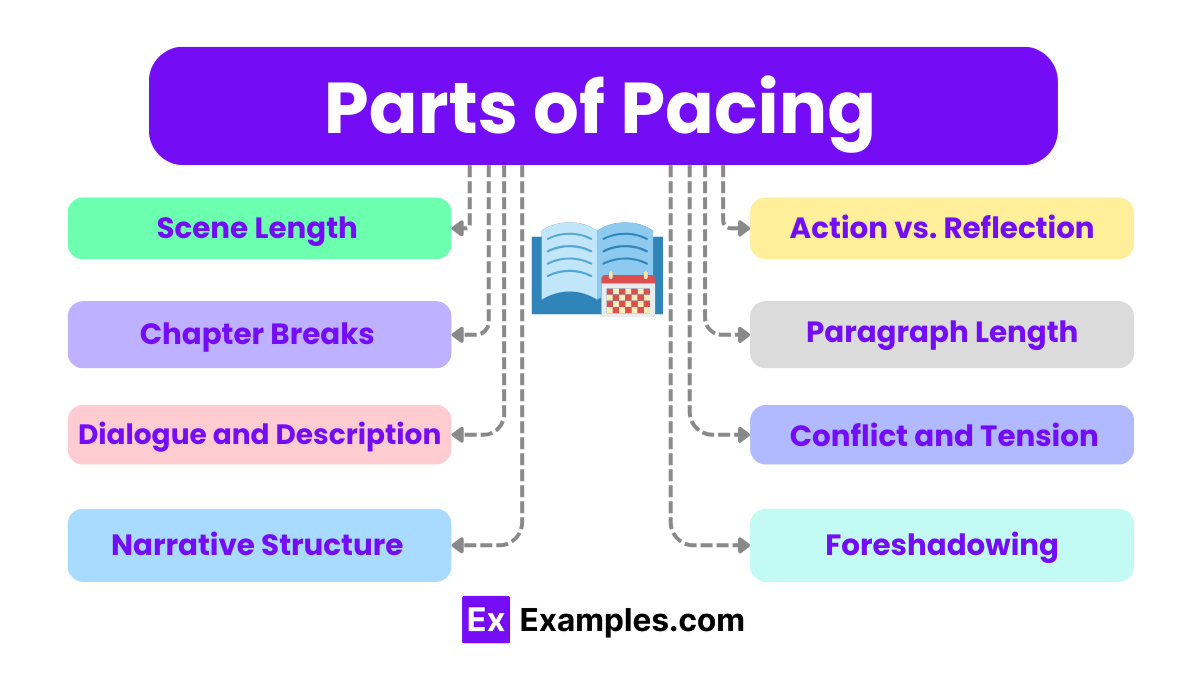
The key is to use these tools deliberately. A fast-paced scene is built from short sentences, strong verbs, and a focus on action. A slow-paced scene is constructed with longer sentences, rich description, and access to a character's internal thoughts.
3. Functional Pacing: Matching Tempo to Purpose
Now that we have the mechanical "how," we must connect it to the functional "why." The choice between a fast or slow pace is determined by the scene's narrative purpose.
-
Use Fast Pacing for:
- Action sequences (fights, chases, escapes)
- Tense arguments or confrontations
- Moments of sudden revelation or crisis
- Propelling the plot forward and building urgency
-
Use Slow Pacing for:
- Character introspection and emotional reaction (aftermath)
- Establishing mood and atmosphere
- World-building and description
- Deepening a relationship moment
- Allowing the reader to absorb the significance of an event
Most stories require a rhythm of both. A story that is entirely fast-paced can be exhausting and emotionally shallow. A story that is entirely slow-paced can feel stagnant and boring. The goal is to create a dynamic flow.

Test your understanding!
Imagine you are writing a scene where a character receives a letter containing life-changing news.
- Describe the techniques you would use to write this scene with a fast pace, focusing on the moment of discovery.
- Describe the techniques you would use to write this scene with a slow pace, focusing on the character's dread and anticipation before opening it.
Show answer
-
Fast Pace (Focus on Discovery):
- Sentences: Short, punchy. "He saw the seal. His name. He tore it open."
- Verbs: Strong, active. "Ripped. Scanned. Froze."
- Focus: Action-oriented. Eyes darting across the page, heart pounding, a single line of text jumping out. Minimal description of the room or the paper's texture. The focus is entirely on the event of learning the news.
-
Slow Pace (Focus on Anticipation):
- Sentences: Longer, more complex. "The envelope, made of a heavy, cream-colored stock that felt unnervingly formal in his hand, was addressed in a script he hadn't seen in nearly a decade."
- Focus: Introspection and sensory detail. Describe the weight of the paper, the smell of old ink, the character's memories of the sender, the way the light from the window hits the dust motes in the air. The event (opening the letter) is delayed to build tension.
4. Advanced Concept: Decoupling Event from Pace
A common misconception is that certain types of events are inherently fast or slow. While a car chase lends itself to fast pacing, a skilled writer can manipulate the reader's experience of any event.
In our last lesson, you analyzed the Gormenghast scene breakdown from Jeff VanderMeer's guide. The event is a chase and a fight—a classic high-action scenario. However, as VanderMeer explains, Mervyn Peake writes it as a slow-paced scene.
Let's revisit why. Peake uses:
- Extremely long, convoluted sentences.
- Deep introspection, recapping the long, hateful history between the combatants during the chase.
- Slow-motion detail, focusing on the how of the fight (a spider landing in an eye, a blade smashing a wall) rather than just the what.
This is a masterclass in decoupling the event from the pacing. Peake takes a "fast" event and deliberately slows it down to build psychological tension and emphasize character, rather than just delivering a sequence of actions. This demonstrates that pace is not dictated by the plot, but is a conscious and powerful choice made by the author at the sentence level.
Conclusion
You have now added another crucial tool to your mechanical writing kit. You can not only decide whether to dramatize an event but also control the tempo of that dramatization.
Key Takeaways:
- Fast-paced scenes are defined by high event density and are used to create urgency and advance the plot. They are built with short sentences, action verbs, and sparse detail.
- Slow-paced scenes are defined by high detail density (description and introspection) and are used to create depth, mood, and emotional resonance. They are built with long sentences, rich description, and internal thought.
- The choice of pace is a strategic one dictated by the scene's function.
- The writer's technique—sentence structure, focus, and word choice—ultimately determines the pace, not the nature of the plot event itself.
Preview of the Next Lesson:
We have now examined narrative structure from several angles: the causal logic of scene order, the choice between summary and scene, and the internal tempo of scenes. With this foundation in place, we will shift our focus from the architecture of the story to the engine that drives it. In the next module, we'll begin our study of Character Engineering, starting with how to define a protagonist's function as the primary agent of causal change in the plot.