Introduction
In our last lesson, we developed a diagnostic skill: reverse outlining. You learned to deconstruct a finished text into its structural components, much like analyzing an existing program's architecture. This allows you to identify a story's functional beats and assess their effectiveness.
Today, we move from deconstruction to a foundational model of construction. This lesson addresses the learning outcome: Map a story's major turning points to a classic three-act structure (Setup, Confrontation, Resolution). We will treat this structure as a high-level architectural blueprint for narrative. Just as a system has a defined lifecycle—initialization, main execution loop, and termination—most stories follow a similar macro-structure. Understanding this framework is the first step in engineering a compelling plot.
1. The Three-Act Paradigm: A Structural Blueprint
The idea that a story has a beginning, a middle, and an end dates back to Aristotle. In modern storytelling, this has been codified into the three-act structure. This model is not a restrictive formula but a robust framework that describes the flow of dramatic tension.
From a systems perspective, think of the acts as distinct phases with specific functions and resource allocations (in this case, page count or screen time). A widely used model, popularized by screenwriter Syd Field, suggests the following proportions:
- Act I: The Setup (~25% of the story)
- Act II: The Confrontation (~50% of the story)
- Act III: The Resolution (~25% of the story)
The transition between these acts is controlled by specific, critical events called Plot Points. A plot point is a turning point that pivots the story in a new direction and locks the protagonist into the next phase, making it impossible to return to the previous state.
To get a concise overview of this paradigm, let's turn to a summary based on Syd Field's work.
WRITING A SCREENPLAY (The Syd Field Paradigm)
The document 'WRITING A SCREENPLAY (The Syd Field Paradigm)' provides a clear, technical breakdown of the three-act structure. It defines each act's purpose and its proportional length within the whole.
First, read the introduction under the heading 'THE PARADIGM' to understand the definition of the three acts and their proportional lengths. Then, read the 'RECAP' section at the end of the document. This provides a clear, tabular summary of each act's function and key events.
2. The Major Turning Points: Load-Bearing Pillars
With the high-level architecture defined, we can now zoom in on the specific "load-bearing" beats that hold the structure together. The following diagram provides a visual representation of how dramatic tension changes across the three acts, highlighting the key turning points we will discuss.
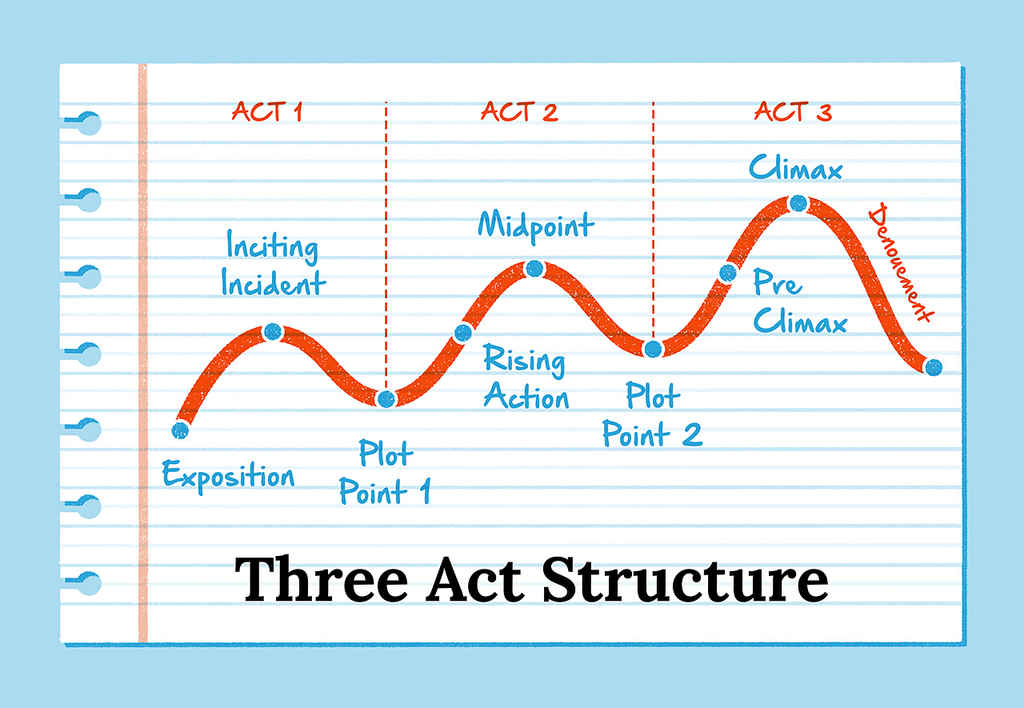
To understand the function of each point on this map, we will use a detailed guide that breaks down the structure using the classic film The Wizard of Oz as a running example.
The Three-Act Structure: The King of Story Structures
The article 'The Three-Act Structure: The King of Story Structures' from Reedsy offers an excellent, practical walkthrough of each major story beat. It provides clear definitions and illustrates them with a consistent example.
Please read the section titled 'Common story beats in the three-act structure.' As you go through each beat—from Exposition to Denouement—focus on two things: 1) the definition of the beat's function, and 2) how it is mapped to a specific event in 'The Wizard of Oz'.
Let's synthesize the information from that reading into a clear, functional breakdown.
Act I: The Setup (Begins at 0%, ends at ~25%)
The goal of Act I is to establish the initial state and then disrupt it, forcing the protagonist to act.
- Exposition: The story begins by showing the protagonist's ordinary world. We see their life, their immediate goals, and their flaws before the main conflict begins. In The Wizard of Oz, this is Dorothy's life on the farm in Kansas where she feels unappreciated.
- Inciting Incident: An event that destabilizes the protagonist's world and presents them with a problem or opportunity. The tornado hits Kansas.
- Plot Point 1 (The First Turning Point): This is the lock-in. The protagonist makes a decision or is forced into a situation that commits them to the story's central journey. They cross a threshold and cannot easily return to their old life. Dorothy, having landed in Oz, decides to follow the Yellow Brick Road to find the Wizard. Act I ends here.
Act II: The Confrontation (Begins at ~25%, ends at ~75%)
This is the longest act, where the protagonist actively struggles to achieve their goal, facing escalating obstacles.
- Rising Action: A series of events where the protagonist tries to solve their problem, but things get more complicated. They may gain allies, learn new skills, and face increasing opposition. Dorothy meets the Scarecrow, Tin Man, and Lion, and they face challenges from the Witch.
- Midpoint: A major event that happens around the 50% mark. It often involves a significant reversal of fortune, a major revelation, or the first major confrontation with the antagonist. The stakes are raised dramatically. Dorothy and her friends finally meet the Wizard, who refuses to help them until they bring him the Witch's broomstick. The goal has just become much harder.
- Plot Point 2 (The Second Turning Point): This beat marks the end of Act II. It's often an "all is lost" moment where the protagonist suffers a major defeat, their plan fails, and they are at their lowest point. This defeat, however, provides them with the final piece of knowledge or resolve they need to face the climax. Dorothy is captured by the Witch and threatened with death. She and her friends decide they must confront the Witch directly.
Act III: The Resolution (Begins at ~75%, ends at 100%)
The final act is about the direct confrontation and its aftermath.
- Pre-Climax: The protagonist gathers their resources and executes their final plan. It's the build-up to the final showdown. Dorothy's friends rescue her from the Witch's castle.
- Climax: The peak of the conflict. The protagonist and antagonist face off, and the story's central question is answered. This is not necessarily a big fight; it's the point of maximum tension and decision. Dorothy accidentally throws water on the Witch, who melts. She obtains the broom.
- Denouement: The "falling action." The tension subsides, and we see the consequences of the climax. Loose ends are tied up, and the protagonist's new normal is established. The Wizard gives gifts, and Dorothy learns she always had the power to go home.
Test your understanding!
You are reverse outlining a sci-fi manuscript. Below are summaries of four key scenes. Map each scene to one of the major turning points: Plot Point 1, Midpoint, Plot Point 2, or Climax.
- The protagonist, a disgraced starship pilot, has been smuggling illegal data chips to survive. After a deal goes wrong, she discovers one chip contains the coordinates to a hidden rebel base. Imperial agents corner her, and her only escape is to jump to those coordinates, committing herself to finding the rebels.
- After weeks of fighting alongside the rebels, the pilot leads an assault on an Imperial communications hub. They succeed, but in the process, she discovers the rebellion's leader is secretly feeding information to the Empire, hoping to lead both sides to mutual destruction. The entire war is a lie.
- The pilot's plan to expose the traitorous leader fails. The leader frames her as the Imperial spy, turning the entire rebellion against her. Her ship is destroyed, her allies are captured, and she's left stranded on a desolate moon with only a single, encrypted datapad that she believes contains proof of the leader's treachery.
- On the bridge of the rebel flagship, the pilot confronts the traitorous leader as he prepares to transmit a virus that will cripple the Imperial fleet, leaving the galaxy defenseless against a hidden, third fleet. She has one chance to physically stop the transmission and reveal the truth to both sides.
Show answer
- Plot Point 1: The pilot makes an irreversible decision to jump to the rebel base, abandoning her old life and "locking in" to the main conflict.
- Midpoint: This is a major revelation that dramatically changes the protagonist's understanding of the conflict and raises the stakes. She's no longer just fighting the Empire; she's fighting a conspiracy within the rebellion itself.
- Plot Point 2: This is a classic "all is lost" moment. The protagonist has failed, is isolated, and her situation seems hopeless. This defeat forces her into a final, desperate gambit for Act III.
- Climax: This is the final, direct confrontation where the story's primary conflicts (the war, the leader's treachery) converge at a point of maximum tension. The outcome will resolve the central questions of the story.
Conclusion
Today you learned to map a story's key events onto the classic three-act structure. This model provides a robust architectural framework for organizing a plot and managing narrative tension. By understanding the function of each act and the major turning points that connect them, you gain a powerful tool for both outlining new stories and diagnosing structural problems in existing drafts.
Key Takeaways:
- The three-act structure divides a story into Setup (25%), Confrontation (50%), and Resolution (25%).
- Plot Point 1 is the turning point that locks the protagonist into the main conflict, ending Act I.
- The Midpoint is a significant reversal or revelation near the 50% mark that raises the stakes.
- Plot Point 2 is typically an "all is lost" moment that ends Act II and forces the protagonist into the final confrontation.
- The Climax is the peak of tension where the central conflict is resolved.
Preview of the Next Lesson:
We've identified the Inciting Incident as the event that destabilizes the protagonist's world and initiates the chain of cause and effect. In our next lesson, we will focus exclusively on this beat, analyzing its function in removing the protagonist's ability to remain in their initial state.