Introduction
In our last lesson, we constructed a character's values hierarchy, an internal operating system that governs their decision-making under pressure. We established that this hierarchy is the engine of conflict, revealed when a character must sacrifice one value for another.
Now, we will populate your protagonist's world with other characters who are not merely decorative, but are themselves precision-engineered tools designed to test that hierarchy. This lesson addresses the learning outcome: Assign functional roles to supporting characters, such as ally, mirror, or foil.
We will move beyond simple labels like "friend" or "rival" and analyze supporting characters as functional components of the narrative machine. You will learn to define these roles based on the specific pressures they apply to the protagonist's goals, flaws, and values.
1. Supporting Characters as Functional Units
In a well-designed story, no character is superfluous. Each has a specific job to do. Their function is defined by their relationship to the protagonist and their impact on the protagonist's journey. Today, we'll dissect three primary functional roles: the Ally, the Foil, and the Mirror.
To start, let's get a brief overview of the common categories of supporting characters.
Types of Characters in a Story - Character Functions
The video 'Types of Characters in a Story' by Augmented Actor provides a quick survey of common character roles. This will give us a shared vocabulary before we dive into the specific mechanics of the major functional types.
Watch the sections on the deuteragonist/sidekick (02:34 - 03:04) and the mentor/confidant (04:39 - 05:04). Notice that these roles are primarily defined by their supportive relationship to the protagonist.
As the video suggests, many supporting roles are based on providing help. We'll group these under the functional category of "Ally."
2. The Ally: The Support Function
The most straightforward function is that of the Ally. This category includes roles like the sidekick, mentor, or confidant.
- Function: To support the protagonist's goals, reinforce their values, and provide assistance (e.g., skills, knowledge, emotional comfort).
- Relationship to Values Hierarchy: An ally's values hierarchy is often aligned with the protagonist's, at least regarding the story's central goals. If the protagonist values "Justice," their ally likely does too. This alignment is what enables cooperation. A mentor figure, like Obi-Wan Kenobi, directly teaches the protagonist the values they need to succeed. A sidekick, like Robin, acts as an extension of the protagonist's will.
The primary role of the Ally is to help the protagonist move forward and to serve as a sounding board, allowing the protagonist to verbalize their thoughts and plans for the reader's benefit.
3. The Foil: The Contrast Function
The Foil is one of the most powerful tools in character design. It is not defined by antagonism, but by contrast. The foil's purpose is to make the protagonist's traits, beliefs, and choices stand out in sharp relief.
To understand this crucial function, let's explore it in detail.
What is a Foil Character — How to Make Your Protagonist Shine
The video 'What is a Foil Character' from StudioBinder offers a superb mechanical breakdown of this concept. It explains not just what a foil is, but how to construct one by analyzing different axes of contrast.
Watch from the beginning to 09:02. Pay close attention to: The Core Definition: How a foil accentuates another character's qualities through contrast. The Types of Foils: The video provides a systematic categorization (Wise, Ethical, Emotional, Class) that is highly useful for design. Note the examples used for each.
As the video demonstrates, a foil illuminates the protagonist by being different across a key dimension.
- Dr. Watson is an ethical and emotional foil to Sherlock Holmes. Watson's warmth and conventional morality highlight Holmes's cold logic and willingness to bend rules.
- Donkey is an emotional foil to Shrek. Donkey's relentless optimism and talkativeness emphasize Shrek's pessimism and desire for solitude.
Foil vs. Antagonist
It is critical to distinguish the foil's function from the antagonist's.
What are character foils? Simple explanation and examples
The article 'What are character foils?' by WriteSeen clarifies this important distinction.
Read the section 'Character Foil Versus Antagonist: What’s the Difference?'. Focus on the core idea: antagonists directly oppose the protagonist's goals, while foils highlight character traits, often while being allies.
- Antagonist's Function: To directly oppose the protagonist's pursuit of their goal. Voldemort wants to achieve immortality and power; Harry Potter wants to stop him. Their goals are mutually exclusive.
- Foil's Function: To provide contrast, which challenges the protagonist's worldview or methods. Draco Malfoy is Harry's foil. He represents a different path—one of privilege, prejudice, and thirst for status. While he often creates obstacles for Harry, his primary narrative function is to make Harry's humility, bravery, and sense of justice more visible.
A character can be both a foil and an antagonist (like Draco at times), but many of the most effective foils are allies (Watson, Donkey, Samwise Gamgee).
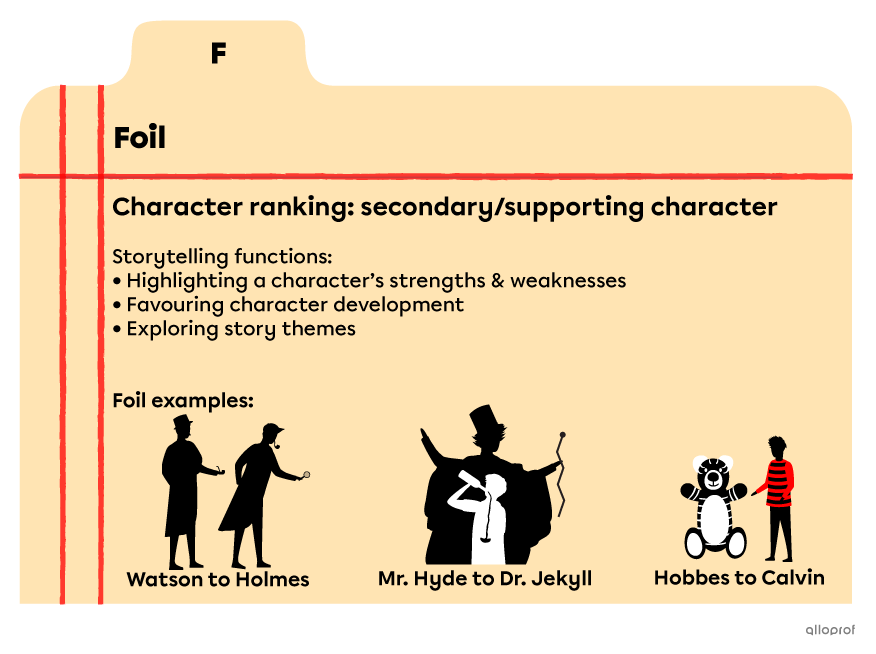
4. The Mirror: The Resonance Function
The Mirror character is a more complex and subtle device. While a foil works by contrast, a mirror works by similarity. This role is designed to create emotional resonance and intensify the protagonist's internal conflict.
The concept is best explained through a functional, almost algorithmic lens.
Foil vs. Mirror Characters: How to Design a Cast ... - NotMFA
The article 'Foil vs. Mirror Characters' from NotMFA provides the most precise and mechanical definition of these roles you will find. It treats them as architectural components of the story.
Read the entire article, paying close attention to the sections 'The Difference Isn’t Surface. It’s Function.', 'Mirror Character Test,' and the final summary. The key concepts are: Mirror as a 'parallel algorithm': It shares a core wound, flaw, or goal with the protagonist. The Divergence: The mirror and protagonist diverge at a key choice, showing a possible future—a warning of what the protagonist could become. Function Distinction: A mirror deepens the protagonist's internal need (emotional resonance), while a foil complicates their external want (thematic resistance).
Let's codify this distinction:
| Feature | Foil Character | Mirror Character |
|---|---|---|
| Core Principle | Contrast | Similarity / Parallelism |
| Primary Function | To highlight the protagonist's traits by being different. | To show the protagonist a version of themselves. |
| Mechanism | Challenges the protagonist's worldview or methods. | Shares the protagonist's wound, flaw, or situation. |
| Impact on Protagonist | Forces them to defend their beliefs and choices. | Forces them to confront who they are becoming. |
| Example | Tom Hagen in The Godfather. He and Michael share the goal of protecting the family, but Tom's logic (negotiation, caution) provides thematic resistance to Michael's logic (force, dominance). | Harvey Dent in The Dark Knight. He and Bruce Wayne share the goal of saving Gotham and a deep personal wound. Dent's descent into Two-Face is a mirror showing what Bruce could become if he abandoned his moral code. |
The Mirror character is a powerful tool for driving a character arc because they present the protagonist with a tangible, living example of a choice and its consequences.
Test your understanding!
Let's return to the detective from our previous lesson. Her values hierarchy is:
- Autonomy (to never be helpless)
- Truth
- Justice
- Security
- Reputation
Design a Foil and a Mirror character for this detective. For each, explain why they fit the functional definition by referencing her values hierarchy.
Show answer
Here are example answers. Your own may vary but should follow the same logic.
1. The Foil Character (The Pragmatic Partner):
- Role: The detective's older, more cynical partner.
- Values Hierarchy: Security > Justice > Reputation > Truth > Autonomy.
- Function: This character serves as an ethical foil. He shares the goal of closing cases (Justice), but his top value is
Security. He constantly advises the protagonist to drop the dangerous case, to accept a convenient lie instead of the difficultTruth, and to not risk herReputation. His pragmatism constantly forces our protagonist to defend her riskier, truth-obsessed methods. His logic provides thematic resistance to hers.
2. The Mirror Character (The Corrupt Ex-Cop):
- Role: A disgraced former detective who now works for the criminals.
- Shared Wound/Situation: This ex-cop also suffered a traumatic event where he was helpless to stop a crime. Like the protagonist, his driving fear is helplessness, and he also has
Autonomyas his #1 value. - The Divergence: At his moment of crisis, this character chose to regain his sense of autonomy not by seeking
TruthorJustice, but by accumulating power and money, even if it meant joining the other side. - Function: He is a mirror of what the protagonist could become. When they meet, he might say something like, "We're the same, you and I. We both know the system is a joke. The only thing that matters is never being a victim again. I just realized it's easier to get paid for it." This forces the protagonist to confront the dark path her own core value could lead her down, creating powerful emotional resonance.
Conclusion
Today we have broken down supporting characters into functional units designed to serve the protagonist's story. Instead of a random cast, you now have a framework for engineering a "character web" where each node has a clear purpose.
Key Takeaways:
- Supporting characters should not be decorative; they must have a function.
- The Ally function is to support and enable the protagonist, often by sharing their core values.
- The Foil function is to create contrast, highlighting the protagonist's traits by embodying a different worldview or methodology. This provides thematic resistance.
- The Mirror function is to create resonance through similarity, showing the protagonist a potential future or a path not taken by sharing a core wound or flaw but diverging at a key decision. This deepens internal conflict.
Preview of the Next Lesson:
We have now defined the core components of a character (Desire, Need, Fear, Values) and the functional roles of those around them. These pieces are the engine of character change. In our next lesson, we will begin exploring the output of this engine by analyzing character arcs, starting with a fundamental pattern: Analyze a positive arc by tracking a character's journey from misbelief to truth. We will see how foils and mirrors are often the primary forces that push a character along this journey.