Introduction
In our previous lessons, we've treated your story outline as a logical system, performing a series of audits to validate its internal mechanics: causality, character motivation, coincidence, and stakes escalation. We confirmed that the sequence of events is not just logically sound but also builds momentum and tension.
Now that the internal machinery of your plot is robust, we need to address a crucial project management variable: scope. A story idea is abstract, but a finished manuscript is a concrete object with a specific size. This lesson addresses the learning outcome: Determine the appropriate story scope by aligning the number of major plot events with target word count.
We will establish a systematic process to ensure the story you've outlined fits within the container you intend to build. This moves us from the logic of the plot to the physicality of its execution, translating your list of events into a predictable number of pages.
1. Defining the Container: Estimating Target Word Count
Before you can fit your story into a container, you must first define the size of that container. In writing, this is the target word count. This decision is not arbitrary; it's constrained by several practical factors, primarily genre expectations.
Just as a software project has market and platform constraints, a novel has reader and publisher expectations for length.

To formalize this estimation process, let's examine the key variables involved.
How to Calculate Your Book's Length Before Writing
The article 'How to Calculate Your Book's Length Before Writing' by K.M. Weiland offers a practical framework for this initial step. It breaks down the decision into three main considerations.
Please read the section titled 'How Long Should Your Book Be?' Focus on the three factors presented for determining your target word count.
Based on the reading, we can define the primary parameters for estimating your story's total word count:
- Genre: This is your primary constraint. As the chart above shows, readers of specific genres have ingrained expectations for story length. Writing a 40,000-word epic fantasy or a 150,000-word young adult contemporary novel can create market friction.
- Story Complexity: How large is your story's "problem space"? A tale of one person's internal struggle over a weekend requires less space than a multi-generational saga spanning continents. Your list of major plot events is the first indicator of this complexity.
- Personal Writing Style: Are you an "underwriter" (tend to be concise) or an "overwriter" (tend to be descriptive and expansive)? Knowing your natural tendency allows you to set a realistic target, adding or subtracting a buffer to your initial estimate.
By weighing these three factors, you can arrive at a reasonable target word count for your project, for example, 90,000 words for a standard fantasy novel.
2. Mapping the Outline to the Word Count
Once you have a target word count, you can begin to map your major plot events to it. We do this by treating the total word count as a timeline and placing key structural "milestones" at specific percentage points.
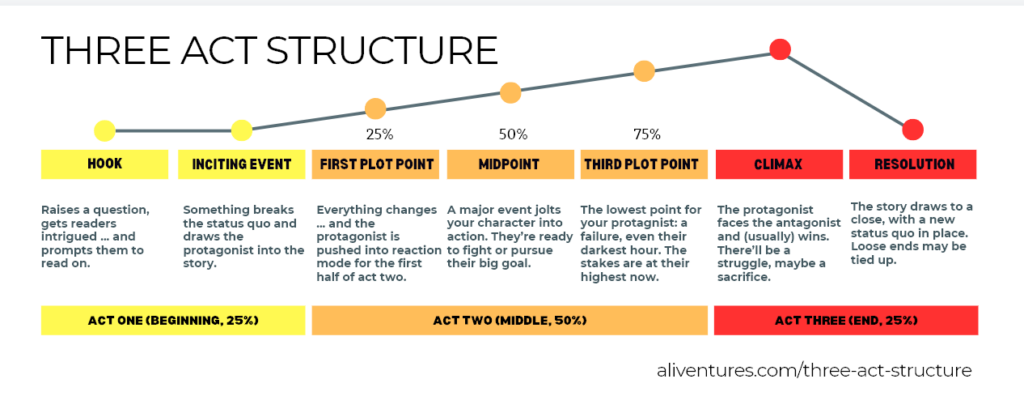
This percentage-based placement is the core of our scoping calculation. To see a more granular model, let's return to our first resource.
How to Calculate Your Book's Length Before Writing
The first section of K.M. Weiland's article provides a detailed list of these structural milestones and their corresponding percentage markers. This gives us a higher-resolution 'map' of a typical story.
Review the section 'The Basics of Structural Timing.' Note how each major plot point, from the Hook to the Resolution, is associated with a percentage value. You don't need to memorize these points now; focus on the concept of using percentages to distribute the plot across the total length.
With these percentages, you can calculate the approximate word count for each major beat.
Calculation:
For a 90,000-word novel:
- Inciting Event (12%): words
- First Plot Point (25%): words
- Midpoint (50%): words
- Third Plot Point (75%): words
This process transforms your abstract outline into a scaled map. You now know that the first quarter of your story, the setup, needs to be accomplished within roughly 22,500 words.
3. The Unit of Work: From Word Count to Scene Count
While knowing the word count for major milestones is useful, it's still too large a unit for practical outlining. The fundamental building block of a story is the scene. To make your plan actionable, you need to translate your word count targets into scene count targets.
This requires a simple, three-step algorithm.
How to Calculate Your Book's Length Before Writing
Both of our main resources describe this process. We'll start with the method from 'How to Calculate Your Book's Length Before Writing' as it follows directly from the 8-part structure we just reviewed.
Read the section 'How to Calculate Plot-Point Timing in the Outline.' Focus on the three steps it provides for translating a total word count into a scene count for your outline.
Let's codify this into a clear procedure:
- Estimate Average Scene Length: Analyze your own writing or use a common industry average. A typical scene length is between 1,500 and 2,500 words. Let's use 2,000 words for our example.
- Calculate Total Scenes: Divide your target word count by your average scene length.
- Allocate Scenes to Structural Sections: The 8-part structure divides the story into eight roughly equal segments. Divide your total scene count by 8 to find the number of scenes per segment.
This result is profoundly useful. You now know that the section between your First Plot Point (25%) and your First Pinch Point (37.5%) should contain approximately 5-6 scenes. If your outline has 10 major plot events planned for that section, you have a scope mismatch. You must either combine those events into fewer scenes or accept that your story is larger than your initial 90,000-word target.
For an alternative perspective on this calculation, the "Save the Cat!" method offers a similar approach but breaks the story down into 15 beats and 3 acts.
How to Outline Your Novel with the Save the Cat! Beat Sheet
The article 'How to Outline Your Novel with the Save the Cat! Beat Sheet' by Savannah Gilbo provides another excellent, mechanical approach to this same problem.
Read 'Step 1: Divide Your Target Word Count Into 3 Acts,' 'Step 2: Divide Each Act Into Scenes,' and 'Step 3: Figure Out Where the 15 Story Beats Go.' Notice how this method also uses simple arithmetic to break a large word count down into manageable scene counts allocated to specific structural functions.
This reinforces the core principle: a story's scope can be managed by breaking it down into standardized units (scenes) and allocating them according to a structural blueprint.
Test your understanding!
You are planning a Young Adult (YA) fantasy novel. Your outline contains approximately 30 major plot events that you feel are essential to the story.
Your Task:
- Using the "Book Length by Genre" chart, choose an appropriate target word count for a YA fantasy novel.
- Assuming an average scene length of 1,800 words, calculate the total number of scenes your target word count allows for.
- Compare the number of scenes available with your 30 planned plot events. Do you have a potential scope mismatch?
- Briefly state one action you could take to resolve any mismatch.
Show answer
1. Target Word Count:
The chart suggests a range of 70,000-90,000 words for YA Fantasy. Let's choose 80,000 words as our target.
2. Total Scenes Calculation:
Your target word count allows for approximately 44 scenes.
3. Scope Mismatch Analysis:
You have 30 major plot events planned and space for about 44 scenes. Assuming one major plot event takes at least one scene, this appears to be a good fit. You have enough "space" for your essential plot events, with additional scenes available for transitions, subplots, and character moments between the major beats. There is no obvious scope mismatch; in fact, there's a healthy buffer.
4. Resolving a Mismatch (Hypothetical):
If the calculation had shown space for only 25 scenes, you would have a mismatch. A possible action would be to combine plot events. For example, instead of one scene where the hero gets a map and a separate scene where they buy supplies, you could combine them: the hero must bargain for the supplies with the same shady character who has the map, creating a single, more complex scene.
Conclusion
You now possess a clear, quantitative method for aligning your creative vision with the practical constraints of a finished novel. By treating scope as a manageable variable, you can proactively design your story to fit its intended length, preventing major structural problems during the drafting and revision phases.
Key Takeaways:
- Story scope is determined by balancing genre expectations, story complexity, and target word count.
- A structural model (like the 3-act, 8-part structure) provides percentage-based milestones to map your plot across the total word count.
- The fundamental unit of work for an outliner is the scene.
- You can create a scene budget by dividing your target word count by your average scene length.
- Comparing your planned plot events against your scene budget is the primary method for identifying and correcting scope mismatch before you start writing.
Preview of the Next Lesson:
We have established the size of our story and its major sections. Next, we will begin examining the function of those sections in detail. Our next lesson will address the learning outcome: Map a story's major turning points to a classic three-act structure (Setup, Confrontation, Resolution). We will move from the "how big" to the "what for" of narrative architecture.