Introduction
Welcome to today's lesson. In our last session, we analyzed how the physical length of a dialogue line can be engineered to signal a character's confidence, emotional state, and social status. We treated dialogue form as a system for conveying information. Today, we move from the form of what is said to the meaning hidden beneath it.
Your learning outcome for this lesson is to identify subtext by contrasting what a character says with what the context implies they mean.
Subtext is often perceived as a mysterious, intuitive part of writing. However, it operates on a logical, almost mathematical principle. We will deconstruct it into a clear, analytical framework that you can apply systematically. This will allow you to read and write dialogue not just for its surface meaning, but for the complex negotiations happening underneath.
1. The Subtext Equation: Text + Context
At its core, subtext is not magic; it's the product of a simple relationship. To grasp this foundational concept, we'll start with a short video that frames it as an equation.
Writing Subtext — The Secret to Writing What's Under the Surface
The video 'Writing Subtext — The Secret to Writing What's Under the Surface' by StudioBinder provides an excellent mechanical definition of subtext that will serve as our core model.
Watch the section from 02:19 to 04:20. Focus on the central formula presented: Subtext = Text + Context. Absorb the definitions: Text: The literal words spoken or actions performed. Context: The surrounding circumstances, relationships, and situations that inform the text's ultimate meaning.
As the video explains, the literal text ("As you wish") combined with the context (a man performing difficult tasks for the woman he loves) produces the subtext ("I love you"). The words themselves don't contain the full meaning; the meaning is generated in the space between the words and their situation.
This infographic provides a few simple examples of this principle in action.
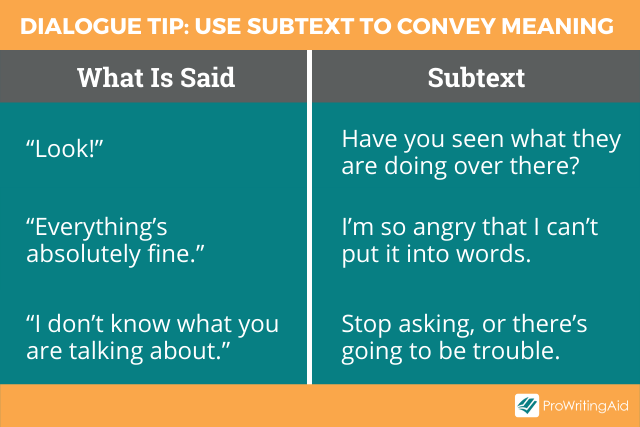
2. The Analytical Engine: Identifying Contrast
If subtext is the result of combining text and context, how do we reliably detect it? The mechanism is contrast, or what we can call a dichotomy. Subtext becomes visible when there is a mismatch, contradiction, or tension between what a character says and what the situation implies.
Your job as an analyst of writing is to spot these dichotomies.
The Only 5 Ingredients You Need for Story Subtext
The article 'The Only 5 Ingredients You Need for Story Subtext' by K.M. Weiland formalizes this idea of dichotomy as the heart of subtext.
Read section 4, 'Story Subtext Is Created by Dichotomy.' The key takeaway here is that interesting subtext arises when a character's surface behavior seems to contradict their underlying nature or situation. This creates an implicit question for the reader, and the answer to that question is the subtext.
With this framework, we can now break down the process of identifying subtext into a systematic analysis of different types of contrast.
3. A Taxonomy of Contrast
Let's examine the most common ways text and context can be contrasted to generate subtext. We will use a series of short examples to illustrate each type.
The video 'Writing Subtext in Dialogue' by Diane Callahan offers a series of excellent, classic literary examples that we can use as case studies for our taxonomy.
Watch the segment from 00:58 to 11:55. You don't need to absorb it all at once. We will use the specific examples within it to illustrate the following categories. Keep the video handy as a reference as we proceed.
A. Contrast: Words vs. Actions & Body Language
This is the most direct form of dichotomy. A character says one thing while their body does another.
- Example: From Gone with the Wind (as seen in the video from 00:58 to 03:51).
- Text: Scarlett tells Rhett, "if you think I’ll marry you... I won’t."
- Context: She simultaneously gives him a "sidelong glance" and has her lips "pursed up in that ridiculous way" (the proper pose for a kiss). Her internal thoughts, which the novel provides, confirm she wants him to kiss her.
- Subtext: Her words say "no," but her actions and body language say "Kiss me, I'm trying to manipulate you into pursuing me."
B. Contrast: Stated Cause vs. True Emotion
This occurs when a character has a powerful emotional reaction that is wildly disproportionate to the stated cause. The dialogue focuses on a triviality to mask a much deeper, unstated issue.
- Example: From The Great Gatsby (as seen in the video from 03:51 to 05:37).
- Text: Daisy, looking at Gatsby's shirts, sobs, "They’re such beautiful shirts."
- Context: Daisy is visiting the home of the man she once loved but gave up to marry a wealthy brute. Gatsby has built his entire fortune to win her back, and the shirts are a symbol of that wealth.
- Subtext: Her crying isn't about the shirts. It's about overwhelming regret and the heartbreaking realization of what she lost. The subtext is, "I'm heartbroken because I see now that you have the wealth I married for, and we can never get back what we had."
C. Contrast: Polite Language vs. Harsh Reality
Characters often use polite, evasive, or indirect language to navigate a difficult social situation, creating a stark contrast between the placid surface of the dialogue and the brutal reality underneath.
- Example: From Death of a Salesman (as seen in the video from 05:37 to 07:51).
- Text: Willy and his boss Howard engage in a circular conversation. Willy talks about his history with the firm and needing less money. Howard talks about there being "no spot" for him.
- Context: Willy is an aging, failing salesman who can no longer handle his traveling job. He is, in effect, begging for a demotion to an office job to survive. Howard wants to get rid of him.
- Subtext: Despite the polite overuse of each other's names, this is a power struggle. Willy's subtext is a desperate plea: "You owe me this job; please don't cast me aside." Howard's subtext is a firm but indirect rejection: "You're finished here, and I'm firing you without saying the word."
D. Contrast: Neutral Words vs. Loaded Implication
Here, the literal words are harmless, but the context loads them with accusation, passive aggression, or unspoken tension.
- Example: From "Hills Like White Elephants" (as seen in the video from 07:51 to 11:55).
- Text: A couple discusses the scenery. "They look like white elephants," she said. "I’ve never seen one," the man drank his beer. "No, you wouldn’t have."
- Context: The couple is at a train station, implicitly discussing whether she should have an abortion. The entire conversation is tense and strained.
- Subtext: The argument is not about seeing white elephants. Her comment is a flight of fancy, and his curt dismissal of it is part of a larger pattern of him shutting her down. Her reply ("No, you wouldn't have") is a passive-aggressive jab, with the subtext: "You lack imagination and you no longer see the world with the same sense of wonder I do."
Test your understanding!
Two roommates, Alex and Ben, had a major argument last night. The next morning, Alex is in the kitchen. Ben walks in.
Alex: "There's no coffee."
Ben: "I was up late."
Using the principles we've discussed, what is the subtext of this exchange? Deconstruct it by identifying the Text, Context, and Contrast.
Show answer
- Text: Alex states a fact: "There's no coffee." Ben states another fact: "I was up late."
- Context: The two are in a state of high tension after a fight. The normal, cooperative social contract between them is broken.
- Contrast: The conversation is ostensibly about coffee, but the terse, clipped nature of the lines and the avoidance of the real issue create a stark contrast. In a normal situation, the exchange might be, "Hey, we're out of coffee." "Oh, sorry, I forgot to make more."
- Subtext: The coffee is a proxy for their conflict.
- Alex's subtext is an accusation: "You were so inconsiderate last night that it's carried over into this morning. You couldn't even do the one simple thing you normally do."
- Ben's subtext is a defensive justification, not just for the coffee but for his behavior last night: "Don't blame me. You're the reason I was up late, so this is your fault."
The conversation is not about coffee; it's about blame.
4. A Case Study in Subtextual Analysis
Now let's apply this analytical process to a full scene. The following article provides an annotated first chapter of a novel where, on the surface, "nothing happens." The real story is entirely in the subtext, built through the constant contrast between what is said and what is implied.
The article 'Text and subtext' from Jericho Writers offers a masterclass in deconstructing a scene to reveal its hidden meaning. It perfectly demonstrates the analytical process this lesson is about.
Read the section 'THE FIRST CHAPTER FROM TALKING TO THE DEAD'. Pay close attention to the author's annotations in brackets [...]. Notice how for every line of dialogue or action (Text), the annotator refers to the unspoken situation (Context) to derive the Subtext. For example: Text: The character gives a fake smile. Context: Nothing has happened to warrant a real smile. Subtext: The character is being performative and is likely hiding her true feelings. Your goal is to follow the analyst's logic step-by-step to see how a seemingly inert scene is actually charged with tension and mystery.
This extended example shows how a skilled writer can build an entire opening chapter not on plot events, but on the reader's growing awareness of a massive gap between the surface conversation and the hidden truths of the character's life.
Conclusion
You have learned to identify subtext not as an art, but as a technical skill rooted in a clear analytical process. By systematically looking for the contrast—the dichotomy—between the explicit text and the implicit context, you can uncover the hidden layers of meaning in any dialogue exchange.
Key Takeaways:
- The Subtext Equation: Subtext is generated by the formula Text + Context. The meaning lies in the interaction between what is said and the circumstances surrounding it.
- Contrast is the Key: Subtext becomes visible at points of contrast between words and actions, stated causes and true emotions, polite language and harsh realities, or neutral words and loaded implications.
- A Systematic Process: To identify subtext, you can follow a four-step process:
- Identify the literal Text.
- Establish the surrounding Context.
- Pinpoint the Contrast between the two.
- Formulate the Subtext that resolves the contrast.
Preview of the Next Lesson
Today, we explored the general mechanism of subtext. In our next lesson, we will zoom in on a specific, powerful technique used to generate it. Your learning outcome will be to analyze emotional evasion, where a character deliberately deflects or ignores a direct emotional query. This is a common and critical tool for revealing a character's fears, vulnerabilities, and hidden goals.