Introduction
In our last lesson, we engineered external tension by deploying tangible threats, obstacles, and deadlines—the environmental pressures that create plot. We established that these external forces are the "what happens" in a story.
Today, we address the other half of the equation: the character's reaction to that pressure. This lesson focuses on internal tension, the "why it matters" that gives external events their weight and meaning. Your goal for this lesson is to learn how to layer internal tension by highlighting a character's doubt, fear, or moral conflict about their actions.
We will approach this not as an abstract emotional exercise, but as a system of conflicting forces within the character. If external tension is the input to the system, internal tension is the processing—the internal calculus of desire, fear, and values that drives a character's decisions and makes them compelling.
1. The Mechanics of Internal Conflict
Before we can layer internal tension, we must define its components. At its core, internal conflict is a character's struggle against themselves.
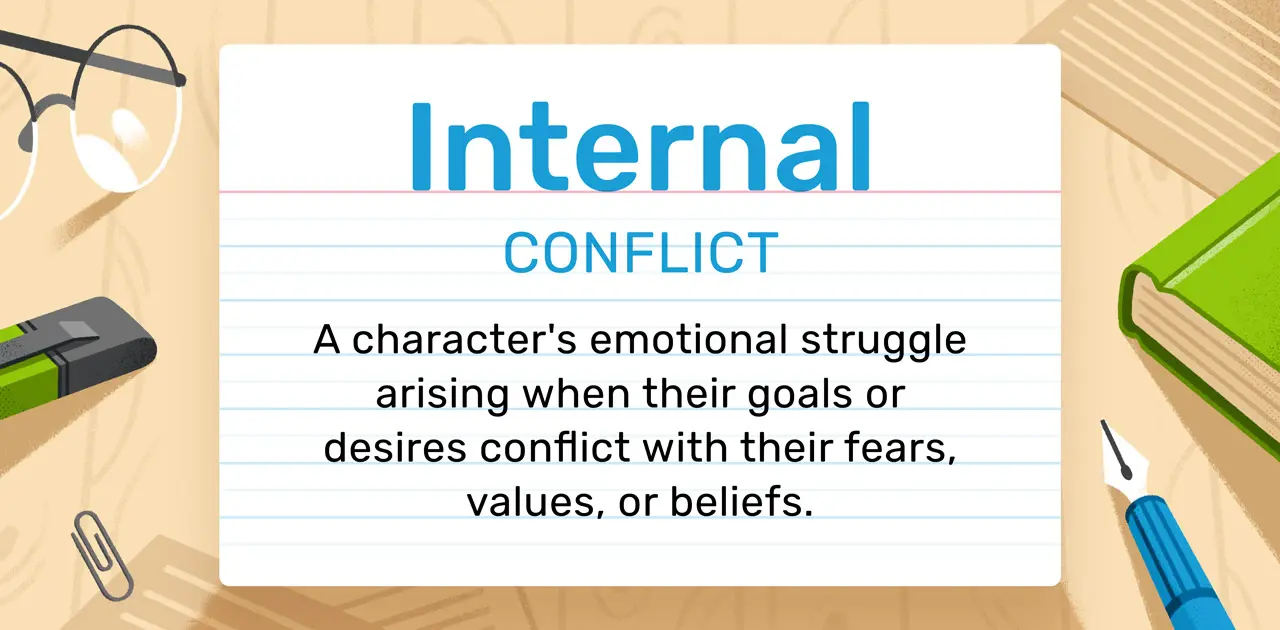
This opposition creates a state of cognitive dissonance. To engineer this, we can break it down into a more formal equation:
Internal Tension = Desire vs. Counter-Force
The Desire is the character's conscious goal, which we've discussed in previous lessons. The Counter-Force is the internal obstacle preventing the smooth pursuit of that desire. We can categorize this counter-force into three primary types:
- Doubt/Fear: The character wants something but is afraid of the consequences of pursuing it (fear) or doubts their ability to succeed (doubt).
- Moral Conflict: The character wants something, but getting it would require them to violate a core value or belief.
- Conflicting Desires: The character wants two mutually exclusive things at the same time.
Today, we will focus on engineering the first two: doubt/fear and moral conflict.
2. Highlighting Doubt and Fear
The most common form of internal tension comes from the battle between what a character wants and what they fear. A key principle here is that characters are often poor narrators of their own flaws. A character who perfectly analyzes their own fears for the reader sounds like a therapist, not a person.
Your task is to demonstrate this conflict through action, thought patterns, and conflicting emotions, rather than summarizing it.
Showing vs. Telling Internal Conflict
Let's analyze a practical example of how to execute this. The following video provides a clear, side-by-side comparison of a weak, "telling" approach and a strong, "showing" approach to a character's internal conflict.
This is the Secret to Writing Juicy *INTERNAL CONFLICT*
In the video 'This is the Secret to Writing Juicy INTERNAL CONFLICT,' Abbie Emmons demonstrates how to reveal a character's internal state through their actions and thoughts.
Please watch from 08:13 to 11:23. This segment contrasts two versions of a scene where a writer, Pam, is about to submit her work. Pay close attention to the specific differences in how her fear of rejection is conveyed in the 'bad' version versus the 'good' version.
Let's deconstruct why the second version is mechanically superior:
- Direct Statement vs. Indirect Evidence: The first version tells us, "I'm just so afraid of being criticized and rejected." The second version shows this by having her "proofread my query letter for possibly the hundreth time." The obsessive action is evidence of the fear.
- Abstract Emotion vs. Concrete Origin: The first version states a general fear. The second version grounds that fear in a specific, sensory detail: "it's mom's voice I hear now whispering those words in the back of my mind." This externalizes the internal critic, making it more tangible.
- Self-Analysis vs. Goal-Oriented Thought: The first version has Pam psychoanalyzing her childhood. The second version keeps her thoughts focused on the immediate goal (impressing the agent) and the obstacles (her lack of credentials), letting the anxiety bleed through her calculations.
Engineering Conflict with Opposing Emotions
A simple, repeatable technique for generating internal tension within any scene—even one with minimal action—is to give the point-of-view character two strong, conflicting emotions simultaneously.
How to Add Tension to EVERY PAGE of Your Book (Fiction Writing Advice)
The video 'How to Add Tension to EVERY PAGE of Your Book' by writer Brandon McNulty offers a simple algorithm for this technique.
Watch the segment from 01:45 to 03:29. The presenter rewrites a boring paragraph about a mother picking up her son from school. Notice how the only thing that changes is the addition of an opposing emotion (dread) to the initial one (excitement).
The example demonstrates a clear formula:
- Version 1 (No Tension): Emotion A (Excitement) -> Action -> Outcome.
- Version 2 (Tension): Emotion A (Excitement) + Opposing Emotion B (Dread) -> Action -> Outcome.
The external actions remain identical, but the addition of the character's internal conflict about the custody battle completely changes the texture of the scene. The reader is now engaged, waiting to see which emotion will be validated by the outcome.
Test your understanding!
A character is preparing for a first date. Their primary emotion is excitement. What is an opposing emotion you could layer in to create internal tension, and what specific thought could manifest this conflict?
Show answer
- Opposing Emotion: Insecurity or Self-Doubt.
- Manifestation: While excitedly choosing an outfit, the character catches their reflection in the mirror. Their smile falters as they fixate on a small flaw—a scar, a crooked tooth, a feature they've always disliked. The thought, "What if they see me the way I see myself right now?" flashes through their mind.
This instantly layers the excitement with the fear of being seen and found wanting, creating internal tension.
3. Highlighting Moral Conflict
The second major type of internal tension arises from moral conflict. This occurs when a character's goal requires them to act against their own established values. This is not about broad thematic statements but about a specific, difficult choice.
This is a powerful tool because it forces a character to question their own identity. "I want X, but am I the kind of person who would do Y to get it?"
The article 'Crafting Tension in Fiction' provides a concise explanation of this technique under the heading 'Character-Driven Tension Techniques.'
Please read the subsection 'Internal Contradiction.' Focus on the examples provided: 'A pacifist who must fight to protect their family. An honest person who must lie to save someone they love.'
The key to engineering a moral conflict is to ensure the stakes are competing and there is no easy answer. The conflict arises from the character having to choose between two things they value. The article "Conflict Thesaurus" labels these as "Moral Dilemmas and Temptations," noting that they target a character's core belief system.
Let's apply this. Imagine a detective who discovers her long-time partner and friend is corrupt.
- Goal: Uphold the law.
- Value 1 (Professional): Justice. "No one is above the law."
- Value 2 (Personal): Loyalty. "You never turn your back on your partner."
Her desire (bring the corrupt officer to justice) is in direct opposition to a core personal value (loyalty). Any action she takes violates one of her values. This forces an internal battle: is she a cop first, or a friend first? Her struggle with this question is the internal tension.
4. Layering Internal with External Tension
Internal tension does not exist in a vacuum. It is most effective when layered directly on top of the external tension we discussed in the last lesson. The external situation forces the action, and the internal conflict gives that action meaning.
Let's revisit the scenario from our previous lesson: A journalist needs to retrieve an incriminating file from her editor's locked office before he returns.
External Layers (from last lesson):
- Obstacle: A new electronic lock she can't bypass.
- Threat: A security guard patrolling the hallways.
- Deadline: The editor texted that he is 10 minutes away.
Now, let's add Internal Layers:
- Layer 1 (Doubt/Fear): As she fumbles with the lock, her hands shake. She thinks, I've only ever seen this done in movies. What if I trip the alarm? I'll lose my job. I'll never work in this city again. This highlights her doubt in her abilities and fear of the personal consequences.
- Layer 2 (Moral Conflict): She briefly pauses. The editor's friendly face flashes in her mind. He gave her her first real job, mentored her. The thought comes unbidden: He trusted me. Am I really doing this to him? This highlights the conflict between her values of loyalty/gratitude and her professional pursuit of justice.
The external obstacles force her to act under pressure. The internal layers show us why this is hard for her specifically. The combination of the ticking clock, the approaching guard, her trembling hands, and her crisis of conscience creates a scene that is rich with tension on every level.
Conclusion
Today, we deconstructed internal tension into a set of engineering principles. We defined it as the conflict between a character's desire and an internal counter-force, and we practiced layering it into scenes.
Key Takeaways:
- Internal Tension is a System of Conflict: It arises from the opposition between a character's goals and their own doubts, fears, or moral values.
- Show, Don't Tell: Reveal internal states through a character's actions, specific thoughts, and physical reactions, not through overt summary or self-analysis.
- Use Conflicting Emotions: You can reliably generate tension in any scene by giving your character two powerful, opposing feelings about the situation (e.g., hope vs. despair, excitement vs. dread).
- Engineer Moral Dilemmas: Force characters into impossible choices where any action violates one of their core values. This is a direct attack on their identity and creates profound internal conflict.
- Layer for Depth: Internal tension gives meaning to external events. The most powerful scenes combine external pressure (obstacles, threats, deadlines) with a character's internal struggle.
Preview of the Next Lesson
We have now examined two major categories of conflict: External (Character vs. Environment/World) and Internal (Character vs. Self). In our next lesson, we will complete the triad by focusing on the third and final category. The learning outcome will be: Layer interpersonal tension by staging a conflict of goals or values between characters.