Introduction
In our last lesson, we completed our analysis of tension by examining how to engineer interpersonal conflict through opposing character goals and values. We saw how a structured clash, like a chess match, can make a scene feel electric. However, a story can have many tense scenes and still feel like it's going nowhere. The missing ingredient is momentum.
Your learning outcome for this lesson is to master a core principle of narrative engineering: sustain momentum by ensuring each scene asks a new question or complicates an existing one. We will approach this as a problem of causality. A well-constructed story is not a list of events linked by "and then..."; it's a chain reaction where each event is linked by "therefore..." or "but...". Each scene must be both a consequence of the last and a cause for the next.
1. The Engine of Momentum: Want and Cost
The fundamental mechanism for creating this narrative chain reaction is the dynamic of Want at a Cost. A character pursues a goal (a want), and in achieving it—or failing to—they pay a price (a cost). This cost becomes the problem or question that the next scene must address.
This video from Tyler Mowery explains this principle with clear, mechanical precision.
The video 'How to Build Story Momentum' breaks down the core engine of narrative propulsion into a simple formula: everything a character wants must come at a cost. This cost is what creates the complication or new question that drives the story forward.
Watch the segment from 00:54 to 02:37, which explains the 'want and cost' dynamic using the opening of 'Indiana Jones and the Raiders of the Lost Ark'. Then, watch from 04:03 to 05:33, which explains why this cost is narratively necessary to force change and reveal character.
As the video demonstrates, this isn't an abstract concept; it's a repeatable algorithm:
- Character wants X. (Indiana Jones wants the idol.)
- Character acts to get X. (He grabs the idol.)
- The action has a cost. (The temple starts to collapse.)
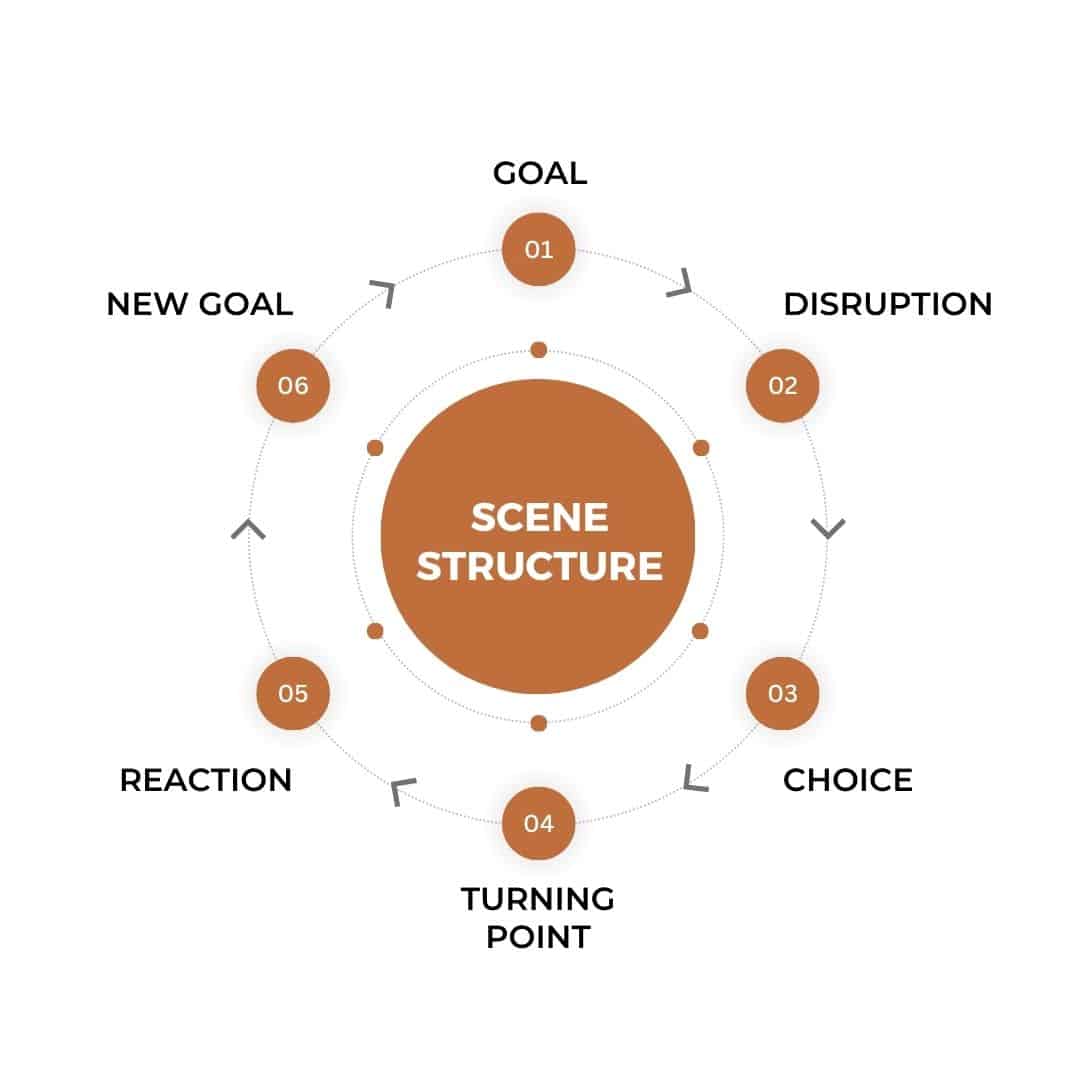
- The cost creates a new want. (Now, Indiana Jones wants to escape the temple alive.)
This cycle creates a non-stop sequence of problems. The solution to one problem directly causes the next. This causal link is what gives a story its feeling of relentless forward motion.
This process can be visualized as a cycle. The "cost" of one scene's action becomes the "disruption" or "new goal" for the next.
Test your understanding!
In the last lesson, we analyzed the therapy scene from Good Will Hunting. Will's goal was to get out of the session, and his tactic was to provoke Sean. He succeeded in provoking Sean, who grabbed him and threatened him.
Using the "Want and Cost" model, what was the cost of Will's "success"? What new question does this cost create for the next scene?
Show answer
- Want: Will wanted to end the therapy session on his own terms.
- Cost: He succeeded in getting a reaction, but the cost was that he lost control of the situation. He provoked a therapist into a physical threat, fundamentally changing their dynamic from a dismissible annoyance to a serious confrontation.
- New Question: The original question was "Will Will get out of therapy?" The new, more complicated question is "What will happen now between these two men? How will Sean use this new power dynamic in their next session?" The story has moved forward.
2. A Taxonomy of Scene Outcomes
The "Want and Cost" dynamic is implemented at the end of a scene. The scene's outcome is the mechanism that either solves the current problem cleanly (stalling momentum) or complicates it (sustaining momentum). We can classify scene endings into a few key types, some of which are far more useful for driving a story forward than others.
The following article provides a clear, systematic breakdown of these outcomes.
The 5 Types of Scene Endings Every Writer Must Master
The article 'The 5 Types of Scene Endings Every Writer Must Master' by K.M. Weiland provides a practical taxonomy for scene outcomes. Understanding these categories allows you to consciously choose an ending that creates the desired effect on momentum.
Read the entire article, paying close attention to the five categories: 'Yes,' 'No,' 'Yes, But,' 'No, And,' and 'No, But.' For each one, focus on its specific effect on narrative momentum.
To summarize the system:
| Scene Ending | Character's Goal in the Scene | Outcome | Effect on Momentum |
|---|---|---|---|
| Yes | Achieved | A clean success. | Stalls. The question is answered with no new complication. Use sparingly. |
| No | Not Achieved | A hard failure. | Stalls. The path is blocked with no new options. Use sparingly. |
| Yes, But... | Achieved | Success comes with a new problem or complication. | Drives. Answers the scene question but immediately asks a new, harder one. The workhorse of storytelling. |
| No, And... | Not Achieved | Failure introduces a new piece of information or a new avenue to try. | Drives. The character fails, but the failure itself reveals the path forward. |
| No, But... | Not Achieved | Failure is paired with a misleading "win" or false hope. | Trap. Creates the illusion of progress but leads to a dead end. Use intentionally to show a character's flawed thinking. |
Your primary tools for sustaining momentum are "Yes, but..." and "No, and...". They ensure that every scene ends with either a new complication or a new question, forcing the story and the reader onward.
3. Practical Techniques for Generating Complications
Now that we understand the principle ("Want at a Cost") and the implementation mechanism (Scene Outcomes), let's look at a few simple, algorithmic techniques for creating the "but...", "and...", or "complication" part of the equation.
Technique 1: Therefore / But
As we discussed, a story is a causal chain. The creators of South Park, Trey Parker and Matt Stone, famously advise connecting your story beats with "therefore" or "but" instead of "and then."
- And then: The character did this, and then this happened. (A list of events, low momentum).
- Therefore: The character did this, therefore this happened. (A direct consequence, good momentum).
- But: The character did this, but this happened. (A reversal or complication, excellent momentum).
This is a powerful diagnostic tool. If you can't link your scenes with "therefore" or "but," your narrative's causal chain may be broken.
Three Strategies for Creating Progressively Escalating ...
The article 'Three Strategies for Creating Progressively Escalating ...' from Writers Helping Writers details this technique.
Read the section titled 'Technique 2: Choosing Consequences Over Continuations.' It provides a concise explanation of using 'therefore' and 'but' to ensure every scene builds on what came before.
Technique 2: Forwarding Devices
Another way to ensure your scene endings propel the story is to use a "forwarding device." This is a specific piece of information or an unresolved action that leaves the reader with a question.
This video offers a concise list of effective forwarding devices.
STOP Writing Scenes Until You Know the LAMB Method!
The video 'STOP Writing Scenes Until You Know the LAMB Method!' from Bookfox introduces three powerful 'forwarding devices' designed to prevent 'dead end' scenes.
First, watch from 00:16 to 01:34. This section defines a 'dead end' scene and introduces three forwarding devices: new information, a decision made but not yet acted upon, and a new complication. Then, watch from 07:12 to 08:00. This reinforces the idea by advising you to refrain from solving obstacles in the same scene they are introduced.
The three forwarding devices are:
- A piece of new information: The discovery of a clue, a secret revealed, a change in the game's rules. (The dragon eggs can hatch.) This creates the question, "What will they do with this new information?"
- A decision made but not yet acted upon: The characters commit to a dangerous plan, but the scene ends before they execute it. (Katniss and Peeta decide to eat the berries.) This creates the question, "Will their plan work?"
- A new complication: Just as the character solves one problem, a new, often ironic, problem appears. (The detective discovers his own name at the crime scene.) This creates the question, "How will they deal with this new mess?"
These are all practical ways to implement the "Yes, but..." and "No, and..." outcomes.
Conclusion
Sustaining momentum is not a mystical art; it is a technical skill based on the logic of cause and effect. By treating each scene as a link in a causal chain, you create a narrative that feels inevitable and unstoppable.
Key Takeaways:
- Momentum is Causality: A story moves forward when each scene is a direct consequence of the previous one ("therefore" or "but") and the cause of the next.
- The Engine is "Want at a Cost": The pursuit of a goal leads to a consequence (the cost), which creates the next goal/problem.
- The Mechanism is the Scene Outcome: "Yes, But" and "No, And" endings are the most effective tools for sustaining momentum, as they answer one question while immediately posing another.
- The Tools are Complications: You can reliably generate momentum by ending scenes with forwarding devices like new information, an un-acted-upon decision, or a fresh complication.
Preview of the Next Lesson
Today we learned how to ensure every scene creates a question to drive the reader forward. In the next lesson, we will examine a specialized, high-intensity version of this technique. Your next learning outcome is to analyze the strategic placement of cliffhangers to maximize reader curiosity. A cliffhanger is, in essence, a forwarding device weaponized for maximum effect.