Introduction
Guten Tag! In our last lesson, we concluded our exploration of German phonology by dissecting word stress. We saw how its predictable patterns in simple and compound words contribute to the language's rhythm, and how stress shifts can even change a word's meaning—a powerful concept to teach using minimal pairs like umfahren.
Today, we transition from the sound of German to its structure. We'll tackle one of the most fundamental and frequently encountered topics in beginner German grammar: negation. Our goal is to explain the rules for using nicht and kein, including their correct placement in various sentence structures. For you as a future teacher, mastering this topic is essential, as it's a common source of confusion for learners. A clear, logical explanation is key to helping students build correct sentences from day one.
1. The Core Distinction: nicht vs. kein
The first step in explaining German negation is establishing a clear division of labor between nicht and kein. At its heart, the choice is determined by what you are negating.
Let's start by reading the relevant sections from two excellent articles that break down this core concept.
German Negation Rules Explained: Use “Nicht” and “Kein” Correctly
First, please read a brief section from the article 'German Negation Rules Explained' by Preply. It provides a concise summary of when to use each word.
Please read the section titled 'When to use “nicht” versus “kein”'. Focus on the bullet points that list the use cases for each word and the helpful 'Quick Test'.
NICHT vs KEIN: Master the Difference in German Negation
Next, let's read the introduction from 'NICHT vs KEIN' on the 'Learn German Easily' blog, which reinforces this fundamental difference.
Read the sections 'The Main Difference in Negation in German: Nicht vs. Kein' and 'How to use the word kein in German'. These sections clearly define the roles of nicht and kein.
A Teacher's Framework for Negation
As the resources explain, the logic is quite systematic. Here is how you can frame it for your future students:
The first question to ask is: "What am I making negative?"
-
Use
keinto negate a noun that has an indefinite article (ein,eine) or no article at all. Think ofkeinas the negative version ofein. It essentially means "not a," "not any," or "no."- Ich habe einen Hund. → Ich habe keinen Hund. (I don't have a dog.)
- Ich habe Geld. → Ich habe kein Geld. (I have no money.)
- Das sind Äpfel. → Das sind keine Äpfel. (Those are not apples.)
-
Use
nichtfor almost everything else. This includes negating:- Verbs (the entire action): Ich schlafe nicht. (I am not sleeping.)
- Adjectives: Das Auto ist nicht schnell. (The car is not fast.)
- Adverbs: Er läuft nicht schnell. (He doesn't run fast.)
- Nouns with a definite article (the/der, die, das): Ich kaufe das Buch nicht. (I am not buying the book.)
- Nouns with a possessive pronoun (my/mein, your/dein): Das ist nicht mein Auto. (That is not my car.)
- Proper nouns (names): Das ist nicht Peter. (That is not Peter.)
The "Quick Test" from the Preply article is an excellent tool for learners: if you can say "a/an" or "any" in the English equivalent (e.g., "I don't have a car"), you will likely use kein in German.
2. Declining kein: The Negative Article
As you saw in the examples, the ending of kein changes. This is because, grammatically, kein is an Artikelwort (article word). It functions just like the indefinite article ein and therefore must be declined to match the gender, number, and case of the noun it modifies.
This is not a new set of rules to memorize, but rather an application of the declension patterns your students will learn for ein.
The following resource provides a comprehensive table of these declensions. For a teacher, having such a clear reference is invaluable.
NICHT vs KEIN: Master the Difference in German Negation
Let's examine the declension of kein in detail. This table from the 'Learn German Easily' article shows kein in all four cases.
Please study the section 'Examples of the German word kein in different cases'. Focus on the tables for Nominativ, Akkusativ, Dativ, and Genitiv. Notice how the endings change based on the noun's gender and the case required by the sentence.
Pedagogical Tip: When you teach kein, present it as the "negative twin" of ein.
- Ich sehe einen Mann. (Akkusativ, maskulin) → Ich sehe keinen Mann.
- Ich helfe einer Frau. (Dativ, feminin) → Ich helfe keiner Frau.
By connecting it to a pattern they already know, you reduce the cognitive load and make the rule easier to acquire.
3. The Rules of Position: Where to Place nicht
While the rule for kein is simple—it comes right before the noun—the placement of nicht is more variable and a frequent source of errors. Its position depends on whether you are negating the entire sentence or just one specific part of it.
This image provides a great high-level summary.
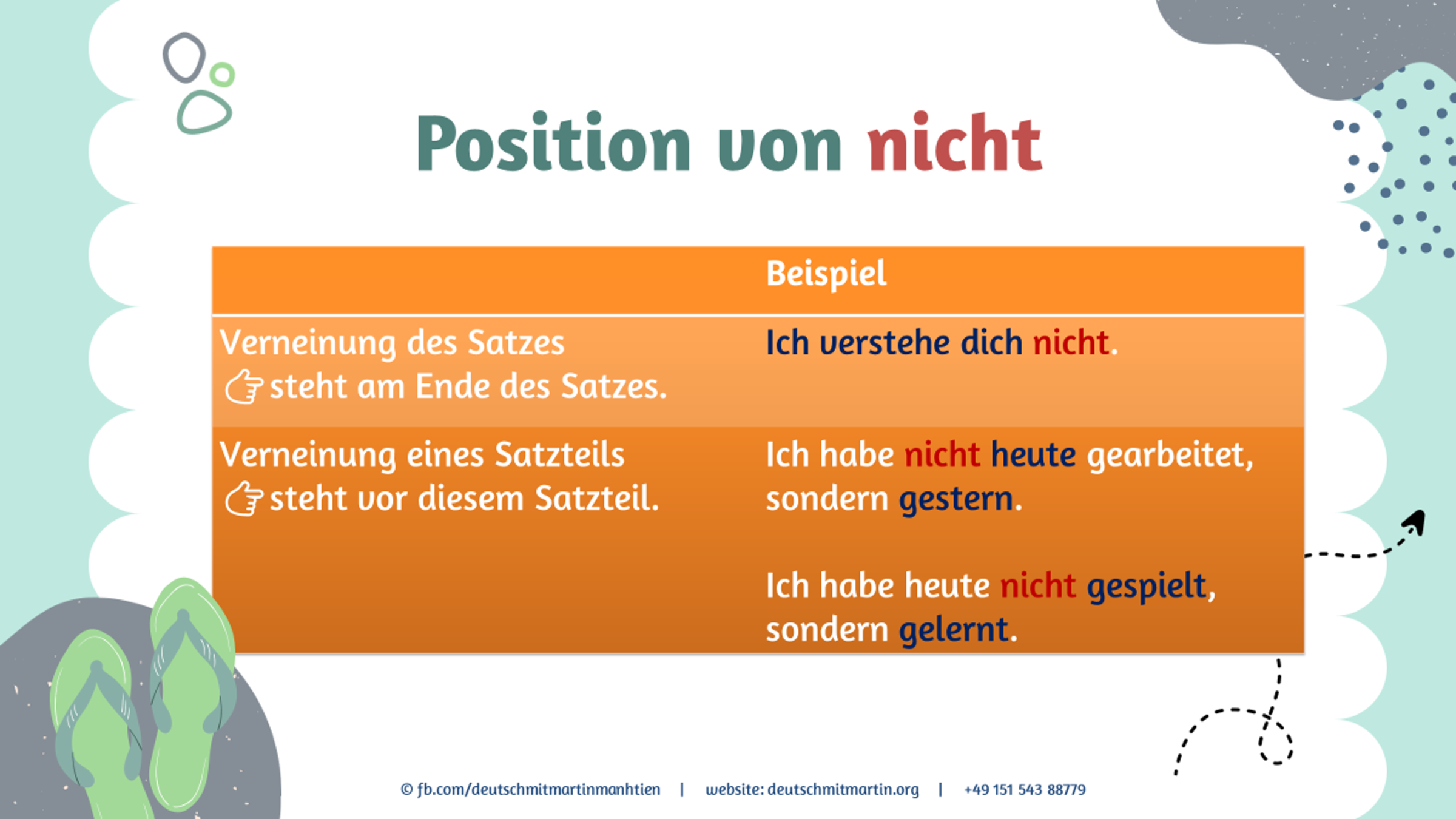
Let's break this down further with specific sentence structures.
NICHT vs KEIN: Master the Difference in German Negation
This article details the placement of nicht in different types of sentences. Mastering these patterns is crucial for constructing grammatically correct negative statements.
Please read the section 'Here are some basic rules for placing “nicht” in a sentence'. Pay close attention to the examples for main clauses, sentences with modal verbs, separable verbs, and auxiliary verbs.
A Systematic Approach to Teaching nicht Placement
Here is a step-by-step way to explain the position of nicht:
-
To negate a specific element (adjective, adverb, prepositional phrase):
nichtcomes directly before it. This emphasizes the contrast.- Der Kaffee ist nicht heiß. (The coffee is not hot [but maybe warm].)
- Wir fahren nicht heute, sondern morgen. (We are not driving today, but tomorrow.)
-
To negate the main verb/the whole action:
nichtgoes as far to the end of the clause as possible.- Ich kaufe das Buch nicht.
- Sie kommt nicht.
However,
nichtgets "stopped" by certain elements that must go at the very end of a German clause. This creates a very reliable pattern:- Before a past participle (in Perfekt):
- Ich habe das Buch nicht gelesen.
- Before an infinitive (with a modal verb):
- Ich kann nicht schwimmen.
- Before a separable prefix:
- Der Zug kommt heute nicht an.
This "goes-to-the-end-unless-stopped" rule is a simple and effective way to teach a complex topic.
4. Common Pitfalls for Learners
As a teacher, it's not enough to know the rules; you must also anticipate the mistakes your students will make.
German Negation Rules Explained: Use “Nicht” and “Kein” Correctly
This final reading points out the most common errors learners make with negation. Being aware of these will help you create targeted exercises and explanations.
Read the section 'Common mistakes with German negation'. Note the three main points of confusion.
To summarize the key errors you'll need to address:
nichtvs.keinconfusion: Continuously reinforcing the "what is being negated?" question is crucial.- Incorrect placement of
nicht: Using sentence-building exercises and providing clear examples ofnichtbefore adjectives vs. at the end for verbs will help. - Forgetting to decline
kein: This error is best addressed by constantly bundlingkeinwitheinduring grammar practice.
Also, briefly mention that, like in English, a double negative in German creates a positive, which is generally avoided.
- Incorrect: Ich habe nicht keine Zeit.
- Correct: Ich habe keine Zeit. (I have no time.) OR Ich habe Zeit. (I have time.)
Conclusion
In this lesson, we have systematically broken down the rules of German negation, focusing on the distinct roles and placement of nicht and kein.
Key Takeaways:
- The Core Rule:
keinnegates nouns that could take an indefinite article (or no article).nichtnegates everything else, including verbs, adjectives, adverbs, and specific nouns (with definite/possessive articles). keinis an Article: It must be declined just like the indefinite articleein, matching the gender, number, and case of its noun.nichtPlacement: Its position is key. It goes immediately before a specific element being negated, or it moves towards the end of the clause to negate the entire action, stopping only for final-verb elements like participles or infinitives.- Teaching Focus: Anticipating common errors—like
nicht/keinconfusion orkeindeclension—is essential for creating effective teaching materials.
You have now analyzed a foundational piece of German grammar from a pedagogical standpoint. These rules are the building blocks for expressing complex thoughts.
In our next lesson, we will officially begin Module 2, "Nouns, Gender, and Word Formation." We will start by exploring the three grammatical genders in German. This topic connects directly to what we learned today, as understanding gender is a prerequisite for correctly declining articles like kein.