Hello! Welcome to our final lesson in this module on the winter seasons.
In our last session, we drew a fine but critical distinction between Hemanta and Shishira, identifying the increased Sheeta (cold) and the emerging Rukshata (dryness) of Shishira as the key differentiators. We concluded that the clinical strategy for Shishira is an intensification of the Hemanta regimen to counter these heightened qualities.
This naturally leads to a crucial question: beyond diet and lifestyle, what therapeutic interventions are most effective during winter? Today, we will address this by focusing on our learning outcome: to justify the use of therapies like Abhyanga, Swedana, and Brimhana Basti during the winter seasons.
You are already familiar with these Panchakarma procedures from your BAMS studies. Our goal here is not to review the procedures themselves, but to construct a precise, principle-based justification for why they are the treatments of choice for Hemanta and Shishira, linking their therapeutic actions directly to the unique physiological state of the body during this period.
The Core Therapeutic Strategy for Winter
First, let's consolidate our understanding of the body's state during Hemanta and Shishira:
- Dominant Qualities: Sheeta (cold) and Rukshata (dryness).
- Doshic State: This environment inevitably leads to the aggravation of Vata dosha (due to its inherent cold and dry nature) and the accumulation (Sanchaya) of Kapha dosha (which solidifies in the cold).
- Agni & Bala: The body's core strength (Bala) and digestive fire (Agni) are at their peak, creating a powerful capacity for nourishment and resilience, provided Vata is kept in check.
From this assessment, our therapeutic goals become clear:
- Pacify Vata: We must counteract its cold, dry, light, and mobile qualities.
- Manage Kapha: Prevent it from becoming overly dense and stagnant.
- Support and Leverage Agni & Bala: Utilize the strong metabolism for deep nourishment (Brimhana).
This points to a three-pronged therapeutic strategy: Snehana (oleation), Swedana (fomentation), and Brimhana (nourishment). Let's see how our chosen therapies perfectly embody this strategy.
Justifying Abhyanga (Therapeutic Oleation)
Abhyanga, or full-body oil application, is more than a simple massage; it's a primary form of external Snehana. Its use in winter is fundamentally justified by the principle of Samanya-Vishesha (like increases like, and opposites decrease).
-
Directly Countering Vata: The primary qualities of Vata are Ruksha (dry), Sheeta (cold), and Laghu (light). A proper Abhyanga, typically performed with warm sesame oil (Tila Taila), provides the exact opposing qualities: Snigdha (unctuous), Ushna (hot), and Guru (heavy). This direct application of opposing Gunas is the most straightforward way to pacify aggravated Vata. The increased dryness of Shishira makes this daily practice not just beneficial, but essential.
-
Systemic Action via Bhrajaka Pitta: The effect is not just skin-deep. As you know, the skin is the seat of Bhrajaka Pitta. This sub-dosha of Pitta governs the absorption and "processing" of anything applied to the skin.
To explore this, let's consult a paper on the mode of action of Abhyanga.
a conceptual study on mode of action of abhyanga
The paper 'a conceptual study on mode of action of abhyanga' provides excellent justifications for our purpose. We will look at a few specific sections.
Please read the following sections: Under 'INDICATIONS', find subsection '3. Abhyanga for the Seasons'. In the 'THERAPEUTIC IMPORTANCE' section, review the list of beneficial effects, specifically noting its Vatahara and Kaphahara properties. Finally, read the section 'ROLE OF BHRAJAKA PITTA IN MODE OF ACTION OF ABHYANGA'.
As the reading highlights, Bhrajaka Pitta "digests" the oil, allowing its medicinal properties to be absorbed and transported systemically. This means Abhyanga pacifies Vata not only in the skin (Twak) but also in deeper tissues (Dhatus), making it a powerful tool against symptoms like joint pain and stiffness.
- Managing Kapha Accumulation: The warmth (Ushna Guna) of the oil and the mechanical action of the massage help to counteract the stagnating effect of cold on Kapha, keeping it from becoming excessively dense and immobile.

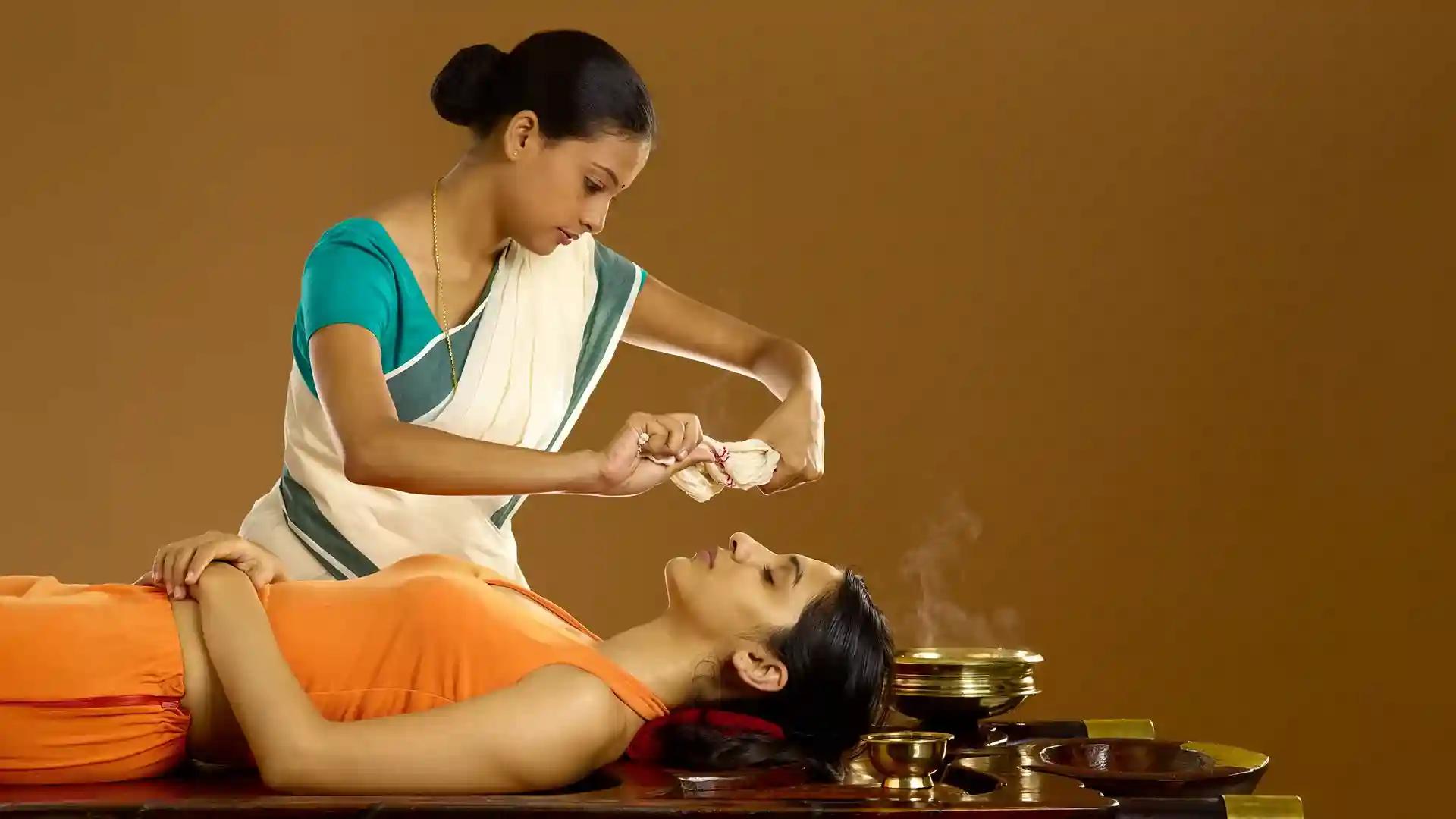
Justifying Swedana (Therapeutic Fomentation)
Swedana is the logical and necessary follow-up to Abhyanga. Its justification rests on its ability to amplify the effects of Snehana and directly combat the environmental cold.
-
Synergy with Snehana: The classical texts are clear that Swedana should follow Snehana. Acharya Vagbhata's famous analogy is perfect here: just as a dry stick can be bent without breaking only after being oiled and heated, the stiff, dry channels (Srotas) and tissues of the body become pliable and functional after Snehana and Swedana. The oleation first liquefies and softens the vitiated doshas, and the heat then dilates the channels, allowing these doshas to move from the peripheral tissues (Shakhas) back to the GI tract (Koshtha) for elimination.
-
Directly Countering Sheeta Guna: The most obvious quality of Swedana is its intense heat (Ushnatva). This is the most direct antidote to the prevailing cold (Sheeta) of winter, alleviating cold-induced stiffness (Stambha), heaviness (Gaurava), and pain.
-
Clearing the Srotas: By inducing sweat and dilating the channels, Swedana ensures proper circulation and prevents the stagnation that cold weather naturally promotes, thereby supporting the healthy flow of nutrients and removal of wastes.
Justifying Brimhana Basti (Nourishing Enema)
While Abhyanga and Swedana are excellent external therapies, Basti is considered the ultimate treatment for Vata disorders because it targets the root of the dosha.
-
Targeting the Seat of Vata: The Pakvashaya (colon) is the primary site of Vata dosha. Administering medicated substances directly into this site via Basti is the most potent method for pacifying Vata at its source. Given that winter is a period of natural Vata aggravation, this intervention is profoundly logical.
-
Systemic Nourishment and Oleation: A Brimhana Basti is a form of Anuvasana (oil) Basti specifically designed for nourishment. It typically uses oils, fats, and nourishing decoctions or meat soups (Mamsa Rasa). This not only pacifies Vata in the colon but also provides deep, systemic nourishment as its substances are absorbed. It combats the internal Rukshata (dryness) that Abhyanga cannot reach.
-
Leveraging Peak Bala and Agni: The strong metabolic state of the body in winter makes it highly receptive to the nourishing (Brimhana) qualities of this therapy. It is the ideal time to build and fortify the body's tissues (Dhatus), and a nourishing Basti is a powerful way to achieve this.
Let's turn to a resource on Anuvasana Basti to cement this justification.
Anuvasana Basti: Method, Benefits, Mode Of Action, Contra ...
The article 'Anuvasana Basti: Method, Benefits...' provides precise indications that align perfectly with the conditions of the winter seasons.
Please read the following sections: Under 'Anuvasana basti indications', note the specific indications for this therapy. Under 'Factors to be assessed', read the subsection 'Anuvasana is basically nurturing'. Read the next subsection, 'Kala or time factor', for a crucial piece of clinical timing.
The readings confirm our reasoning perfectly. Anuvasana Basti is specifically indicated for "excessive rukshata" and "Vata Vyadhis," the exact conditions of winter. It is defined as a nurturing, Brimhana-type therapy. Furthermore, the text provides the precise clinical pearl that in cold seasons like Hemanta and Shishira, it should be administered during the day to avoid the Kapha-aggravating cold of night.
Test your understanding!
A patient in Shishira Ritu presents with significant constipation, dry skin, and aching joints. You have recommended increasing ghee in their diet and daily Abhyanga. The patient asks, "If I'm already eating fat and putting oil on my skin, why do I need a Basti?"
How would you justify Brimhana Basti as a superior intervention in this case, based on Ayurvedic principles?
Show answer
Your justification should include three key points:
- Targeted Action: Explain that the colon (Pakvashaya) is the main home of Vata dosha. While dietary fats and skin oils help, Basti delivers the medicine directly to the root of the problem, making it far more powerful for pacifying high Vata.
- Systemic Oleation: Mention that the unctuous substances in a Basti are absorbed by the colonic mucosa and provide a deep, internal lubrication and nourishment that is more profound and systemic than what can be achieved through digestion or skin absorption alone. It directly combats the internal dryness causing constipation and contributing to joint aches.
- Potent Nourishment (Brimhana): Clarify that a Brimhana Basti is not just oil; it's a potent nutritive formula. In winter, when the body's strength is high, this therapy acts as a powerful tonic to build tissue health (Dhatu Pushti) and overall resilience (Bala), addressing the patient's symptoms from a foundational level.
Conclusion
You can now construct a robust, principle-based argument for the use of Abhyanga, Swedana, and Brimhana Basti in winter. These are not arbitrary choices but a sophisticated and synergistic therapeutic strategy.
Key Takeaways:
- Abhyanga provides an essential external barrier, using Snigdha and Ushna qualities to counteract the environmental Rukshata and Sheeta and pacify Vata via the skin.
- Swedana acts in synergy with Abhyanga, using heat to relieve stiffness, open the body's channels (Srotas), and mobilize doshas.
- Brimhana Basti offers the most profound treatment by targeting Vata at its root in the colon, providing deep internal oleation, and delivering powerful nourishment (Brimhana) when the body is most receptive.
- Together, these three therapies form a comprehensive clinical protocol to maintain health and vitality through the demanding winter seasons of Hemanta and Shishira.
Preview of the Next Lesson:
With this lesson, we conclude our deep dive into the classical six-season model. You now have a solid foundation connecting astronomical cycles to detailed clinical reasoning within the Indian context. We are now prepared to tackle a more complex challenge: applying these principles globally.
In our next lesson, we will begin Module 7 by exploring how geographical latitude alters the astronomical parameters (e.g., day length, solar angle) that define the Ritus. This will be the first step in learning how to adapt Ritucharya for any location on Earth.