Hello! Welcome back to our journey through the winter seasons.
In our last lesson, we analyzed the astronomical reality of peak Dakshinayana. We established that during Hemanta and Shishira, the Northern Hemisphere experiences its shortest days and receives the least intense solar energy due to the Earth's axial tilt. The key takeaway was that the external environment is defined by a deficit of cosmic heat and light.
Today, we address a fascinating paradox. While the external fire of the sun is at its weakest, Ayurveda teaches that our internal fire, Agni, becomes its strongest. Our learning objective is to explain the physiological basis for peak Agni (digestive strength) and Bala (physical strength) during Hemanta and Shishira. We will bridge the astronomical cold you learned about previously with the internal physiological heat that defines our clinical approach to this season.
1. The Core Principle: External Cold Ignites Internal Fire
The fundamental Ayurvedic principle for winter is one of compensation. The body intelligently responds to the cold, dry external environment by conserving and increasing its own internal heat.
To begin, let's watch a short video that succinctly states this principle as described in the classical Samhitas.
How to Balance Vata Pitta and Kapha in Winter- Charaka Samhita- Hemanta Ritu Charya
This clip from 'How to Balance Vata Pitta and Kapha in Winter' by The Sanskrit Channel provides an excellent introduction to the Ayurvedic view of Agni in winter, referencing both Charaka and Vagbhata.
Please watch from 01:11 to 02:23. Focus on the core idea of what happens to the bodily Agni when the outside temperature drops and the warning associated with it.
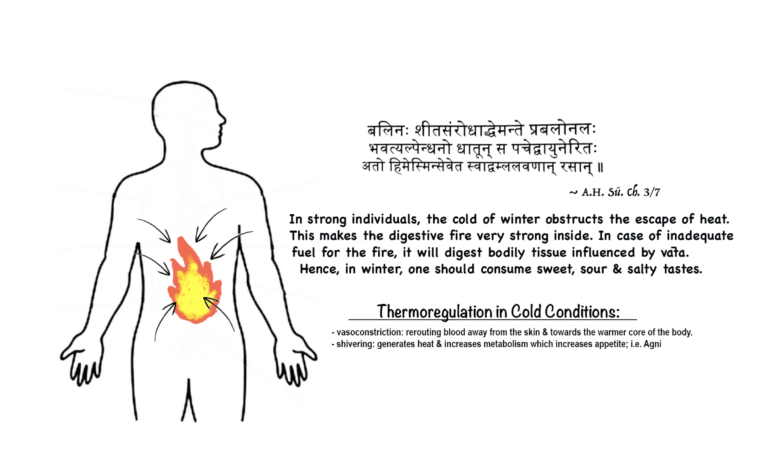
The video introduces the central concept: as the external environment becomes cold, the body's heat recedes or is drawn inwards, strengthening the digestive fire (Jatharagni). This creates a powerful metabolic state capable of handling heavy foods.
This process is elegantly visualized in the following image.
2. The Classical Explanation from Charaka Samhita
Your background in the Samhitas will make this next part particularly insightful. The classical texts provide a precise mechanical explanation for this phenomenon. The following reading contains a key verse from Charaka Samhita that is foundational to understanding Hemanta Ritucharya.
Seasonal Regimen In Ayurveda (Ritucharya)
The article 'Seasonal Regimen In Ayurveda (Ritucharya)' presents and translates the essential verses from Charaka Samhita on Hemanta Ritu. This will give you the original textual basis for our discussion.
Please read section 3.3.3, titled 'Hemanta Ritu (Early Winter: Mid-November to Mid-January)'. Pay close attention to the Sanskrit shloka and its translation at the beginning of the section, which starts with 'Acharaya Charaka said...'. Focus on the mechanism described for why Agni becomes strong.
As Acharya Charaka explains, the chain of events is as follows:
- Contact with Cold Wind (Shitanila Sparsha): The body's pores and superficial channels (Srotas) are exposed to the cold, dry winter air.
- Obstruction of Heat (Samruddha): This external cold causes these peripheral channels to constrict, preventing the body's natural heat from escaping. The heat is effectively "trapped" or "locked in".
- Strengthening of Agni (Balee): This conserved heat is directed towards the core, powerfully intensifying the Jatharagni.
- Clinical Consequence: This fortified Agni becomes capable of digesting large quantities and heavy (Guru) qualities of food. However, Charaka gives a critical warning: if this powerful fire is not provided with adequate fuel (indhana), it will begin to consume the body's own tissues (Rasa Dhatu first, then the others), a process driven by the aggravated Vata dosha of the season.
This isn't just an abstract theory; it's a direct guide for clinical practice, emphasizing the need for a substantial, nourishing diet in winter.
3. The Modern Physiological Correlate
This ancient Ayurvedic observation has a clear and well-documented parallel in modern physiology, primarily through the mechanism of thermoregulation—the body's process of maintaining a stable internal temperature.
WORLD JOURNAL OF PHARMACEUTICAL RESEARCH
This research article provides a clear link between the Ayurvedic view and modern science. It explains the physiological response to cold that results in what Ayurveda calls strong Agni.
Read the section titled 'Ayurvedic Perspective of Winter Season' and the following section, 'Concept of Dietary Pattern of Winter Season'. Focus on how the body's response to cold weather (constriction of pores) directs heat to the body's core and affects Agni.
The modern explanation validates the Ayurvedic view beautifully:
- Peripheral Vasoconstriction: When your body is exposed to cold, the autonomic nervous system triggers the muscles around your superficial blood vessels to tighten. This process, called vasoconstriction, narrows the vessels, reducing blood flow to the skin. This is the physiological equivalent of the "obstruction" of heat that Charaka described. Its purpose is to minimize heat loss from the surface of the body and preserve it for the vital organs in the core.
- Increased Basal Metabolic Rate (BMR): Maintaining a core temperature of around 37°C (98.6°F) in a cold environment requires the body to generate more internal heat. It does this by increasing its overall metabolic activity. This elevation in BMR is the direct modern correlate of a stronger Agni. Your body is literally burning more fuel at rest just to stay warm.
Essentially, the Ayurvedic seers observed the outcome—increased appetite and digestive capacity—and brilliantly deduced the internal mechanism. Modern science, with its tools, has simply confirmed the specifics of this process.
4. From Strong Agni to Peak Bala
Now we can complete the physiological picture. Why does this state of high Agni lead to a state of peak Bala (strength, immunity, vitality)?
The connection is direct and logical:
- Enhanced Digestion and Assimilation: A powerful Agni means food is digested more completely and efficiently.
- Superior Dhatu Poshana (Tissue Nourishment): This efficient digestion allows the body to metabolize the heavy, unctuous, and nourishing foods recommended for winter (like grains, fats, and proteins) into high-quality nutrient plasma (Rasa Dhatu).
- Building Bodily Tissues: A well-formed Rasa Dhatu leads to the superior nourishment of all subsequent tissues (Rakta, Mamsa, Meda, Asthi, Majja, Shukra).
- Emergence of Ojas and Bala: When all seven Dhatus are optimally nourished, the result is an abundance of Ojas (the essence of vitality) and a natural peak in Bala.
Therefore, the highest strength is not in spite of the cold, but because of the body's intelligent response to the cold. The articles you read confirm this, stating that physical strength (Sharir-bal) is at its highest grade during Hemanta and Shishira (see Resource LINK, sections 3 & 4).
Test your understanding!
A patient following a modern diet trend tells you they are using the winter to lose weight by practicing intermittent fasting and eating only light foods like salads and juices. Based on the principles you've learned today, what specific Ayurvedic risk does this regimen pose during Hemanta Ritu, and why?
Show answer
The primary risk is that the patient's Agni, which is naturally very strong and high in winter, will be deprived of adequate "fuel" (indhana). According to Charaka, a powerful, unfed Agni can begin to catabolize the body's own tissues (Dhatus), starting with Rasa Dhatu. This leads to a state of depletion and a subsequent increase in Vata dosha, which can cause dryness, weakness, emaciation, and a compromised immune system, despite the patient's intention to be healthy. The feeling of extreme hunger they might experience is a sign of this powerful, under-fueled Agni.
Conclusion
Today, we have unlocked the physiological logic behind winter wellness in Ayurveda. We've seen how a seemingly harsh external environment triggers a powerful and beneficial internal response.
Key Takeaways:
- The Winter Paradox Solved: The external cold of Dakshinayana does not extinguish our internal fire; it strengthens it.
- The Mechanism: External cold triggers peripheral vasoconstriction (the "closing of pores"), which traps heat and redirects it to the body's core.
- The Effect on Agni: This conserved heat increases the basal metabolic rate, which manifests as a powerful Jatharagni capable of digesting heavy, nourishing foods.
- The Resulting Bala: Efficiently digesting these foods leads to superior nourishment of all Dhatus, culminating in peak physical strength (Bala) and immunity (Ojas) for the year.
Preview of the Next Lesson:
We have now established the "why"—why our body has high Agni and the potential for high Bala in winter. In our next lesson, we will move firmly into clinical application by addressing the "how": Deduce a Brimhana (nourishing) and Agni-supporting Ahara (diet) and Vihara (lifestyle) regimen for Hemanta. We will use today's principles to logically construct the perfect seasonal prescription.