Hello! Welcome to the final lesson of this module.
In our last session, we explored Ritu Sandhi, the critical 14-day junction between seasons. We established that this clinically significant period corresponds astronomically to the Sun's transit from one Rashi (zodiac sign) to the next. This concept serves as a perfect bridge to today's topic, where we will zoom out and look at the entire year.
Our objective is to justify the classical Shad Ritu (six-season) model as a division of the Sun's 360-degree path. By the end of this lesson, you will see how the six Ayurvedic seasons are not just a quaint description of climate, but a precise and elegant mathematical division of the Sun's annual journey, forming the very foundation of Ritucharya.
The Solar Year: A 360-Degree Celestial Circle
As we've discussed, from our perspective on Earth, the Sun appears to travel along a fixed path in the sky over the course of a year. This path is called the ecliptic. The Suryasiddhanta and other Vedic astronomical texts model this path as a 360-degree circle.
The time it takes for the Sun to complete one full journey around this circle and return to its starting point relative to the fixed stars is defined as one Solar Year, or Saura Varsha.
The Surya Siddhanta: Ancient Mathematical Genius ... - ZODIAQ
For a concise astronomical definition of the Solar Year from the perspective of the Suryasiddhanta, let's refer to the article 'The Surya Siddhanta: Ancient Mathematical Genius...'.
Please find the section titled 'Seasonal Divisions: The Ritu Cycle'. Within it, read the definition for 'Varsha: The Year', specifically focusing on the 'Saura Varsha meaning Solar Year'. Note how it is explicitly defined by the Sun's 360-degree journey.
This 360-degree path is the canvas upon which the entire year is painted. It is the fundamental Kala Chakra (Wheel of Time).
Dividing the Circle: Rashis and Solar Months
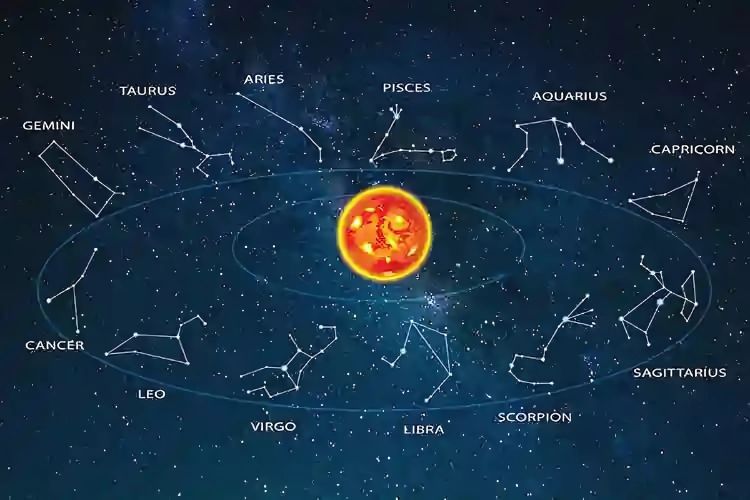
The ancient Indian astronomers divided this 360-degree ecliptic into 12 equal segments, each spanning 30 degrees (360° / 12 = 30°). Each of these 30-degree segments is a Rashi, or zodiac sign.
The Sun takes approximately one month to transit through each Rashi. This period is known as a Saura Masa (solar month). The precise moment the Sun leaves one Rashi and enters the next is a powerful transition point called a Sankranti. This is the astronomical event that marks the beginning of each new solar month.
Solar Panchang: Sun-Based Vedic Calendar, Sankranti ...
The article 'Solar Panchang: Sun-Based Vedic Calendar...' provides an excellent explanation of this foundational principle.
First, read the section 'The Core Principle: Sankranti and Solar Months' to understand how the 360-degree ecliptic is divided into 12 Rashis of 30 degrees each. Then, look at the subsection 'Key Solar Calculations' and read points 1 ('Solar year duration') and 2 ('Daily solar movement') to reinforce this idea.
So, we have a clear hierarchy:
- 1 Solar Year = 1 full 360° journey of the Sun.
- 12 Solar Months (Saura Masa) = 1 Solar Year.
- 1 Solar Month = The time for the Sun to cross 1 Rashi (30°).
The Justification: From Two Months to One Ritu
Here is the key to justifying the Shad Ritu model: Each of the six seasons is defined as spanning two consecutive solar months.
This creates a simple and elegant mathematical structure:
- 1 Ritu = 2 Solar Months = Sun's transit through 2 Rashis = 2 x 30° = 60° of the ecliptic.
- The Full Year = 6 Ritus x 60° per Ritu = 360°.
This proves that the Shad Ritu system is a systematic and logical division of the Sun's complete annual journey. It is not an arbitrary or purely meteorological classification, but one grounded in precise astronomical observation.
Mapping the Ritus to the Zodiac
Let's make this concrete. We can map each of the six Ritus to the specific pair of Rashis the Sun is transiting through.
Solar Panchang: Sun-Based Vedic Calendar, Sankranti ...
The 'Solar Panchang...' article beautifully lays out this mapping. By combining information from two sections, we can build the complete model.
First, review the section 'Ritu: The Six Seasons'. It lists each Ritu and its corresponding two solar months. Then, cross-reference this with the table in the section 'The Twelve Solar Months and Associated Rashis' to see which Rashi corresponds to each solar month. This will allow you to build the full Ritu-to-Rashi mapping.
Based on your reading, here is the complete mapping of the Shad Ritus to the Sun's position in the zodiac:
| Ritu (Season) | Vedic Months | Sun's Transit Through Rashis (30° each) | Total Angular Span |
|---|---|---|---|
| Shishira (Late Winter) | Magha & Phalguna | Aquarius (Kumbha) & Pisces (Meena) | 60° |
| Vasanta (Spring) | Chaitra & Vaishakha | Aries (Mesha) & Taurus (Vrishabha) | 60° |
| Grishma (Summer) | Jyeshtha & Ashadha | Gemini (Mithuna) & Cancer (Karka) | 60° |
| Varsha (Monsoon) | Shravana & Bhadrapada | Leo (Simha) & Virgo (Kanya) | 60° |
| Sharad (Autumn) | Ashwina & Kartika | Libra (Tula) & Scorpio (Vrishchika) | 60° |
| Hemanta (Early Winter) | Margashirsha & Pausha | Sagittarius (Dhanu) & Capricorn (Makara) | 60° |
| Total | 12 Months | 12 Rashis | 360° |
This table is the ultimate justification of the Shad Ritu model. It demonstrates a perfect, unbroken cycle where each season is allocated a 60-degree segment of the Sun's path, directly linking the passage of time and seasons to celestial mechanics.
Test your understanding!
The festival of Makar Sankranti marks the moment the Sun enters Makara Rashi (Capricorn). Based on the table above, which Ritu is ending and which Ritu is beginning at this astronomical point? What does this tell you about the clinical focus during this time?
Show answer
Makar Sankranti marks the Sun's entry into Makara Rashi. According to the table, Makara Rashi is the second half of Hemanta Ritu. This means the Sun is leaving Dhanu Rashi and thus completing the first half of Hemanta.
Therefore, Makar Sankranti does not mark the start or end of a Ritu, but the midpoint of Hemanta Ritu. The preceding season, Sharad (Tula, Vrishchika), has already ended. The next season, Shishira (Kumbha, Meena), has yet to begin.
Clinically, this time represents the peak of early winter. The body's strength (Bala) and digestive fire (Agni) are at their highest. The focus should be on nourishing, heavy, and warming foods (Brimhana Ahara) to build strength for the rest of the winter and the year ahead.
A Note on Precision: The Sidereal (Nirayana) System
A final point that speaks to the robustness of this model is its use of the Nirayana or Sidereal zodiac. This is a key feature of the Suryasiddhanta.
- Sidereal (Nirayana) System: Measures the Sun's position against the backdrop of fixed stars. The Rashis are aligned with the actual constellations. This system is stable over millennia.
- Tropical (Sayana) System: Measures the Sun's position relative to the Vernal Equinox. Because the equinoxes slowly shift due to precession, the relationship between the signs and the background stars changes over time.
The use of the Nirayana system ensures that the start of Mesha Rashi (Aries) remains consistently aligned with a fixed point in the stars, providing an unchanging reference for the entire calendar. This astronomical precision is what allows the Ayurvedic seasonal recommendations to remain so consistently valid.
Solar Panchang: Sun-Based Vedic Calendar, Sankranti ...
To understand this important distinction, please read the brief explanation of the Sidereal approach in the 'Solar Panchang...' article.
Locate the section 'The Astronomical and Mythological Foundation' and read the subsection 'The Sidereal Approach: Fixed Stars'. Focus on the difference between Sidereal and Tropical measurement.
Conclusion
This lesson concludes our module on bridging astronomy and Ayurveda. We have demonstrated that the Shad Ritu model is far more than a simple weather calendar. It is a sophisticated system derived from dividing the Sun's 360-degree annual path into six equal, 60-degree segments, each corresponding to two zodiacal signs.
Key Takeaways:
- A solar year (Saura Varsha) is the time it takes the Sun to travel 360° through the ecliptic.
- This path is divided into 12 Rashis of 30° each. The Sun's transit through one Rashi defines a solar month (Saura Masa).
- The classical Shad Ritu model is justified by defining each season as a period of two solar months, or 60° of the Sun's path.
- This creates a complete 360° map (6 Ritus x 60° = 360°) that directly links the Ritus to the Sun's position in the zodiac.
- The use of the Nirayana (Sidereal) system ensures the long-term astronomical accuracy and stability of this model.
You now have the complete astronomical framework that underpins Ritucharya. We've connected the broad strokes of Uttarayana and Dakshinayana to the subtle variations of Dosha, Guna, and Agni, and finally organized it all within the precise 60-degree segments of the six Ritus.
In our next module, we will begin our deep dive into the practical application of this knowledge. Starting with Module 4: Vasanta & Grishma: The Ascendant Sun, we will calculate the duration of these seasons based on the Sun's transit and deduce the specific dietary (Ahara) and lifestyle (Vihara) recommendations for each.