Hello! Welcome to the first lesson of our course on Ritucharya and its astronomical foundations in Suryasiddhanta.
As an Ayurvedic practitioner, you are well-versed in the principles of Ritucharya—the seasonal regimen that is crucial for maintaining health. You know what to recommend in each Ritu. Our goal in this course is to delve into the why by exploring the astronomical engine that drives the seasons: the ancient and profound text known as the Suryasiddhanta.
Today's lesson will set the stage for our entire journey. We will explore the historical context and immense significance of the Suryasiddhanta. By the end of this lesson, you will be able to describe what this text is, understand the fascinating debate surrounding its age, and appreciate its role not just in Indian astronomy, but as the very foundation upon which the science of Ritucharya is built.
What is the Suryasiddhanta?
The Suryasiddhanta (सूर्यसिद्धान्त), which translates to "The Sun Treatise," is a foundational Sanskrit text of Indian astronomy. It belongs to a genre of texts known as siddhantas, which are systematic treatises that establish the principles and calculations of the cosmos.
Divine Origins and Expert Focus
Traditionally, the knowledge within the Suryasiddhanta is not considered to be of human origin. It is believed to have been revealed by the Sun God, Surya, to an Asura sage named Maya, near the end of the last Krita Yuga. This mythological framing is important as it grants the text a sacred authority and suggests its principles are timeless truths.
This is not a beginner's guide to astronomy. It is a highly condensed work of about 500 verses (shlokas) across 14 chapters, written for those already skilled in the field. Think of it less as a textbook and more as a master's reference manual, filled with formulas and rules for complex calculations.
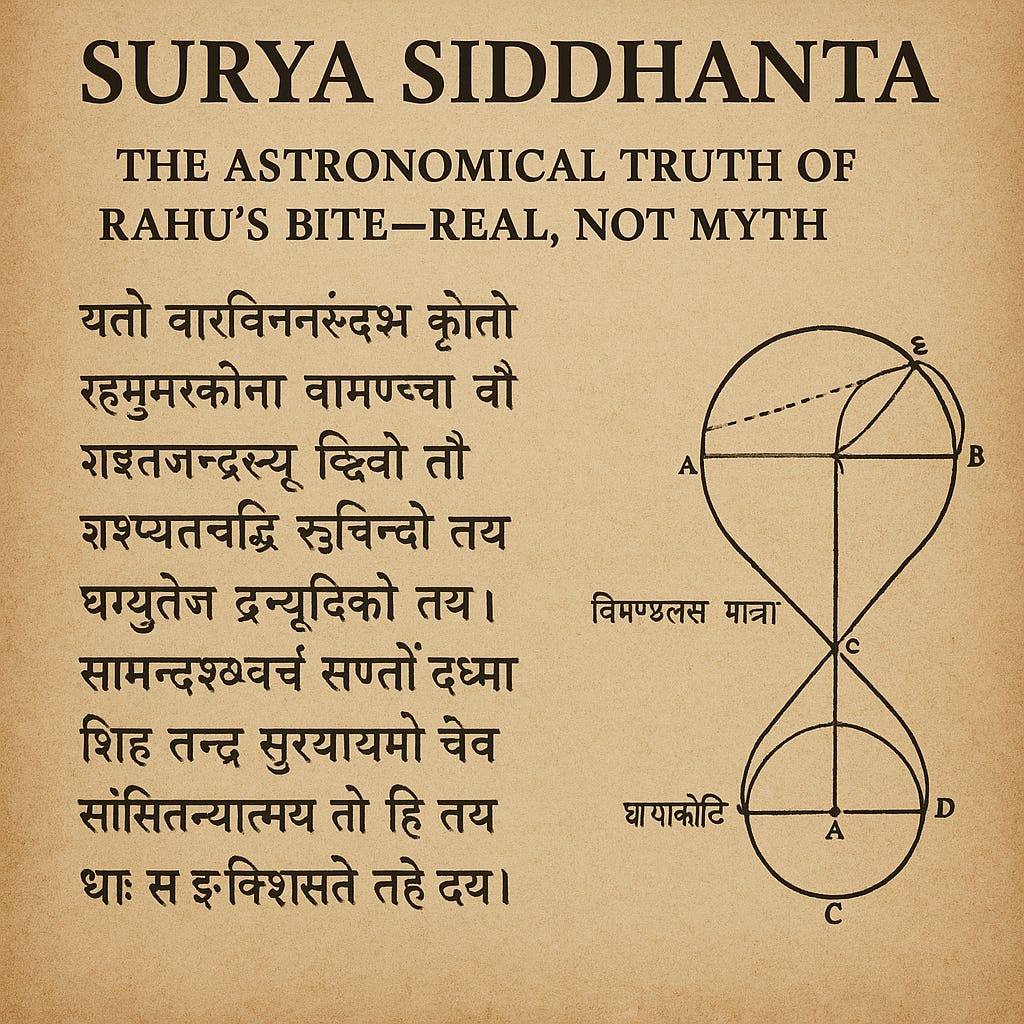
To get a feel for what the original text looks like, consider the image below. It shows a page with Sanskrit verses and a geometric diagram used to explain astronomical concepts, in this case, the calculation related to eclipses.
To understand the scholarly consensus on the text's nature and origins, the following resource provides a concise overview.
Please read the introductory section of the Grokipedia article on 'Surya Siddhanta'. It provides a high-level summary of the text's content, structure, and traditional attribution.
Read the first main paragraph of the article, which begins with 'The Sūrya Siddhānta is an ancient Sanskrit treatise...' and ends with '...facilitating global appreciation of its mathematical rigor.' Focus on how the text is described: its purpose (calculating planetary positions, eclipses), its format (verses), and its mythological origin.
The Great Dating Debate: A Living Text
One of the most fascinating aspects of the Suryasiddhanta is the ongoing debate about its age. Understanding this debate is key to appreciating its historical context. There are two main perspectives.
The Academic Consensus: The Gupta Era Redaction
Most modern historians and Indologists, based on linguistic analysis and specific astronomical data within the surviving manuscripts, date the current version of the Suryasiddhanta to the Gupta period, around the 4th to 5th century CE. They also note that it was likely revised and updated over the subsequent centuries.
For example, the text mentions the Earth's axial tilt (Kranti) as 24 degrees. This value was accurate around 500 CE. Later astronomers like Varahamihira (c. 575 CE) and Brahmagupta (c. 628 CE) refer to and critique the Suryasiddhanta, confirming its existence as a central text during that era. This view also suggests some cross-cultural influence, particularly from Hellenistic (Greek) astronomy, in the development of its mathematical models.
The following reading provides more detail on this perspective.
To understand the scholarly dating of the text, please read the section 'Textual history' from the Wikipedia article.
Read the section titled 'Textual history'. Pay attention to the mention of Varāhamihira's Pañca-siddhāntikā, the evidence that places the text in the 4th-5th centuries CE, and the idea that it was a 'living document' that underwent revisions.
The Archaeo-Astronomical View: A Far More Ancient Origin
An alternative and compelling view, championed by researchers using modern astronomical software, proposes that the knowledge contained within the Suryasiddhanta is far older than the 5th-century CE manuscript tradition suggests. The core idea is that the text is not a single creation but a living tradition, a body of knowledge that was observed, recorded, and updated over many millennia.
These researchers treat the text as a repository of astronomical "fingerprints." By simulating the sky of the distant past, they can find moments when unique astronomical descriptions from the text align perfectly.
The following short videos present this fascinating line of inquiry.
Ancient Astronomy of Surya Siddhanta: 12,000 BCE Evidence | Nilesh Oak | Oxford Conference
The first video, featuring researcher Nilesh Oak, argues for an ancient origin based on a unique combination of three astronomical observations mentioned in Chapter 12 of the text. He proposes this points to an observation date around 12,000 BCE.
Please watch the following segments: Conventional Dating Critique (5:16 - 7:17): Understand how the 580 CE date was derived and why the speaker questions it. The Three Pieces of Evidence (10:03 - 14:31): This is the core of the argument. Focus on the three astronomical markers: two pole stars, a 24-degree obliquity, and the timing of apoapsis/periapsis. The Concept of a 'Living Text' (23:02 - 26:14): This part explains that the 12,000 BCE date is just one of several 'updates' found in the text, suggesting a continuous tradition of astronomical observation.
8800 Years Old Indian Calendar of Mayasura's Surya Siddhanta - A Documentary by Vedveer Arya
This second documentary, by Vedveer Arya, presents a different but complementary argument. It dates the epoch, or starting point, of the original Suryasiddhanta to 6778 BCE based on its description of a rare planetary conjunction.
Please watch the segment from 1:10 to 2:59. Focus on the description of the planetary conjunction in Aries (Mesha) and how modern software is used to pinpoint this event to a specific date in 6778 BCE, establishing a potential origin for the text's calendrical system.
Synthesizing the Views: How do we reconcile these perspectives? It is likely that both are partially correct. The knowledge and key observations within the Suryasiddhanta may indeed stretch back thousands of years, as the archaeo-astronomers suggest. The version that has survived, and was cited by later astronomers like Varahamihira, is likely a major redaction or compilation from around the 5th century CE.
For our course, we will treat the Suryasiddhanta as the product of a long, dynamic tradition of scientific inquiry, giving us a powerful tool whose principles were refined over ages.
Test your understanding!
A scholar points to the text's mention of the Earth's axial tilt being 24 degrees to argue for a date of ~500 CE. Another researcher points to the description of having two bright pole stars (North and South) to argue for a date of ~12,000 BCE. How can both of these observations exist in the same text?
Show answer
This is possible if the Suryasiddhanta is not a single, static text written at one point in time, but a "living document" or a compilation of knowledge gathered over millennia. The description of two pole stars may represent a very ancient observation that was preserved, while the 24-degree axial tilt could be from a later update or redaction made around 500 CE when that value was accurate. The text appears to contain layers of observations from different historical periods.
The Significance of the Suryasiddhanta
The Suryasiddhanta is far more than just an old astronomy book. Its influence has been profound, both within India and globally.
-
Foundation of the Hindu Calendar (Panchanga): The text provides the mathematical backbone for the traditional Hindu luni-solar calendar. Its algorithms are used to calculate the length of the solar year, the start and end of lunar months, the timing of tithis (lunar days), nakshatras, and yogas. The dates of major festivals like Diwali and Holi are determined using principles derived directly from this text.
-
Cornerstone of Siddhantic Astronomy: It is one of the most important of the siddhantas and heavily influenced subsequent astronomical works for over a thousand years, including those by titans like Bhaskara II. It established a standard methodology for observation and calculation.
-
Global Influence: In the 8th century, the Suryasiddhanta was translated into Arabic under the patronage of the Abbasid Caliph Al-Mansur. This translation, known as the Zij al-Sindhind, had a significant impact on Islamic astronomy. Through Islamic scholars, these ideas—including advanced trigonometry and the sine function—eventually made their way to medieval Europe, contributing to the development of astronomy there.
-
The Astronomical Basis for Ritucharya (Our Focus): This is the most critical point for our course. The qualitative descriptions of seasons and their effects on the body, which you know from the Samhitas, find their precise, quantitative definitions in the Suryasiddhanta.
- The concepts of Adana Kala (the taking-away period) and Visarga Kala (the giving-back period) directly correlate with the Sun's northward journey (Uttarayana) and southward journey (Dakshinayana), which are defined by the solstices.
- The six Ritus (Vasanta, Grishma, Varsha, Sharad, Hemanta, Shishira) are not arbitrary divisions of the year. They are defined by the Sun's transit through pairs of zodiac signs (Rashis), a 360-degree journey that the Suryasiddhanta teaches us how to map.
- The changing strength of digestion (Agni) and physical vitality (Bala) throughout the year is a direct consequence of the changing solar intensity and day length, which can be precisely calculated using the text's principles.
In essence, the Suryasiddhanta provides the celestial mechanics that explain why Ritucharya works. It elevates it from a set of traditional rules to a predictive science based on the observable, measurable, and cyclical laws of the cosmos.
Conclusion and Next Steps
In this introductory lesson, we have laid our foundation. We've established that:
- The Suryasiddhanta is an authoritative and foundational text of Indian astronomy, traditionally held to be of divine origin.
- Its historical age is complex, with evidence supporting both a major compilation around the 5th century CE and a much more ancient origin for its core observations, making it a "living tradition."
- Its significance is immense, having shaped the Hindu calendar, influenced global astronomy, and most importantly for us, providing the precise astronomical rationale for the Ayurvedic principles of Ritucharya.
You now have the context to appreciate the source of the knowledge we are about to explore. In our next lesson, we will open the book itself and begin with Module 1, Lesson 2: "Explain the geocentric model and the concept of the celestial sphere (Bhugola) as described in Suryasiddhanta." We will start building the cosmic map that the ancient Indian astronomers used to track the heavens and understand our place within them.