Hello! Welcome back to our study of Ritucharya.
In our last session, we established the grand astronomical context for Varsha Ritu, linking its onset to the sun's southward journey, Dakshinayana, which initiates the replenishing period of Visarga Kala. We noted that while Visarga Kala marks the beginning of strength-building, the body enters Varsha Ritu at its weakest, having just endured the depleting effects of Adana Kala.
Today, we will bring this cosmic understanding down to the level of clinical physiology. Our learning outcome is to explain the physiological basis of Agnimandya (weakened digestion) and Vata Prakopa (Vata aggravation) in Varsha Ritu due to its characteristic atmospheric changes. We will explore precisely how the dampness, cloud cover, and cool winds of the monsoon season directly impact Agni and the Doshas.
The Weakening of Agni: A Two-Stage Process
The state of poor digestion, or Agnimandya, in Varsha Ritu is not a sudden event. It's the culmination of a process that begins in the preceding season and is then exacerbated by the new environmental conditions.
Stage 1: The Legacy of Adana Kala
As you know, the body's strength (Bala) and digestive fire (Agni) are intrinsically linked. The intense heat of Adana Kala, particularly in Grishma Ritu, depletes both. The body arrives at the doorstep of Varsha Ritu already weakened. Acharya Charaka states this clearly:
ādānadurbalē dēhē paktā bhavati durbalaḥ |
sa varṣāsvanilādīnāṁ dūṣaṇairbādhyatē punaḥ || (Charaka Samhita, Sutra Sthana 6:33)
This means: "In a body weakened by Adana Kala, the digestive fire (paktā) is also weak. It is then further afflicted by the vitiating factors like Anila (Vata) during the rainy season."
Stage 2: The Three-Pronged Attack in Varsha Ritu
The already fragile Agni is then confronted by a new set of atmospheric challenges unique to the rainy season. Classical texts, including Charaka Samhita and Ashtanga Hridaya, identify three primary causative factors.
To understand these factors, please read the following brief but crucial passages.
Tasyashiteeya Adhyaya - Charak Samhita
These passages from Charaka Samhita and Ashtanga Hridaya are the cornerstones of today's lesson. They pinpoint the exact environmental factors responsible for suppressing Agni and vitiating the Doshas in Varsha Ritu.
In the resource from Charaka Samhita Online, please read the section titled 'Diet and lifestyle guidelines in Varsha ritu', focusing on shlokas 33 and 34. Pay close attention to the three factors mentioned: 'bhūbāṣpa' (earth vapors), 'meghanisyanda' (rainfall/clouds), and 'pākādamlājjalasya' (acidic transformation of water).
Ashtanga Hrudaya Sutra Sthana Chapter 3: Ritucharya ...
This excerpt from Ashtanga Hridaya reinforces the same concepts, describing how the weak fire from Adana Kala is further impacted.
In the Easy Ayurveda article, find the section 'Varsha Ritu carya'. Read shlokas 42-44, which explain how the weak digestive fire is worsened by clouds, cold wind, 'bhūbāṣpa' (earth vapors), and 'amlapāka' of the earth and water.
As you've just read, the texts converge on three key environmental phenomena:
- Bhūbāṣpa (Vapors from the Earth): During Grishma, the earth is intensely heated. When the first rains fall, this heat causes steam and vapor to rise, creating a damp, humid atmosphere. This quality of pervasive dampness (Kleda) is antithetical to the dry, sharp, and hot nature of Agni, effectively smothering it.
- Meghanisyanda (Cloud Cover and Rain): The thick cloud cover blocks the sun's rays. The environment loses the sun's Ushna (hot) quality and becomes predominantly Sheeta (cold). Both cold and dampness are known to suppress Jatharagni.
- Amla Vipaka of Jala (Acidic Nature of Water): The texts describe that the water itself (both rainwater and ground water) becomes turbid and acquires an acidic quality (Amla Paka or Amla Vipaka). This can be understood as rainwater mixing with minerals and organic matter from the superheated earth, leading to fermentation and an acidic nature. Consuming this water, and foods grown in this environment, further contributes to the weakening of Agni.
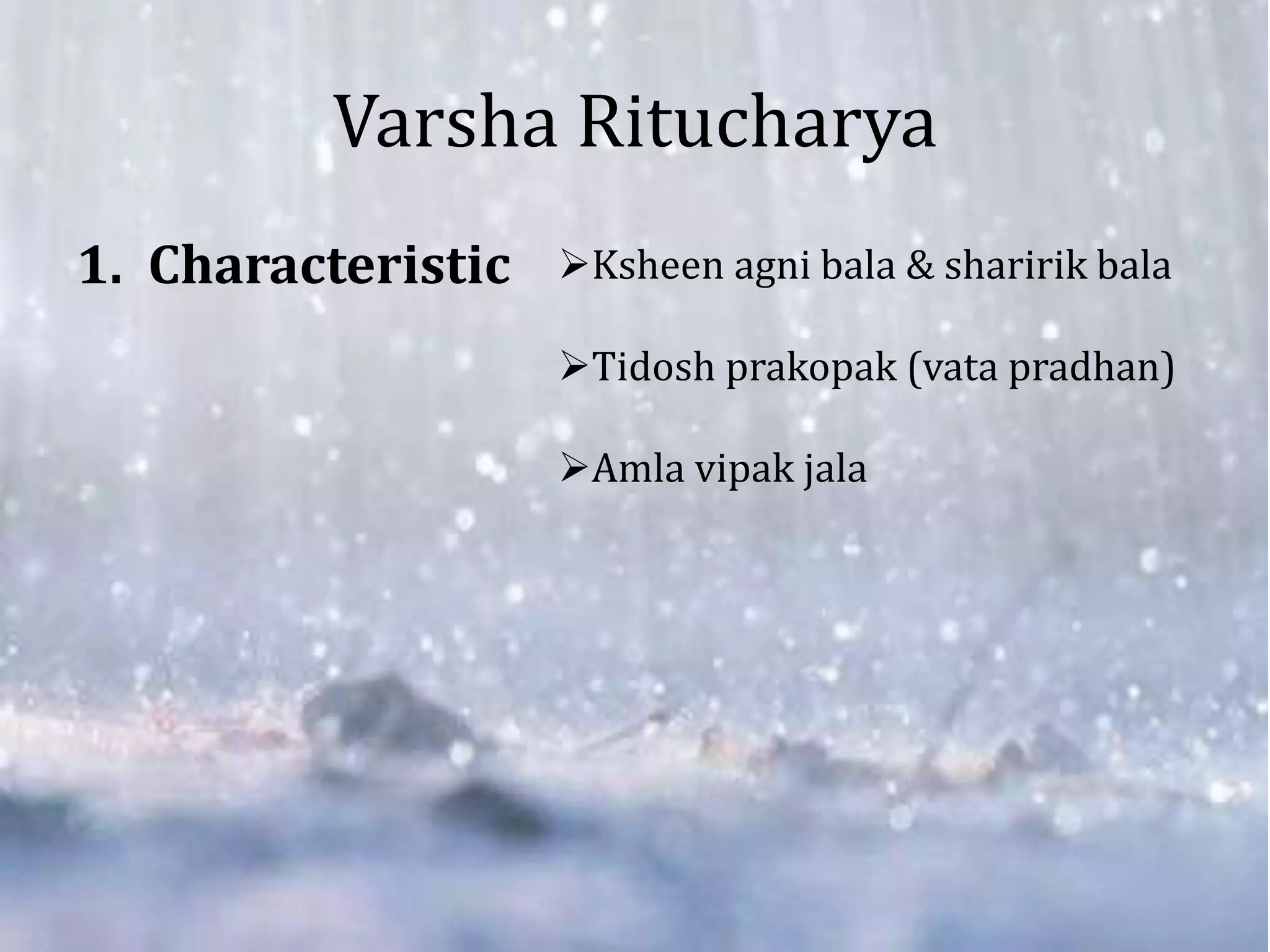
The direct consequence of this sustained attack on Agni is the state of Mandagni (slow/dull digestive fire). When Agni is impaired, it cannot properly metabolize food. This leads to the formation of Ama—the sticky, toxic byproduct of incomplete digestion.

The Aggravation of Vata (Vata Prakopa)
The second major physiological event in Varsha Ritu is the aggravation of Vata Dosha. This also follows a logical, sequential process that begins in the previous season.
Stage 1: Sanchaya (Accumulation) in Grishma
Let's refer to the classical cycle of Dosha activity.
Tasyashiteeya Adhyaya - Charak Samhita
This table from the Charaka Samhita resource provides a concise overview of the Dosha cycle throughout the year. It will help you visualize the process of accumulation and aggravation.
Please locate the table under the heading 'Seasonal variation in strength'. Observe the row for Vata and note the seasons listed for Sanchaya (Accumulation) and Prakopa (Aggravation).
As the table shows, Vata Sanchaya (accumulation) occurs in Grishma Ritu. Why? Because the intense heat and dryness of summer increase the corresponding qualities of Ruksha (dry) and Laghu (light) in the body, which are primary attributes of Vata. The Vata accumulates in its primary sites (like the colon) but is not yet aggravated, as the ambient heat (Ushna Guna) prevents the full expression of Vata's coldness (Sheeta Guna).
Stage 2: Prakopa (Aggravation) in Varsha
When the season shifts to Varsha, the accumulated Vata is met with a powerful trigger: the cold and damp environment.
The primary qualities of Vata are Ruksha (dry), Laghu (light), and Sheeta (cold). The sudden onset of the cold, windy, and damp weather of the monsoon directly resonates with and provokes the Sheeta quality of the already-accumulated Vata, causing it to "overflow" and become aggravated (Prakopa).
The Vicious Cycle of Agnimandya and Vata Prakopa
It is crucial to understand that Agnimandya and Vata Prakopa are not independent events. They create a vicious, self-perpetuating cycle:
- Agnimandya → Vata Prakopa: The Ama produced due to weak Agni can clog the body's channels (Srotorodha). This obstruction impedes the natural, downward flow of Vata (especially Apana Vayu), causing it to become deranged and move in improper directions.
- Vata Prakopa → Agnimandya: Aggravated Vata, particularly Samana Vayu which governs the digestive process, can blow on the digestive fire like an unsteady wind, making it irregular (Vishamagni) or extinguishing it further (Mandagni).
This interplay is why addressing both Agni and Vata is the cornerstone of clinical management in Varsha Ritu.
Test your understanding!
A patient complains of bloating, gas, and joint stiffness that gets significantly worse every year as soon as the rains begin. Using the principles we just discussed, explain the likely samprapti (pathogenesis) connecting the weather to their symptoms.
Show answer
The samprapti can be explained as follows:
- Hetu (Cause): The onset of Varsha Ritu with its Sheeta (cold) and Kleda (damp) qualities.
- Dosha Sanchaya: The patient likely accumulated Vata (due to its ruksha quality) during the preceding dry summer (Grishma).
- Dosha Prakopa: The coldness of the rainy season acts as a trigger, aggravating the accumulated Vata.
- Agnimandya: The damp and cold environment simultaneously suppresses their Jatharagni, leading to Ama formation. Bloating and gas are classic signs of this.
- Manifestation: The aggravated Vata, which is mobile and dry, carries the sticky Ama into the channels and deposits it in the joints (sandhi), which are a primary site of Shleshaka Kapha. This causes the characteristic stiffness and pain (Vata-type arthritis), which is exacerbated by cold and damp weather.
Conclusion
Today we have dissected the physiological turmoil of Varsha Ritu. We've seen that it is not random, but a direct and logical consequence of the interaction between a weakened body (post-Adana Kala) and a specific set of atmospheric conditions.
Key Takeaways:
- Agnimandya in Varsha is caused by the compounding effect of prior depletion from Adana Kala and the suppressive qualities of the rainy season: Bhūbāṣpa (earth vapors), Meghanisyanda (cloud cover), and Amla Jala (acidic water).
- Vata Prakopa occurs because the Vata Dosha, which naturally accumulates due to dryness in Grishma, is triggered by the sudden onset of cold (Sheeta Guna) in Varsha.
- These two conditions create a vicious cycle, where poor digestion leads to Ama that obstructs Vata, and aggravated Vata further deranges Agni.
Preview of the Next Lesson:
Understanding this pathogenesis is the key to effective treatment. Now that we know why these conditions arise, we can logically deduce the solutions. In our next lesson, we will focus on the practical application of this knowledge by deducing the specific Ahara (diet) and Vihara (lifestyle) recommendations for Varsha Ritu designed to enhance Agni and pacify Vata.