In our previous lesson, we established the fundamental concepts of thermodynamic systems, states, and the crucial difference between state and path functions. We saw that quantities like work are path-dependent and can be calculated by an integral, . As we move towards applying the First Law of Thermodynamics, we will need to solve such integrals for specific processes.
A particularly important process we'll study is the isothermal expansion of an ideal gas, where temperature is constant. According to the ideal gas law, this means pressure is related to volume by . The work integral therefore becomes . Solving this requires us to integrate the function . You'll notice the standard power rule for integration, , fails spectacularly when , as it leads to division by zero.
This lesson is dedicated to resolving this mathematical puzzle. We will introduce the function that serves as the "missing" integral of : the natural logarithm. We will explore its fundamental properties and, most importantly, rigorously establish the relationship . This will equip you with a vital mathematical tool for the physics ahead.
Defining the Natural Logarithm as an Integral
Instead of defining the natural logarithm, , as the inverse of the exponential function , we will take a more fundamental approach that aligns with your interest in theoretical derivations. We can define the natural logarithm function directly as an integral.
Definition: For any positive number , the natural logarithm of , written , is defined as the area under the curve of the function from to .
Mathematically, this is expressed as:
This definition provides a powerful geometric intuition.
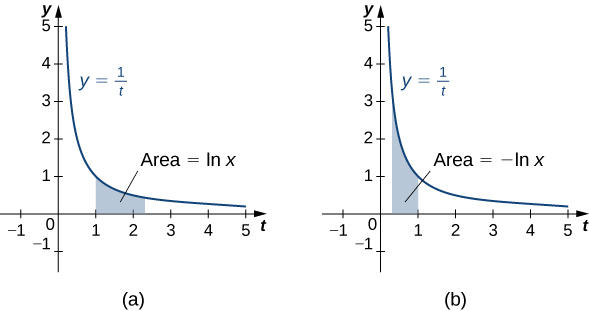
As defined by the integral, is the area under the hyperbola . (a) For , the area is positive. (b) For , the integral runs backwards, so the area is counted as negative, represented here as where is now the upper limit less than 1.
From this definition, a few properties become immediately obvious:
- ln(1): The integral from 1 to 1 is the area of a line, which is zero. Thus, .
- Sign: If , the integral represents a positive area, so . If , the integral's upper limit is smaller than its lower limit, meaning we integrate "backwards," which makes the result negative. So, for , .
To explore this elegant definition and its consequences further, the following video provides an excellent and clear explanation.
Defining the Natural Logarithm as an Integral?!?!?
This video from Dr. Trefor Bazett introduces the idea of defining the natural logarithm as an integral and explores its immediate consequences.
Watch the segment from the beginning of the definition at this timestamp. Pay close attention to how the value and sign of \ln x are interpreted directly from the area under the curve of 1/t.
The Derivative of the Natural Logarithm
One of the most powerful features of defining as an integral is that finding its derivative becomes remarkably simple by applying the Fundamental Theorem of Calculus.
Recall that the Fundamental Theorem of Calculus (Part 1) states that if a function is defined as an accumulation of area, , then its derivative is simply the original function: .
Applying this directly to our definition of :
This gives us one of the most important derivative rules in calculus. The derivative of the natural logarithm function is simply .
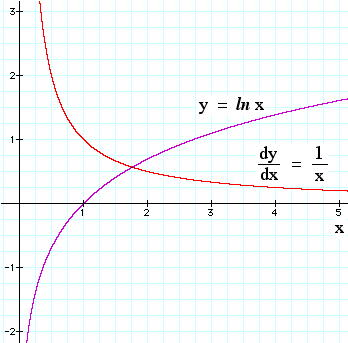
This plot visually confirms the relationship. The purple curve is . The red curve is its derivative, . Notice that at any point on the curve, its slope is equal to the value of the curve at that same -coordinate.
Let's return to the video, which explains this application of the Fundamental Theorem of Calculus.
Defining the Natural Logarithm as an Integral?!?!?
The video now uses the Fundamental Theorem of Calculus to find the derivative of our newly defined function.
Watch the short segment from this point, which shows how the derivative rule \frac{d}{dx}(\ln x) = 1/x follows directly from the integral definition.
Deriving the Properties of Logarithms
You are likely familiar with the "rules" of logarithms from previous studies. Rather than just stating them, we can now derive them from our integral definition. This demonstrates the internal consistency and power of this approach. Let's prove the product rule: .
The proof involves splitting the integral and using a clever substitution (a u-substitution, in calculus terms).
Defining the Natural Logarithm as an Integral?!?!?
This part of the video walks through the proof of the logarithm product rule. This is a great example of the kind of derivation that underpins the mathematical tools we use.
Watch the derivation from this timestamp. Follow the steps as the integral for \ln(xy) is broken into two parts, and a change of variables is used on the second part to show it is equivalent to \ln(y).
The steps of the proof are:
- Start with the definition: .
- Split the integral: .
- Recognize the first term: The first integral is simply the definition of .
- Use substitution on the second term: Let , so and . The limits of integration change from and .
- Simplify the second integral: , which is the definition of .
- Combine the results: .
Similar proofs can be constructed for the other key properties:
- Quotient Rule:
- Power Rule:
The Integral of 1/x
We started with the problem of finding . Since we have now established that , the Fundamental Theorem of Calculus tells us the answer. Integration is the reverse of differentiation, so:
However, there is a subtlety. The function is defined for all , but is only defined for . What about when we integrate over negative values of ? The solution is to use the absolute value. The full, correct antiderivative is:
For a definite integral between two positive numbers and , this becomes:
Let's see the final piece of the argument in the video.
Defining the Natural Logarithm as an Integral?!?!?
This last segment explains why the absolute value is necessary for the general antiderivative of 1/x.
Watch from here to understand why \ln|x| is the complete answer for the indefinite integral, as it has the same domain as the original function 1/x.
To solidify this key result, let's turn to a text that presents it in the context of problems you will soon face in this course.
1 Integration basics — Applying Maths in the Chemical & Biomolecular Sciences
This reading from "Applying Maths in the Chemical & Biomolecular Sciences" connects the integral directly to thermodynamics and states the rule we need.
First, briefly look at the example under the heading Work done by gas. You don't need to follow every step, but notice how the integral for work, W_{rev}, naturally leads to an integral of 1/V. This is our primary motivation. Next, read the section "Integrating 1/x and 1/(ax+b) produces a logarithm". Focus on the rule stated in Equation 7. This is the central mathematical result of our lesson.
Conclusion
In this lesson, we have filled a crucial gap in our mathematical toolkit, preparing us for the quantitative side of the First Law of Thermodynamics.
- We formally defined the natural logarithm function, , as the integral of from to , which represents the area under the hyperbola.
- Using the Fundamental Theorem of Calculus, we showed that this definition leads directly to the derivative rule: .
- This relationship gives us the "missing" integration rule that the power rule could not handle: .
- We also saw how the familiar properties of logarithms, like the product and power rules, can be rigorously derived from this integral definition.
You are now equipped to solve the integral for work done during an isothermal process. In our next lesson, we will formally state the First Law of Thermodynamics () and use the tools from today to calculate both work done and heat transferred for several key types of reversible processes in an ideal gas.