Guten Tag!
In our last session, you learned to conjugate strong verbs like sprechen, lesen, and sehen, allowing you to form more expressive sentences like "Du liest ein Buch" (You read a book) or "Der Zahnarzt spricht mit der Patientin" (The dentist speaks with the patient). You've become quite skilled at saying what is. Today, we'll focus on the opposite: saying what is not.
This lesson will teach you how to negate nouns using the words kein and keine. This is the German equivalent of saying "not a/an" or "no". By the end of our session, you'll be able to transform a sentence like "Ich habe einen Termin" (I have an appointment) into "Ich habe keinen Termin" (I have no appointment) — a crucial skill for managing your student life in Germany. We will focus specifically on using kein in the nominative and accusative cases, which you are already familiar with.
The Two Types of Negation: kein vs. nicht
In German, there are two primary words for negation: kein and nicht. The rule for choosing between them is quite clear. We will explore nicht in our next lesson, but for today, the most important thing to know is that kein is used to negate nouns.
Let's begin by reading a short explanation that establishes this fundamental rule.
NICHT vs KEIN: Master the Difference in German Negation
This article from the "Learn German easily" blog clearly outlines the basic difference between kein and nicht and then introduces how kein functions.
Please read the first two sections of the article. Start with The Main Difference to understand the core concept. Then, continue with the section How to use the word kein. Focus on its translation as "not a/an" or "no" and its position before the noun.
As the article explains, you use kein to negate a noun that either has an indefinite article (ein, eine) or no article at all (as is common with plural nouns or abstract concepts). Think of kein as the negative version of ein.
The Endings of kein: A Familiar Pattern
The most important rule for using kein correctly is that it must agree with the noun it negates in gender, number, and case. This might sound complex, but there's a simple trick: kein takes the exact same endings as the indefinite article ein. You are simply adding a "k" to the beginning.
Let's look at this pattern. You already know these forms for ein:
| Case | Masculine | Feminine | Neuter | Plural |
|---|---|---|---|---|
| Nom. | ein | eine | ein | - |
| Acc. | einen | eine | ein | - |
Now, let's add the "k-" prefix to create the forms of kein. Notice that for the plural, where ein has no form, keine is used.
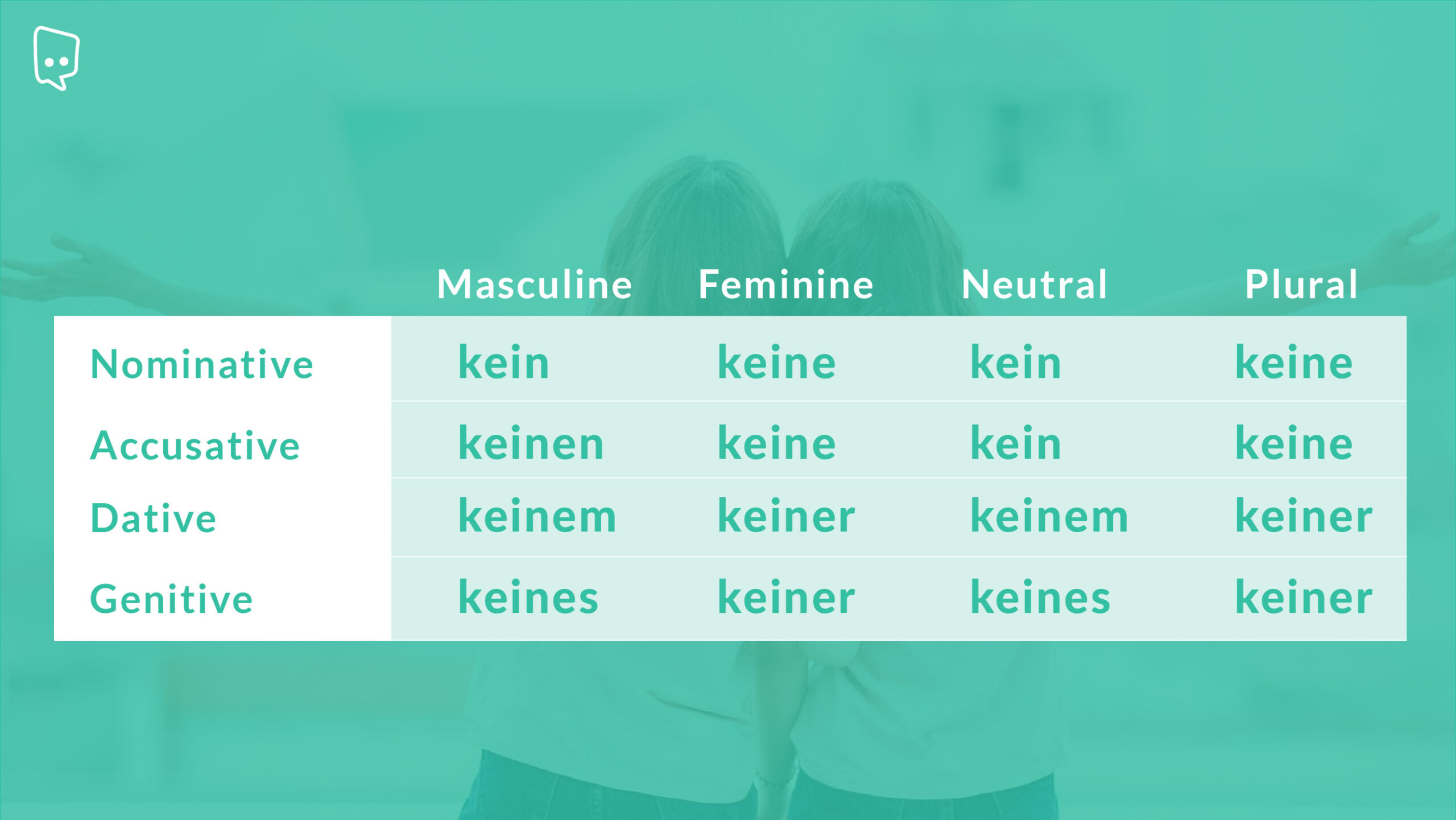
kein in the Nominative Case
You use the nominative case for the subject of a sentence. When you want to say that something is not a particular noun, you use kein in the nominative.
- Affirmative: Das ist ein Stuhl. (That is a chair.)
- Negative: Das ist kein Stuhl. (That is not a chair.)
Let's look at an example that might be relevant in your future professional environment.

The video below explains this concept clearly, showing how kein is used to negate nouns that have an indefinite article or no article.
The Key to Mastering German Negation: NICHT vs KEIN
This video, "The Key to Mastering German Negation", provides a concise breakdown of when and how to use kein.
First, watch the brief introduction from the beginning to understand that kein is a negative article that replaces the indefinite article. Then, watch the segment on the nominative case, which shows exactly how sentences are negated.
As the video demonstrates, the process is straightforward:
- Feminine: Das ist eine Universität. → Das ist keine Universität.
- Neuter: Das ist ein Videospiel. → Das ist kein Videospiel.
- Plural: Das sind Bücher. → Das sind keine Bücher.
kein in the Accusative Case
You already know that the accusative case is used for the direct object of a sentence—the person or thing directly affected by the verb's action. When you want to say you don't have, see, need, or buy something, you'll use kein in the accusative.
The declension pattern remains consistent with ein. This means the form of kein only changes for masculine nouns.
- Affirmative: Ich habe einen Computer. (I have a computer.)
- Negative: Ich habe keinen Computer. (I don't have a computer.)
For feminine, neuter, and plural nouns, the accusative forms are the same as the nominative forms.
- Feminine: Ich brauche eine Brille. → Ich brauche keine Brille. (I don't need glasses.)
- Neuter: Ich lese ein Buch. → Ich lese kein Buch. (I am not reading a book.)
- Plural: Er kauft Stifte. → Er kauft keine Stifte. (He isn't buying any pens.)
Let's watch a short clip that reinforces this crucial point about the masculine accusative.
Nominativ? Akkusativ? Dativ? | 3 Cases in German | Learn German Grammar | A1-A2
The channel "Learn German" offers this detailed video on German cases. We will watch a very specific part that summarizes the article changes in the accusative case.
Please watch the segment from this point. It concisely summarizes how articles behave in the accusative, explicitly stating that der becomes den, ein becomes einen, and, most importantly for us, kein becomes keinen for masculine nouns.
A Complete Picture
To solidify your understanding, it's helpful to see the indefinite article ein and the negative article kein side-by-side. The following reading provides an excellent table and explanation.
Der, Die, Das – Explaining the Cases in German
This guide from Olesen Tuition neatly connects indefinite articles with kein.
Please read the section titled "Indefinite Articles..." to understand the conceptual link. Then, study the chart that follows, focusing only on the Nominative and Accusative rows. Finally, read the explanation right after the chart, from "Looking at ein...", which summarizes how the endings mirror each other.
Practice Time
Now, let's apply what you've learned. Fill in the blanks with the correct form of kein. Pay close attention to the gender of the noun and whether it's the subject (nominative) or direct object (accusative).
Nouns you'll need: der Termin (appointment, masc.), die Zeit (time, fem.), das Geld (money, neuter), der Zahnarzt (dentist, masc.), die Frage (question, fem.), die Bücher (books, plural).
- Ich habe heute leider ______ Zeit. (I unfortunately have no time today.)
- Er ist ______ Student, er ist Professor. (He is not a student, he is a professor.)
- Wir brauchen ______ neuen Computer. (We don't need a new computer.)
- Hast du ______ Geld? (Do you have no money?)
- Sie hat ______ Fragen. (She has no questions.)
- Das ist ______ guter Zahnarzt. (That is not a good dentist.)
Solutions
- keine (
Zeitis feminine, accusative) - kein (
Studentis masculine, nominative predicate) - keinen (
Computeris masculine, accusative) - kein (
Geldis neuter, accusative) - keine (
Fragenis plural, accusative) - kein (
Zahnarztis masculine, nominative predicate)
Conclusion
Fantastic work! You have now mastered a fundamental component of German grammar. By learning how to use kein and keine, you can express absence and negation much more precisely, moving beyond simple positive statements.
Let's recap the key takeaways:
Keinnegates nouns that would have an indefinite article (ein/eine) or no article (plurals).- The endings for
keinfollow the same pattern as the indefinite articleein. - In the nominative and accusative cases, the only change occurs for masculine nouns in the accusative case (
keinen).
In our next lesson, we will complete your basic negation toolkit by learning how to use nicht. This will allow you to negate verbs, adjectives, adverbs, and entire ideas, giving you full control over forming negative sentences in German.
Bis zum nächsten Mal!