Guten Tag! In our last lesson, you mastered the crucial skill of forming the Partizip II (past participle) for all kinds of German verbs. You now have the essential building blocks for talking about the past.
Today, we'll put those blocks into action. This lesson is all about constructing complete sentences in the German conversational past tense, known as the Perfekt. Specifically, we will focus on using the auxiliary verb haben (to have). By the end of this lesson, you will be able to take a past participle you learned, combine it with haben, and form a grammatically correct sentence to describe a past event. This will unlock your ability to talk about what you did yesterday, last week, or at any point in the past.
The Perfekt Tense: The Formula for the Past
In spoken German, the Perfekt is the standard way to talk about the past. Just as you learned in the last lesson, it requires two parts:
- An auxiliary verb (Hilfsverb) – either
habenorsein. - A past participle (Partizip II) at the end of the sentence.
Today, our focus is entirely on haben. The vast majority of German verbs form their Perfekt tense with haben, so mastering this structure is a huge step forward.
The basic word order creates a "sentence clamp" (Satzklammer), which you might remember from modal verbs. The conjugated auxiliary verb sits in the second position, and the past participle is kicked to the very end.
Subject + conjugated haben + ... (other information) ... + Partizip II.
Let's look at a visual representation of this structure.
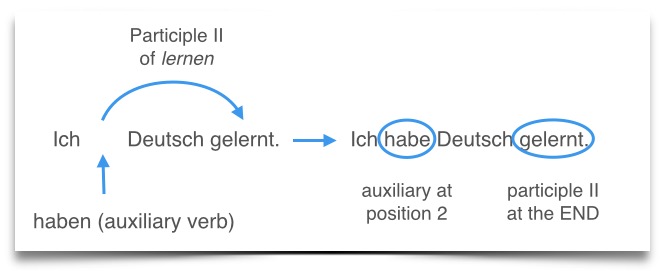
This structure is the most important concept of today's lesson. Let's explore it further with a clear explanation.
Demystifying the Present Perfect Tense in German
This article from Olesen Tuition gives a fantastic, concise overview of how to form the Perfekt tense and, crucially, when to use haben.
Please read the sections How to Form the Perfekt Tense and Haben or Sein?. Pay close attention to the "Key Rule" about word order and the list of conditions for using haben.
When to Use haben
As the article explained, you use haben as the auxiliary verb for:
- The vast majority of verbs.
- Transitive verbs: These are verbs that take a direct object in the accusative case. If you can ask "What?" or "Whom?" after the verb, it's likely transitive. For example,
Ich habe einen Film gesehen.(I saw what? A film.) - Verbs describing an action or state without movement from one place to another.
A good rule of thumb is: When in doubt, it's probably haben. We'll cover the specific verbs that use sein in our next lesson.
Building Sentences with haben
Let's see this in action. We'll take present tense sentences and convert them to the Perfekt. Notice how the main verb in the present tense becomes a Partizip II at the end, and haben takes its place.
1. With a regular (weak) verb:
- Präsens: Ich spiele ein Videospiel. (I play a video game.)
- Perfekt: Ich habe ein Videospiel gespielt. (I played a video game.)
2. With an irregular (strong) verb:
- Präsens: Ich lese ein Buch. (I read a book.)
- Perfekt: Ich habe ein Buch gelesen. (I read a book.)
3. With a separable prefix verb:
- Präsens: Ich rufe meinen Freund an. (I call my friend.)
- Perfekt: Ich habe meinen Freund angerufen. (I called my friend.)
4. With a verb ending in -ieren:
- Präsens: Du studierst Zahnmedizin. (You study dentistry.)
- Perfekt: Du hast Zahnmedizin studiert. (You studied dentistry.)
Asking Questions in the Perfekt
The sentence structure rules you already know still apply!
W-Fragen (W-Questions): The auxiliary verb haben comes right after the question word, in position 2.
- Was hast du gestern gemacht? (What did you do yesterday?)
- Wo hat er das gekauft? (Where did he buy that?)
Ja/Nein-Fragen (Yes/No Questions): The auxiliary verb haben moves to the first position.
- Hast du das neue Spiel gespielt? (Did you play the new game?)
- Haben Sie das Video schon editiert? (Have you already edited the video?)
Let's watch a video that demonstrates these sentence structures, including questions and sentences with separable verbs.
Perfect tense in German | Perfekt | Partizip II | Learn German Grammar | A1-A2
This video from the "Learn German" channel provides many clear examples of forming sentences with haben.
Watch the following segments: From the analysis of the sentences, notice the breakdown of position 2 for the auxiliary and the final position for the participle. Then, watch the section on questions to see how W-Fragen and Ja/Nein-Fragen are formed. Next, see how it works with a separable verb. Finally, listen to the key confirmation at "most of the verbs use haben", which reinforces our focus today.
Let's Practice
Now it's your turn to build some sentences. Transform the following present tense sentences into the Perfekt tense. Remember to conjugate haben correctly and use the Partizip II you learned in the last lesson.
- Ich mache meine Hausaufgaben.
-> Ich _____ meine Hausaufgaben __________. - Du hörst Musik.
-> Du _____ Musik __________. - Er kauft ein neues Mikrofon.
-> Er _____ ein neues Mikrofon __________. - Wir sehen einen Vlog.
-> Wir _____ einen Vlog __________. - Ihr editiert das Video.
-> Ihr _____ das Video __________. - Sie schreiben eine E-Mail.
-> Sie _____ eine E-Mail __________.
Solutions:
- Ich habe meine Hausaufgaben gemacht.
- Du hast Musik gehört.
- Er hat ein neues Mikrofon gekauft.
- Wir haben einen Vlog gesehen.
- Ihr habt das Video editiert.
- Sie haben eine E-Mail geschrieben.
Sehr gut!
Conclusion
You have successfully made the leap from knowing the parts to building the whole machine. You can now form complete, correct sentences about the past using the most common structure in the German language.
Key Takeaways:
- The Perfekt tense is used for speaking about the past and is formed with an auxiliary verb (
habenorsein) and a Partizip II. - The vast majority of German verbs use haben as their auxiliary.
- In a standard sentence, the conjugated form of
habenis in position 2, and the Partizip II is at the very end. - This sentence structure (
Satzklammer) remains consistent in questions, withhabenmoving to position 1 in Yes/No questions.
In our next lesson, we will complete your understanding of the Perfekt tense by exploring the other auxiliary verb: sein. You'll learn which specific verbs use sein (mostly related to motion and change of state) and how to form sentences with them.