Welcome to the final lesson of your A1 course! This is a truly significant moment. You began this journey with the German alphabet and have now successfully navigated through expressing past events, making future plans, and even holding a short introductory conversation. In our last session, you brought all these skills together, which proves you've built a strong and versatile foundation.
Today's lesson is about looking forward. Having completed A1 is like finishing the construction of a solid ground floor; now, we need to draw the blueprints for the next level. The goal of this session is to identify the best resources and formulate a personalized, effective study plan for your transition to the A2 level. This strategic planning is crucial for maintaining momentum and ensuring you continue to progress efficiently toward your ultimate goal of C1.
Let's build your roadmap to A2.
Understanding the A1-A2 Transition
First, it's important to understand what the leap from A1 to A2 entails. It's more than just learning new vocabulary and grammar rules. At A1, your learning was highly structured. You learned to build sentences with specific blocks. At A2, you'll begin to use those blocks more creatively and spontaneously. You'll move from describing concrete, immediate needs to discussing past events, future plans, and personal opinions with more nuance.
This transition can sometimes feel challenging. Many learners experience what's known as the "A1 plateau," where progress seems to slow down. This is a completely normal part of the language learning journey. To understand why this happens and how to prepare for it, I'd like you to read a short article from Olesen Tuition.
Stuck at A1 German? How to Get from A1 to A2 and Break the ...
This article does an excellent job of explaining the common hurdles learners face when moving from A1 to A2 and sets the stage for overcoming them.
First, read the introduction to understand that this plateau is a normal and surmountable challenge. Next, read the section "Why Do Learners Plateau at A1?". As you read, reflect on which of these points—vocabulary gaps, grammar uncertainty, fear of speaking, or passive learning habits—might be areas you'll want to focus on.
Recognizing these potential challenges in advance allows us to build a study plan that addresses them directly, ensuring you don't lose momentum.
What Awaits You at A2?
Before we plan the "how," let's look at the "what." The A2 level introduces some fascinating and powerful new tools for expressing yourself. You'll start connecting ideas in more complex ways and narrating stories with greater detail.
Here is a typical curriculum for an A2 course. It gives you a clear snapshot of the exciting grammar and vocabulary themes ahead.

As you can see, you'll be tackling topics like indirect questions (so you can say "He asked me where the station is"), relative clauses ("The man who is standing there..."), and the simple past tense. Mastering these will significantly increase your ability to understand and engage in more complex conversations, both in your future university life and social settings.
This is just one step on your journey. Remember your goal is C1. The Common European Framework of Reference for Languages (CEFR) provides a clear path.
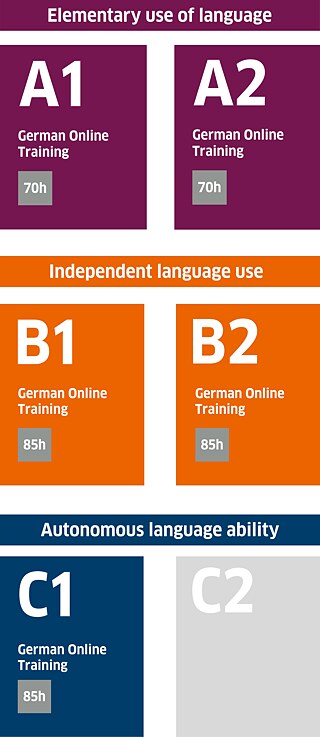
You've completed the A1 block, and now you're embarking on A2. With your dedicated study schedule of 3-5 hours a day, the 70-85 hours suggested here are well within your reach over the next few weeks.
Crafting Your Personalized A2 Study Plan
Now for the main event: building your study plan. A good plan will act as your compass, guiding your daily efforts. We'll use the SMART framework (Specific, Measurable, Achievable, Relevant, Timely) to make your goal concrete.
The article "Learn GERMAN from Beginner to Fluent" provides an excellent foundation for this.
Learn GERMAN from Beginner to Fluent (Step-by- ...
This guide by Herr Antrim breaks down the goal-setting process into manageable steps, which we will adapt for your A2 plan.
Please read the section on Goal Setting. Focus on the concepts of a "pie-in-the-sky" goal, and then how to break it down using SMART Goals and Checkpoint Goals.
Your "pie-in-the-sky" goal is clear: Goethe C1 within a year.
Our "Checkpoint Goal" is now mastering the A2 level.
Let's formulate a SMART goal for this checkpoint:
- S (Specific): I will learn all A2 grammar and vocabulary topics, focusing on relative clauses, past tenses, and conjunctions.
- M (Measurable): I will complete the A2 course on Nico's Weg and pass the end-of-level test. I will also read two A2-level graded readers.
- A (Achievable): By studying 3 hours per day, I can complete the estimated 70-85 hours of study in about 4-5 weeks.
- R (Relevant): Mastering A2 is the essential next step towards my C1 goal for studying in Germany.
- T (Timely): I will complete this A2 checkpoint within the next 5 weeks.
With this goal in place, let's select your resources and design a daily schedule.
Your A2 Resource Stack
A balanced approach requires a mix of resources. Based on recommendations from multiple expert sources and your interests, here is a powerful (and mostly free) A2 resource stack:
-
Core Curriculum: Nico's Weg (from Deutsche Welle)
- This interactive video-based course is consistently recommended as the gold standard for self-learners. It will take you from A1 all the way to B1, providing structure, exercises, and context. This will be the backbone of your studies.
-
Vocabulary: Anki + Goethe Word List
- As recommended in the "Easy Breezy German" video (LINK), find the shared Anki deck for the Goethe-Institut's A2 word list. Spaced repetition is a scientifically-backed, efficient way to memorize vocabulary. Aim for 15-20 new words daily.
-
Reading: Graded Readers
- To build reading fluency, start with books written specifically for A2 learners. The author Angelika Bohn is highly recommended in the "German with Antrim" guide (LINK). A great starting point would be Immer Wieder Sascha or Nie Wieder Merle.
-
Grammar Practice: Grammatik Aktiv
-
Listening/Immersion: Easy German & Others
Your Daily Study Block (Example for a 2-hour session)
You can scale this up or down depending on your daily schedule. The key is to touch on different skills each day.
-
Review (15 mins):
- Start with your Anki deck. Review yesterday's words and any difficult cards.
- Quickly review the grammar point from the previous day's Nico's Weg lesson.
-
Core Lesson (45 mins):
- Work through one lesson of Nico's Weg. Watch the video, do the interactive exercises, and take brief notes on new grammar or key phrases.
-
Active Practice (45 mins):
- Writing (Your AI-Tutor): This is where your interest in AI comes in. Use the ChatGPT method described by Herr Antrim (LINK). Pick a prompt (e.g., "Describe what you did yesterday"). Write your text, then ask ChatGPT to correct it and explain the corrections. Then ask it to improve the text to a B1 level, again explaining the changes. This is like having a personal writing tutor.
- Speaking: Practice shadowing. Re-watch the Nico's Weg video or a short clip from Easy German, and repeat the sentences aloud, trying to mimic the pronunciation and intonation. This trains your mouth and your ear simultaneously.
-
Extensive Exposure (15 mins):
- End your session with something enjoyable. Read a few pages of your A2 graded reader or watch an Easy German video. The goal here is not to understand every word, but to get used to the flow of the language.
Conclusion
Congratulations on completing the entire A1 course! Today, you have done something just as important as learning a new grammar rule: you have created a strategic plan for success. You are no longer just a beginner; you are a learner with a clear path forward.
Key Takeaways:
- The transition to A2 is about moving from structured production to more spontaneous communication.
- A SMART goal provides a clear, motivating target for the next stage of your learning.
- A balanced study plan incorporates a core curriculum (
Nico's Weg), active practice in all four skills, and extensive, enjoyable exposure to the language. - Leverage modern tools: use Anki for vocabulary and the ChatGPT method for writing to create a highly efficient and personalized learning loop.
This is the final lesson of this course module. You have all the tools and a solid plan. The next logical step is to begin your A2 journey. Your first A2 lesson will dive straight into one of the most practical topics: prepositions of direction and time, essential for navigating a German city and scheduling your life as a student.
Well done, and viel Erfolg (much success) with your A2 studies