Hello! Welcome to a new module focused on health and well-being. In the previous lessons, you mastered the skills needed to describe your personal environment, culminating in a written description of your room. We are now going to shift our focus from the world around you to describing the self, starting with the human body.
Today's lesson is designed to equip you with the vocabulary to name major parts of the body, a fundamental skill for discussing health. Given your background as a dental student, we will then take a deeper dive into basic dental vocabulary. This will not only be useful for everyday situations in Germany or Austria but will also provide you with the initial linguistic tools for your specific field of study.
1. The Body from Head to Toe: Die Körperteile
Let's begin with a general overview of the body's main parts. A great way to learn new vocabulary is to see and hear it simultaneously. The following video from the "Learn German with Anja" channel provides an energetic and clear introduction.
GERMAN LESSON 47: BODY PARTY IN GERMAN - DIE KÖRPERTEILE 💃💃💃
Anja is a popular German teacher on YouTube, known for her engaging style. This video introduces the core vocabulary for body parts with correct pronunciation and plural forms.
Please watch the main teaching portion of the video, from the introduction of "der Kopf" to "der Fuß". As you watch, repeat the words aloud after Anja to practice your pronunciation. Pay close attention to the article (der, die, or das) she uses for each noun.
Now that you have an auditory impression of the words, let's review and organize them with some helpful diagrams. As you'll remember from previous lessons, learning a noun in German always means learning its gender (the article) and its plural form.
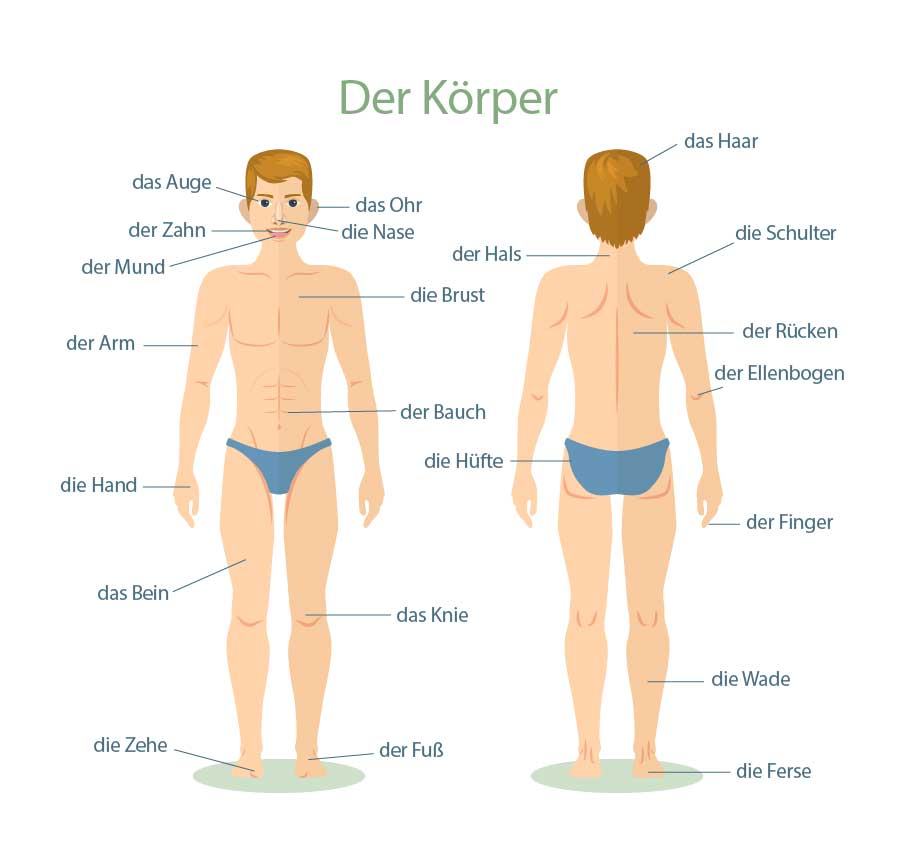
This diagram shows the main parts of the human body from the front and back, clearly labeled with their German names and articles.

This chart provides more detailed vocabulary for the head, hand, and leg, including compound nouns like 'Ohrläppchen' (earlobe) and 'Handgelenk' (wrist).
Take a moment to study these images. Notice how German often creates specific terms by combining simpler words. For example, Hand (hand) + Gelenk (joint) becomes das Handgelenk (the wrist).
To solidify your knowledge of both the gender and plural forms, the following resource is excellent.
Body parts in German – a beginner’s guide with pronunciation, plurals, and phrases
This article from Preply provides a structured list of body parts and a clear explanation of how they are pluralized.
First, review the vocabulary lists under the headings "Head and face" through "Leg and foot". Cross-reference these with the diagrams above. Next, it is crucial to learn the plural forms. Please read the section "How to pluralize body parts in German". Pay close attention to the examples, such as der Fuß becoming die Füße, which involves both an article change and an umlaut.
2. A Closer Look: Dental Vocabulary
We will now transition from general anatomy to an area of your expertise: dentistry. Your task here is to map your existing professional knowledge onto the German linguistic framework. You will likely find the logical, compound nature of German medical terms quite systematic.
This next video is a fantastic visual dictionary for dental-related terms, covering everything from basic anatomy to instruments and procedures.
Deutsch lernen: Zähne, Zahnarzt, Zahnpflege / learning German: the dentist, teeth, dental care
This video from the "Andrea Thionville" channel is specifically designed for German learners and uses clear images and text overlays to teach vocabulary related to dentistry.
Watch the entire video from start to finish. Since this is directly related to your field, you will recognize all the concepts. Focus on connecting the German terms to the images. Don't worry about memorizing every word on the first pass; the goal is to get a comprehensive overview.
The video introduced a wealth of vocabulary. To help you organize and review these terms, we'll turn to a detailed guide. The following article breaks down dental vocabulary into logical categories, which will be helpful for structured learning.
Dental terms in German – complete vocabulary guide
This Preply article serves as an excellent reference, categorizing essential dental vocabulary.
Please read through the following sections to consolidate what you learned from the video: Teeth and mouth anatomy: This covers the fundamental terms like der Zahn (tooth) and das Zahnfleisch (gum). Dental professionals and clinic items: Here you'll find terms like der Zahnarzt (dentist) and der Bohrer (drill). Common problems and diagnoses: This section includes clinically relevant terms such as die Karies (tooth decay) and die Zahnfleischentzündung (gum inflammation). Procedures and treatments: This lists common procedures you'll be familiar with, like die Füllung (filling) and die Wurzelkanalbehandlung (root canal treatment). Materials, medicines, and after-care products: Vocabulary for materials (Keramik, Komposit) and daily care (die Zahnseide). As you read, note the structure of words like Zahnwurzelentzündung (Zahn + Wurzel + Entzündung), which literally translates to "tooth root inflammation." Recognizing these patterns will greatly accelerate your ability to understand and remember complex technical terms. 3. Practice Your New Vocabulary Both of the articles we used contain short exercises to test your knowledge. Completing them is an excellent way to check your retention.
3. Practice Your New Vocabulary
Both of the articles we used contain short exercises to test your knowledge. Completing them is an excellent way to check your retention.
Body parts in German – a beginner’s guide with pronunciation, plurals, and phrases
This is the article on general body parts we looked at earlier.
Scroll down to the section "Practice body parts in German with exercises" and complete the "Matching exercise" and "Fill-in-the-blank exercise". You can check your work with the answers provided just below.
Dental terms in German – complete vocabulary guide
This is the guide on dental vocabulary.
Find the section "Practice dental German with exercises". Try the "Multiple-choice" and "Fill-in-the-blank" questions. The answers are at the end of the article for you to review.
Conclusion
Well done. In this lesson, you have acquired a foundational vocabulary for describing the human body and have taken the first steps in learning professional German relevant to your career in dentistry. This dual focus prepares you for both everyday conversations about health and future academic or clinical settings.
Key Takeaways:
- You can now name major parts of the body in German, from
der Kopftoder Fuß. - You have learned essential dental vocabulary, including terms for anatomy (
der Zahn), problems (die Karies), and procedures (die Füllung). - It is crucial to learn every noun with its grammatical gender (
der,die,das) and its plural form. - German medical and anatomical terms are often logical compound nouns, which can be broken down to understand their meaning.
In our next lesson, you will learn how to put this new vocabulary into action. We will focus on how to state simple health complaints, such as "My tooth hurts," using the verb wehtun and the dative case. See you then