Hallo!
In our last session, we built a crucial skill: conjugating regular German verbs. You learned the systematic formula for taking an infinitive like lernen, finding its stem lern-, and adding the correct endings for each pronoun. Now that you can create the right verb forms, it's time to learn where to place them.
This lesson focuses on what is arguably the single most important rule in German sentence structure: the verb-second (V2) rule. Mastering this concept will allow you to move beyond single words and start building correct, coherent sentences. By the end of this lesson, you will be able to apply this rule to form your own simple declarative sentences (statements) in German.
The Basic Sentence: Subject-Verb-Object
Let's begin with a structure that will feel familiar. In many simple German sentences, the word order is the same as in English: Subject - Verb - Object (SVO). The subject performs the action, the verb is the action, and the object receives the action.
Take a look at this simple example:
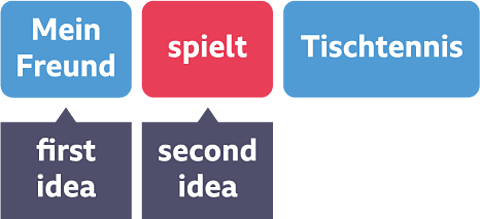
Here, the structure is straightforward:
- Subject:
Mein Freund(My friend) - Verb:
spielt(plays) - Rest of sentence:
Tischtennis(table tennis)
This SVO pattern is a perfectly valid and common way to build a sentence in German. However, it's only half the story.
The Golden Rule: The Verb is Always Second
The true principle governing German main clauses isn't SVO, but something more fundamental called the Verb-Zweit-Stellung, or V2 rule. It states that in a declarative sentence, the conjugated verb must always be in the second position.
This might sound the same as what we just saw, but there's a critical difference. The "positions" don't refer to individual words, but to sentence elements or ideas. The first element can be a single word, like ich, or it can be a whole phrase.
The team at "Easy German" has an excellent video that introduces this as the most important rule of German sentence structure.
German Sentence Structure Explained in 10 Minutes | Easy German 284
This video explains the V2 rule using natural, conversational examples and highlights why it's the one rule you can't break.
First, watch the introduction from the beginning. The presenter explains that the verb is fixed in the second position, while other parts of the sentence can be moved to change the emphasis. Then, skip forward and watch the segment from this point, where he clarifies that "second position" means the second sentence element (Satzglied), not necessarily the second word.
As the video explains, while the verb is locked in place, the other sentence elements have a certain flexibility. This brings us to a key feature of German grammar.
Changing Emphasis: Inverting the Sentence
What if you want to emphasize a different part of the sentence, like when something happens? In English, you might say, "Today, I am going to the cinema." Notice how the subject "I" still comes before the verb "am going".
In German, if you move an element like "today" (heute) to the first position, the verb must stay in the second position. This forces the subject to move to the third position, right after the verb. This is called inversion.
Standard Order (SVO):
Ichlerneheute Deutsch.(I am learning German today.)- Position 1:
Ich(Subject) - Position 2:
lerne(Verb)
- Position 1:
Inverted Order (for emphasis):
Heutelerneich Deutsch.(Today, I am learning German.)- Position 1:
Heute(Time element) - Position 2:
lerne(Verb) - Position 3:
ich(Subject)
- Position 1:
This inverted structure is extremely common in German. The image below shows it perfectly.

To solidify your understanding of sentence "slots" and see more examples, the Duolingo blog provides a very clear explanation.
What Are the Rules for German Sentence Structure?
This article breaks down the concept of sentence "slots" and shows how the V2 rule works with different elements in the first position.
Start at the beginning and read the section How to form German sentences with one verb. Pay close attention to the list of phrases that can occupy the first slot and the examples in the table.
Practice Time
Let's put this into practice. Remember the rule: the verb must be the second element.
Activity 1: Choose the correct sentence.
-
Which sentence correctly means "I am playing a video game now"?
a)Jetzt ich spiele ein Videospiel.
b)Jetzt spiele ich ein Videospiel. -
Which sentence correctly means "The student is learning German in the university"?
a)In der Universität lernt der Student Deutsch.
b)In der Universität der Student lernt Deutsch.
(Answers: 1-b, 2-a)
Activity 2: Reorder the words.
Now, try to build a correct German sentence from these scrambled words. There might be more than one correct answer depending on what you want to emphasize, but make sure the verb is always in the second position!
Deutsch / lerne / ichin Berlin / wohnt / erdu / heute / machst / was(Hint:wasis the question word and always goes first here)
Possible Answers:
Ich lerne Deutsch.Er wohnt in Berlin.ORIn Berlin wohnt er.Was machst du heute?(Here, the question wordWastakes the first position, the verbmachstis second, and the subjectduis third. This pattern also follows the V2 rule.)
For more practice, the Preply article "German Word Order" has some excellent exercises.
German word order explained: Rules and practical examples
This article includes exercises to test your understanding of the V2 rule.
Scroll down to the section Practice German word order. Try the "Sentence reordering" exercises. You can check your work with the answers provided just below.
Conclusion
You have just learned the foundational rule for building sentences in German. It's a concept that you will use constantly as you progress from beginner to advanced levels.
Let's summarize the key takeaways:
- The V2 Rule: In a German main clause (a simple statement), the conjugated verb is always the second element.
- Standard Word Order (SVO): When the subject is the first element, the word order is Subject-Verb-..., similar to English.
- Example:
Ich spiele gern Videospiele.(I like to play video games.)
- Example:
- Inverted Word Order: When another element (like time or place) is moved to the first position for emphasis, the verb stays in the second position and the subject moves to the third.
- Example:
Am Abend spiele ich gern Videospiele.(In the evening, I like to play video games.)
- Example:
So far, we have focused on statements. But what about questions? In our next lesson, we will see how word order shifts to form simple yes/no questions. You'll discover that it's a small and logical change from the rule you've learned today.
Bis zum nächsten Mal! (Until next time!)