Hallo! In our last lesson, we built a calendar in our minds, filling it with the German days, months, and seasons. You learned the very useful rule that these are all masculine (der). Now that we can navigate the calendar, it's time to zoom in and learn how to navigate the clock.
Today's lesson focuses on a fundamental skill for daily life in Germany or Austria: telling time. Whether you need to catch a train, find out when a university lecture starts, or arrange to meet a friend, you'll need to understand and state the time. We will cover both the formal 24-hour system, which you'll see on official schedules, and the informal system used in everyday conversation. By the end of this lesson, you'll be able to ask for and tell the time like a local.
1. Asking for the Time
Before you can tell the time, you need to know how to ask for it. There are two very common ways to do this in German. Both are used universally and mean "What time is it?".
- Wie viel Uhr ist es? (Literally: How much clock is it?)
- Wie spät ist es? (Literally: How late is it?)
The standard response to either question begins with Es ist... ("It is...").
Let's start by familiarizing ourselves with these phrases. The article from "Your Daily German" provides a good introduction.
Talking about Time in German – Time of Day
This article explains the most common ways to ask for the time with a bit of humor.
Please read the first section, "How to ask for time in German". Pay attention to the two main questions and the polite, indirect way of asking.
2. The Formal Time (Die offizielle Uhrzeit)
In Germany and Austria, all official schedules—for trains, university courses, TV programs, and business appointments—use the 24-hour clock. This is often called "military time" in English, but in German, it's simply the offizielle Uhrzeit (official time). Mastering this system is essential for navigating student life.
The system is very straightforward. The basic structure is:
Es ist + [hour] + Uhr + [minutes].
Let's break it down.
Full Hours
For the full hour, you simply say the number followed by Uhr.
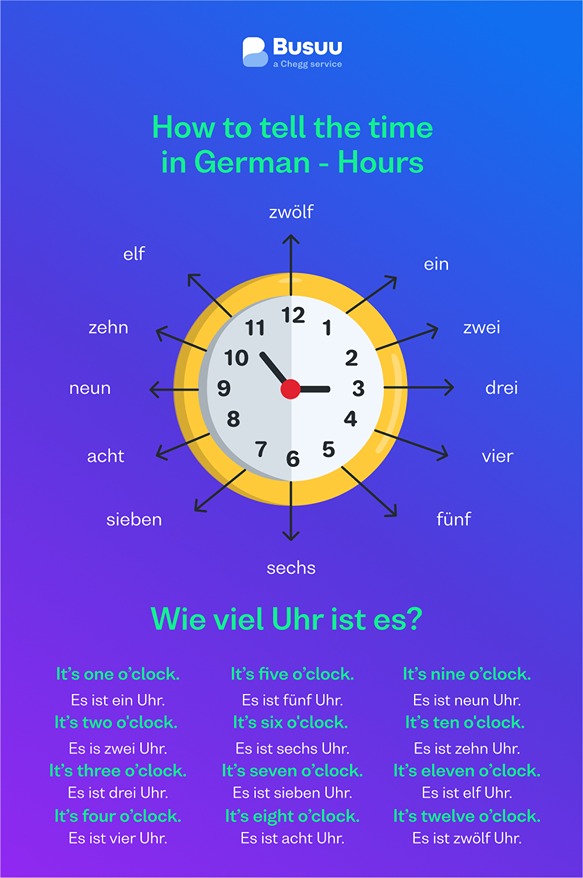
For example:
- Es ist neun Uhr. (It's 9:00.)
- Es ist vierzehn Uhr. (It's 14:00 / 2 PM.)
- Es ist zwanzig Uhr. (It's 20:00 / 8 PM.)
A small but important detail concerns one o'clock. When you use the word Uhr, you say ein, not eins.
- Es ist ein Uhr. (It's one o'clock.)
- If you just say the number, it's Es ist eins. (It's one.)
The video from "Dein Sprachcoach" explains this specific point well.
⏰Lerne die UHRZEIT auf Deutsch | Learn German | Deutsch lernen
This short clip highlights the special rule for saying "one o'clock".
Watch the section from "13 Uhr ist übrigens eine besondere Uhrzeit" to understand the difference between ein Uhr and eins.
Hours and Minutes
When minutes are involved, you just add them after the word Uhr.
- 15:25 → Es ist fünfzehn Uhr fünfundzwanzig.
- 08:10 → Es ist acht Uhr zehn.
- 22:50 → Es ist zweiundzwanzig Uhr fünfzig.
The "Your Daily German" article calls this "news speak." Let's read the section that explains it.
Talking about Time in German – Time of Day
This section explains the formal 24-hour system in detail.
Read the section titled "German Time in 'news speak' (formal)". Notice how Uhr replaces the colon (:) in written time.
3. The Informal Time (Die inoffizielle Uhrzeit)
While the formal time is essential for official purposes, you will almost always use the informal time when talking to friends, family, and colleagues. This system uses a 12-hour clock and is a bit more complex, but it's what makes you sound like a native speaker.
This infographic gives a fantastic overview of the entire system. We will refer back to it as we break down the different components.
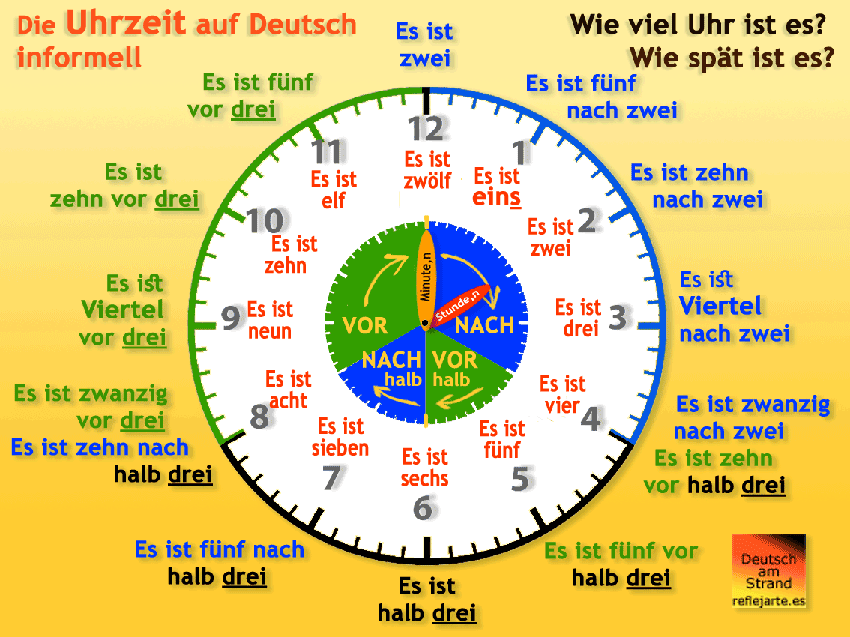
nach (after) and vor (before)
For the first half of the hour (minutes 1-29), you use nach (after). The structure is:
Es ist + [minutes] + nach + [hour].
- 10:05 → Es ist fünf nach zehn.
- 02:20 → Es ist zwanzig nach zwei.
For the second half of the hour (minutes 31-59), you use vor (before) and refer to the next hour. The structure is:
Es ist + [minutes] + vor + [next hour].
- 03:50 → Es ist zehn vor vier. (ten minutes to four)
- 07:40 → Es ist zwanzig vor acht. (twenty minutes to eight)
Viertel (quarter)
For 15 minutes past the hour, you use Viertel nach.
- 06:15 → Es ist Viertel nach sechs.
For 15 minutes before the hour, you use Viertel vor.
- 08:45 → Es ist Viertel vor neun.
You don't say fünfzehn (fifteen) in this context; you just use Viertel.
The Tricky halb (half)
This is the most common point of confusion for learners, so pay close attention. In German, halb does not mean "half past." It means "halfway to the next hour."
So, Es ist halb neun (It's half nine) means it is 8:30, not 9:30. You are halfway to 9 o'clock.
- 02:30 → Es ist halb drei. (halfway to three)
- 11:30 → Es ist halb zwölf. (halfway to twelve)
Let's watch a short video clip that offers a helpful way to remember this.
This "Five Minute German" video gives a great tip for understanding halb.
Watch the section from "let's take one last case". The presenter suggests thinking of halb as "halfway to," which is a perfect mental model.
Putting It All Together
What about times around the half-hour mark, like 10:25 or 10:35? Here, you use the half-hour as your reference point. Look at the bottom part of the clock infographic (LINK).
- 10:25 → Es ist fünf vor halb elf. (five minutes before half past ten)
- 10:35 → Es ist fünf nach halb elf. (five minutes after half past ten)
This might seem complicated, but it's very logical once you get used to it. The article from "Your Daily German" covers this informal "street speak" in great detail.
Talking about Time in German – Time of Day
This reading breaks down the informal system, including the difficult concept of halb and the use of Viertel.
Please read the sections "German Time in 'street speak'" and "How to use 'viertel' for time". The author's explanation of the logic behind halb is particularly helpful.
A quick note on regionalisms: In southern Germany and Austria, you might hear dreiviertel (three-quarters) for the 45-minute mark. For example, dreiviertel neun means 8:45. It's good to recognize this, but for now, stick with the standard Viertel vor neun, which is understood everywhere.
4. Summary & Practice
Let's consolidate the two systems with a comparison.
| Time | Formal (Offiziell) | Informal (Inoffiziell) |
|---|---|---|
| 14:00 | Vierzehn Uhr | Zwei (Uhr) |
| 09:15 | Neun Uhr fünfzehn | Viertel nach neun |
| 18:30 | Achtzehn Uhr dreißig | Halb sieben |
| 20:40 | Zwanzig Uhr vierzig | Zwanzig vor neun |
| 12:55 | Zwölf Uhr fünfundfünfzig | Fünf vor eins |
Now, try to convert these times yourself. Write both the formal and informal versions.
- 07:20
- 15:45
- 21:30
- 11:50
Answers
- Formal: Sieben Uhr zwanzig. / Informal: Zwanzig nach sieben.
- Formal: Fünfzehn Uhr fünfundvierzig. / Informal: Viertel vor vier.
- Formal: Einundzwanzig Uhr dreißig. / Informal: Halb zehn.
- Formal: Elf Uhr fünfzig. / Informal: Zehn vor zwölf.
Conclusion
Great work today! This was a dense but incredibly important lesson. You now have the tools to understand and communicate time in any situation you might encounter as a student in a German-speaking country.
Key Takeaways:
- You can ask for the time with "Wie viel Uhr ist es?" or "Wie spät ist es?".
- Formal time uses the 24-hour clock and the structure
Stunde + Uhr + Minuten. It is used for schedules and official appointments. - Informal time uses the 12-hour clock with key prepositions: nach (past), vor (to), Viertel (quarter), and halb (halfway to the next hour). This is for everyday conversation.
- The golden rule:
halbalways looks forward to the next hour!Halb dreiis 2:30.
In our next lesson, we will build directly on this knowledge. You'll learn how to use temporal prepositions like am, im, and um to state when events happen (e.g., "The lecture is at 10:15," "I study on Monday"). Bis dann