Welcome to your first German lesson! Your journey towards fluency and studying in Germany or Austria begins here, with the very foundation of the language: its sounds. This lesson is designed to help you pronounce the German alphabet, including its unique characters and common sound combinations. Mastering pronunciation from the outset is a crucial step that will make speaking, listening, and learning new vocabulary much easier as you progress.
We will start by going through the 26 letters of the alphabet, paying close attention to those that sound different from their English counterparts. Then, we'll tackle the special German characters—ä, ö, ü, and ß—and learn how to produce their specific sounds. Finally, we'll explore some of the most important letter combinations, such as ch, sch, and st, which are key to sounding natural in German.
Let's begin building your Aussprache (pronunciation).
The German Alphabet: Das deutsche Alphabet
The German alphabet uses the same 26 Latin letters as English, which is a great starting point. Many letters are pronounced identically or very similarly. However, several have distinct sounds that are important to master early on.
To get a complete overview and hear each letter pronounced by a native speaker, please watch the first part of the following video. The instructor will go through the entire alphabet. Try to repeat each letter's name after him.
Learn the German Alphabet together with detailed pronunciation.
This video from the "YourGermanTeacher" channel provides a clear and systematic presentation of the German alphabet.
Please watch the section from the beginning, where the presenter introduces each letter from A to Z. Listen carefully and repeat each letter aloud.
As you heard, many letters like B, D, F, K, L, M, N, P, and T are very familiar. The main differences lie with some of the vowels and a few key consonants.
Let's focus on the trickiest ones:
- C (tseh): Before 'e' and 'i', it's often pronounced like /ts/ (similar to 'z'). In other cases, especially in words borrowed from other languages, it can sound like /k/ (Chor) or even /s/ (Celsius).
- G (geh): At the beginning of a word, it's a "hard" G, as in "go" (gut). At the end of a word, its sound often softens.
- J (yot): This is one of the most common points of confusion for English speakers. The German 'J' is always pronounced like the English 'Y' in "yes". So, the word ja (yes) sounds like "yah".
- R (err): The German 'R' is typically pronounced in the back of the throat, a bit like a soft gargle. It's not rolled with the tip of the tongue as in Spanish. When it appears at the end of a syllable, it often sounds more like a short "ah" vowel. This is a sound that takes practice!
- V (fau): In most native German words, the 'V' is pronounced like an English 'F'. For example, Vater (father) sounds like "Fah-ter".
- W (veh): The German 'W' is pronounced like an English 'V'. The word Wasser (water) sounds like "Vah-sser".
- Z (tsett): The German 'Z' has a sharp sound, like /ts/ in the English word "cats". You will encounter this sound in a word relevant to your field: Zahn, which means "tooth".
For a quick reference, here is a complete chart of the German alphabet. You can use it to review the letters and their basic sounds.
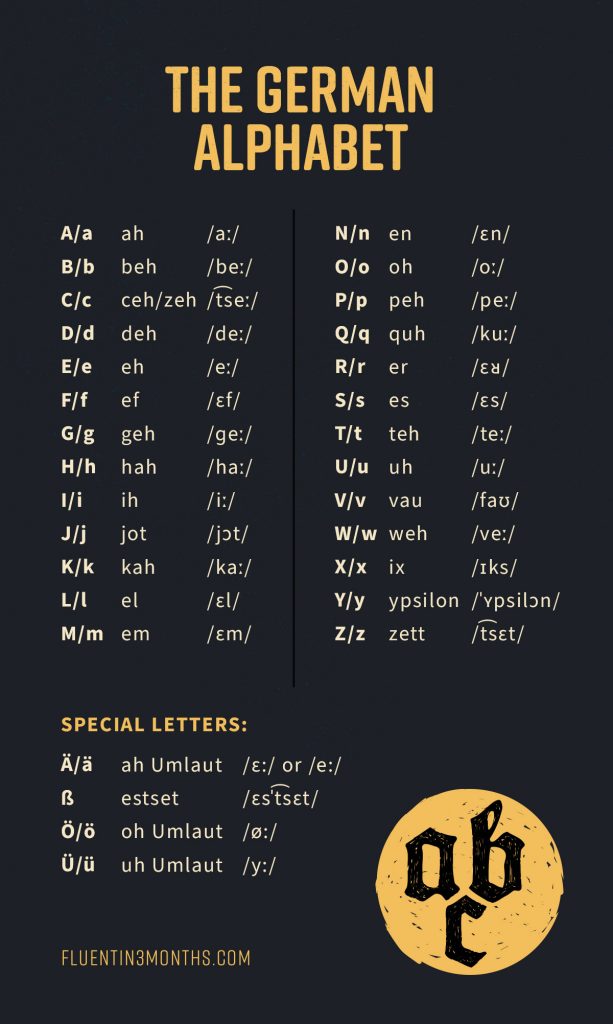
Special Characters: Umlaute and Eszett
Beyond the standard alphabet, German has four special characters that you will see everywhere.
-
The Umlaute: Ä/ä, Ö/ö, Ü/ü
The two dots over these vowels are called an Umlaut. An Umlaut changes the pronunciation of the vowel, typically by "fronting" the sound in your mouth. Getting these right is essential, as they can change the meaning of a word entirely (e.g., schon - already vs. schön - beautiful). -
The Eszett (or scharfes S): ß
This character simply represents a sharp, voiceless "s" sound, like in "miss". It never appears at the beginning of a word. In modern German orthography, it is often replaced by a double 's' (ss), and if you're typing on a keyboard without the 'ß' key, you can always type 'ss' instead.
The following resource provides excellent explanations and, most importantly, audio clips for you to hear and practice these unique sounds.
German sounds, symbols and pronunciation | Learn German
This guide from The German Project offers clear, memorable descriptions and audio examples for the special characters.
First, read the section on the 'ß' sound. Find the heading 'That ß sound' and listen to the audio examples for Straße and heißen. Next, scroll down to the heading 'Umlauts'. Read the descriptions and listen carefully to the audio for ä, ö, and ü. Try to imitate the sounds. For ä, think of the 'e' in "get". For ö, start with the German 'e' sound, then round your lips as if you were going to say 'o'. For ü, start with a long 'ee' sound (like in "see"), and without moving your tongue, round your lips tightly as if you were about to whistle.
Key Sound Combinations
The final piece of the pronunciation puzzle is learning how certain letter combinations create specific, consistent sounds. Mastering these patterns will allow you to correctly pronounce a huge number of new words on sight.
The following video is an excellent guide to these combinations. We will watch it in segments, focusing on one rule at a time.
German Pronunciation for Beginners A1 | Aussprache Basics A1
This video from "YourGermanTeacher" is dedicated to the most important pronunciation rules for letter combinations in German.
First, let's look at the main vowel combinations, or diphthongs. Watch the section from the beginning of the main content. Focus on these three key patterns: ie is pronounced like a long 'ee' in "see". You'll find this in the word Kiefer, which means "jaw". ei is pronounced like the 'i' in "ice" or "my". eu and äu are both pronounced like the 'oy' in "boy". Next, let's tackle the famous ch sound. It has two main variations depending on the letters that come before it. Watch the explanation from this timestamp. After 'a', 'o', 'u', or 'au', it's a "hard" sound from the back of your throat (Ach-laut), as in Buch (book). After 'i', 'e', umlauts, or consonants, it's a "soft" sound from the front of your mouth (Ich-laut), almost like a hiss, as in ich (I) or Bücher (books). Now for a much simpler one: sch. Watch the brief explanation at this point. This combination is always pronounced like the 'sh' in "shoe". Finally, let's look at what happens when 's' is paired with 'p' or 't' at the beginning of a word or syllable. Watch the segment from this section. sp is pronounced as schp. Example: sprechen (to speak). st is pronounced as scht. Example: Straße (street).
Conclusion
Congratulations on completing your first step! Today, you have learned the fundamental sounds of German.
Here are the key takeaways:
- The German alphabet has several letters with pronunciations that differ from English, most notably J (/y/), V (/f/), W (/v/), and Z (/ts/).
- The special characters ä, ö, ü (Umlauts) represent distinct vowel sounds that require specific lip and tongue positions. The ß is simply a sharp 's' sound.
- Key letter combinations create predictable sounds: ie (/ee/), ei (/eye/), eu/äu (/oy/), sch (/sh/), and sp/st at the start of a word (/schp/, /scht/).
- The ch sound has two forms: a hard Ach-laut and a soft Ich-laut, depending on the preceding vowel.
Pronunciation is a physical skill that improves with practice. Don't worry if you don't get every sound perfect immediately. The goal is to build a solid foundation. As you continue learning, try to listen for these sounds in German music, films, or vlogs.
In our next lesson, we will put these new sounds into practice immediately by learning how to count from 0 to 100. This will be an excellent way to train your mouth and your ear. Bis bald! (See you soon!)