In our previous lesson, we focused on learning the specific present tense forms for the five key modal verbs. You now know how to conjugate verbs like können, müssen, and wollen. Today, we'll put that knowledge into action. The goal is to learn how to correctly construct sentences with these verbs, which is a fundamental skill for expressing yourself with more nuance in German.
You'll discover one of the most characteristic features of German sentence structure: the "verb bracket" or Satzklammer. This is the framework that allows you to combine a modal verb with another action. By the end of this lesson, you will be able to confidently form your own sentences to talk about abilities, obligations, and desires.
The Basic Structure: Two Verbs, One Sentence
When you use a modal verb, you're usually modifying another verb. For example, instead of just "I play" (Ich spiele), you want to say "I can play" (Ich kann spielen). In German, this involves a specific word order rule:
- The conjugated modal verb goes in the second position of the sentence. This is the same V2 rule you've already learned for simple sentences.
- The main verb (the action) goes to the very end of the sentence in its original, unconjugated form, the infinitive.
Let's look at a visual representation of this structure.
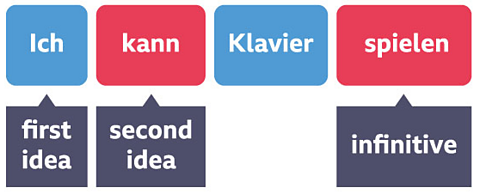
This "verb bracket" (Satzklammer in German) is a core concept. The two verbs act like bookends for the main information in the sentence.
The Rule in Action
Let's hear this rule explained and see a few more examples. The following video breaks down this sentence structure very clearly.
Learn German | German Grammar | Modalverben | Modal verbs | A1
This video from the "Learn German" channel is excellent because it focuses specifically on the position of modal verbs in a sentence, which is our main goal today.
Watch the segment from the rule explanation. Notice how in every example, the speaker points out that the modal verb is conjugated in the second position and the main verb is at the end in its infinitive form.
As you saw in the video, this pattern is consistent across all modal verbs.
Ich **muss** heute viel **lernen**.(I must learn a lot today.)Sie **will** nach Österreich **reisen**.(She wants to travel to Austria.)Wir **dürfen** im Hörsaal nicht **essen**.(We are not allowed to eat in the lecture hall.)
The "Verb Bracket" and Other Sentence Elements
The real power of German word order comes from its flexibility. While the conjugated verb holds the second position, the first position can be occupied by different elements, not just the subject. This is an important concept to master.
The following guide on German word order explains this flexibility and introduces the term Satzklammer (sentence bracket).
Mastering German Word Order: An Absolute Beginner's ...
This PDF guide offers a fantastic, in-depth explanation of German sentence structure. We'll focus on the sections that introduce the "verb bracket" and how it applies specifically to modal verbs.
Please read the following two sections: Start at the heading "Making Verb Sandwiches". This section introduces the concept of the Satzklammer or "sentence bracket," which is the grammatical term for the structure we're learning. Continue directly to the next section, "Modal Verbs and Infinitives". This part applies the Satzklammer concept directly to our topic today, showing how the modal verb and infinitive form the two parts of the bracket.
The key takeaway from this reading is that the modal verb and the infinitive "hug" the other parts of the sentence. You can move other elements around for emphasis, but the two verbs hold the structure together.
For example:
- Subject first:
Ich **kann** am Wochenende ein Videospiel **programmieren**.(I can program a video game on the weekend.) - Time first:
Am Wochenende **kann** ich ein Videospiel **programmieren**.(On the weekend, I can program a video game.)
Notice how kann stays in the second position, even when the subject ich moves.
Common Pitfalls and Final Polish
When learning this structure, there are a couple of common mistakes to avoid. The following video not only reinforces the word order rule but also points out an important detail about what not to do.
This video from the "mugridge language" channel provides a very clear summary of the word order rules and gives practical examples.
First, watch the explanation of the word order rules. Pay close attention to the third point: the infinitive verb at the end does not have zu ("to") before it. This is a key difference from English. Then, watch the examples for each modal verb to see the pattern in action one more time.
To summarize the two most common errors beginners make:
- Forgetting to move the main verb to the end.
- Incorrect:
Ich kann Deutsch sprechen. - Correct:
Ich kann Deutsch sprechen.
- Incorrect:
- Conjugating the main verb.
- Incorrect:
Er muss nach Hause geht. - Correct:
Er muss nach Hause gehen.
- Incorrect:
Remember: Only the modal verb gets conjugated. The second verb stays in its infinitive -en form at the very end.
Let's Practice
Now it's your turn to build some sentences. Try to form a correct German sentence from the following parts.
ich / wollen / ein Video / editierenman / können / mit KI / Sprachen lernendu / müssen / für die Prüfung / lernenwir / dürfen / im Labor / nicht essen
Take a moment to construct your answers before revealing the solutions below.
Solutions:
Ich will ein Video editieren.(I want to edit a video.)Man kann mit KI Sprachen lernen.(One can learn languages with AI.)Du musst für die Prüfung lernen.(You have to study for the exam.)Wir dürfen im Labor nicht essen.(We are not allowed to eat in the lab.)
Conclusion
Great job! You've learned one of the most important sentence structures in the German language. Mastering the Satzklammer with modal verbs is a significant step towards fluency and allows you to express a much richer set of ideas.
Key Takeaways:
- In a sentence with a modal verb, the conjugated modal verb takes the second position.
- The main verb goes to the very end of the sentence in its infinitive form.
- These two verbs form a "bracket" or
Satzklammeraround the other sentence elements. - The infinitive at the end does not use
zu.
In our next lesson, we'll take a closer look at a special verb that behaves like a modal: möchten (would like to). It's incredibly useful for making polite requests, which will be essential when you're ordering food, shopping, or interacting in daily life in Germany or Austria.