Hallo! In our previous lesson, we mastered the German dative personal pronouns like mir, dir, and ihm, learning how to replace the indirect object in a sentence. We saw a glimpse of this with verbs like helfen (to help). Today, we will build directly on that knowledge by exploring a special category of verbs that always demand a dative object.
In English, when you say "I help you," the word "you" is a direct object. However, German sees this differently. For a specific set of verbs, the object is considered the recipient or the one affected by the action, not directly acted upon. Therefore, it must be in the dative case. This lesson focuses on identifying and correctly using these common dative-only verbs. Mastering them is a significant step toward making your German sound natural and correct.
1. Why Some Verbs Only Take the Dative
Most of the time, the dative case marks the indirect object, the recipient of something, as in Ich gebe dem Mann das Buch ("I give the book to the man"). This is intuitive. However, some verbs don't have a direct (accusative) object at all; their only object is dative.
To understand the logic behind this, let's turn to an explanation from the Deutschwunder blog.
German Dative Verbs List: 25+ Verbs With Examples | Deutschwunder Blog | Deutschwunder
This article provides a concise explanation of why this category of verbs exists.
Please read the introductory part, starting from the beginning down to the section titled "Why Do Some German Verbs Take the Dative?". Focus on the distinction between verbs that take both dative and accusative objects (like geben) and verbs that take only a dative object (like helfen).
The key insight is that these verbs historically described actions directed toward someone, not upon them. While English has lost this distinction, German preserves it. There's no shortcut—the best way forward is to memorize the most common ones.
2. The Essential Dative Verbs
Let's start by getting acquainted with the most frequent dative verbs you'll encounter. The image below presents a nice collection of them. Many of these will become central to your daily conversations.
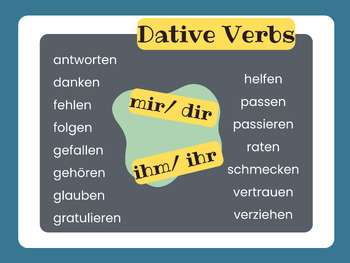
You've already seen helfen, danken, and gefallen. Now we'll expand this list. The following table from the same Deutschwunder article provides a more comprehensive list with examples. Don't feel pressured to memorize all of them at once. We'll focus on the most important ones.
German Dative Verbs List: 25+ Verbs With Examples | Deutschwunder Blog | Deutschwunder
This table is your core reference for the most common dative verbs.
Scan the table under the heading The Essential 25 Dative Verbs. For now, focus on recognizing these key verbs: helfen (to help) danken (to thank) gefallen (to please / to like) gehören (to belong to) glauben (to believe) antworten (to answer) schmecken (to taste good) passen (to fit / to suit) wehtun (to hurt) zuhören (to listen to)
3. Dative Verbs in Action
Now, let's see and hear some of these verbs used in context. Watching a native speaker use them helps solidify the grammar in your mind.
Verben Mit Dativ A1 | ALL 14 German Dative Verbs for A1 Level
The channel "YourGermanTeacher" offers very clear, bite-sized explanations for verbs at the A1 level. We'll watch a few clips to see our target verbs in action.
Watch these specific segments to see how each verb is used: gefallen (to like): Notice how the question is framed: Gefällt dir die Frisur? (Is the hairstyle pleasing to you?). helfen (to help): A straightforward example: Diego hilft seinem Bruder (Diego helps his brother). schmecken (to taste): Similar to gefallen, the food is the subject: Schmeckt dir die Suppe? (Does the soup taste good to you?). wehtun (to hurt): This verb is particularly relevant for you. Note the structure: Der Bauch tut ihm weh (The stomach hurts him / His stomach hurts).
A Special Case: gefallen, schmecken, and wehtun
As you saw in the video, some dative verbs can be tricky because their sentence structure is "flipped" compared to English.
- In English, you say: I like the dress. (
I= subject) - In German, you say: Das Kleid gefällt mir. (The dress is pleasing to me.) (
Das Kleid= subject)
The same logic applies to schmecken (to taste good) and wehtun (to hurt).
- Die Suppe schmeckt mir. (I like the soup / The soup tastes good to me.)
- Der Zahn tut mir weh. (My tooth hurts / The tooth causes pain to me.)
Forgetting this subject-object flip is a very common mistake for learners, so pay close attention to it!
4. How to Memorize Dative Verbs
Since these verbs don't always follow the logic of English, memorization is key. Here are some effective strategies to help them stick.
German Dative Verbs List: 25+ Verbs With Examples | Deutschwunder Blog | Deutschwunder
This article offers practical strategies for learning and points out common errors to avoid.
First, read the three main strategies in the section Memory Tricks. Grouping verbs by meaning and learning them in full phrases are particularly powerful techniques. Next, review the first two points in the following section, Common Mistakes. This will reinforce what we just discussed about using the correct pronoun case and handling verbs like gefallen.
To summarize the key strategies:
- Group by meaning: For example,
antwortenandzuhörenrelate to communication, whilegefallenandschmeckenrelate to personal experience. - Learn in chunks: Instead of just "helfen = to help," memorize the phrase "Ich helfe dir."
- Use the "to/for" test: If you can awkwardly rephrase the English sentence with "to" or "for" (e.g., "I help to you," "The cake tastes good to me"), it's a strong sign the German verb takes the dative.
5. Practice
Let's put this into practice. Translate the following English ideas into German sentences using the correct dative verb and pronoun/article.
- I am helping the student (der Student).
- The video game (das Videospiel) pleases me. (i.e., I like the video game.)
- We thank you (formal,
Sie) for the email. - Does the coffee taste good to you? (informal,
du) - My head hurts. (Der Kopf...)
Answers
- Ich helfe dem Studenten.
- Das Videospiel gefällt mir.
- Wir danken Ihnen für die E-Mail.
- Schmeckt dir der Kaffee?
- Der Kopf tut mir weh.
Conclusion
Excellent work! You have now learned one of the most important concepts in intermediate German grammar. While it requires some memorization, understanding and using dative verbs correctly will make your speech significantly more authentic.
Here are the key takeaways from this lesson:
- A specific group of German verbs always requires an object in the dative case.
- These often include verbs of helping (
helfen), thanking (danken), communication (antworten), and personal experience (gefallen,schmecken,wehtun). - Be especially careful with verbs like
gefallen, where the German subject is the thing being liked, and the person liking it is the dative object. - The best way to master these is to learn them in complete phrases, not as isolated words.
In our next and final lesson for this module, we will explore the other major trigger for the dative case: a set of prepositions like mit, nach, and zu that are always followed by a dative noun or pronoun. Bis bald