Hallo! Welcome to a new module. In our previous lessons, we firmly established the roles of the nominative case (for the subject) and the accusative case (for the direct object). You learned to build sentences like Ich kaufe einen Apfel (I buy an apple), where "I" is the doer and "an apple" is the thing being acted upon.
But what happens when a third party enters the picture? What if you buy the apple for your friend? Or you give the book to the student? To express this "recipient" of an action, German uses its third grammatical case: the dative case (der Dativ).
Today's lesson is your introduction to this crucial concept. We will focus entirely on understanding the primary function of the dative case: to identify the indirect object in a sentence. By the end of our session, you'll be able to look at a German sentence and pinpoint the subject, the direct object, and the indirect object with confidence.
1. Defining the Indirect Object
The simplest way to think about the dative case is that it answers the question Wem? (To whom? or For whom?). While the accusative case identifies the thing directly affected by the verb (What am I reading? Das Buch), the dative case identifies the person or thing that receives the direct object. It is the recipient or beneficiary of the action.
Let's get a formal definition to start.
German dative case explained: A complete guide for learners
This article from Preply provides a clear and concise introduction to the dative case and its importance in German.
First, read the section Understanding the importance to get a sense of why this case is so essential. Then, move to the section on Indirect objects, which explains this core function with two clear examples.
As the article explains, in a sentence like Ich gebe dem Mann das Buch (I give the man the book):
- Ich (I) is the subject doing the giving (Nominative).
- das Buch (the book) is the thing being given (Direct Object - Accusative).
- dem Mann (the man) is the person receiving the book (Indirect Object - Dative).
2. Seeing the Cases in Action
To truly grasp the difference, it's incredibly helpful to see how a single noun behaves when its role in a sentence changes. Let's trace the journey of "the man" (der Mann) as he moves from subject, to direct object, to indirect object.
German Dative Case Basics with Indirect Objects
This blog post by Herr Antrim offers a fantastic, step-by-step comparison of the cases using a consistent example. This is one of the clearest explanations you will find.
First, read the section What is an indirect object? to reinforce the definition. Then, carefully read the examples under the heading Nominative, Accusative and Dative Case Examples. Notice how "the man" is first der Mann (nominative), then den Mann (accusative), and finally dem Mann (dative). Don't worry about memorizing the articles yet; just focus on understanding why they change.
This progression is the key to understanding the case system. The noun Mann doesn't change, but the little word in front of it—the article—changes to signal its grammatical job in the sentence.
To hear this explanation, let's watch a short clip from Herr Antrim's video on the same topic.
Dative Case with Indirect Objects in German
Watching the video version of the concept you just read can help it stick.
Please watch the segment from this point, where Herr Antrim explains the role of the nominative, accusative, and dative cases in sequence.
3. A Simple Rule of Thumb
While the grammatical explanation is important, sometimes a simple mental shortcut can be very effective. When you see a sentence with two objects, how can you quickly identify which is which?
The following video provides a handy set of rules.
What is Dativ? | Dativ in German Simply Explained | German Grammar for beginners | German A1
This video from the "Five Minute German" channel offers a very practical, beginner-friendly way to identify the dative object.
Watch from this section. Pay close attention to the three key points for identifying the dative, particularly the idea of the "beneficiary" and the distinction between a person and a thing.
To summarize the excellent points from the video:
- The dative object is the person who benefits from or receives the action.
- If a sentence has two objects, the person is typically dative and the thing is accusative.
This is a powerful and reliable shortcut for most sentences you'll encounter at this stage. For instance, in your future field:
- Der Zahnarzt gibt dem Patienten einen Rat. (The dentist gives the patient a piece of advice.)
- Who receives the advice? The patient (dem Patienten) -> Dative.
- What is given? The advice (einen Rat) -> Accusative.
4. A Visual Summary
Let's bring all this information together with a helpful infographic. It summarizes the functions of the four cases and provides a chart of how the articles change.
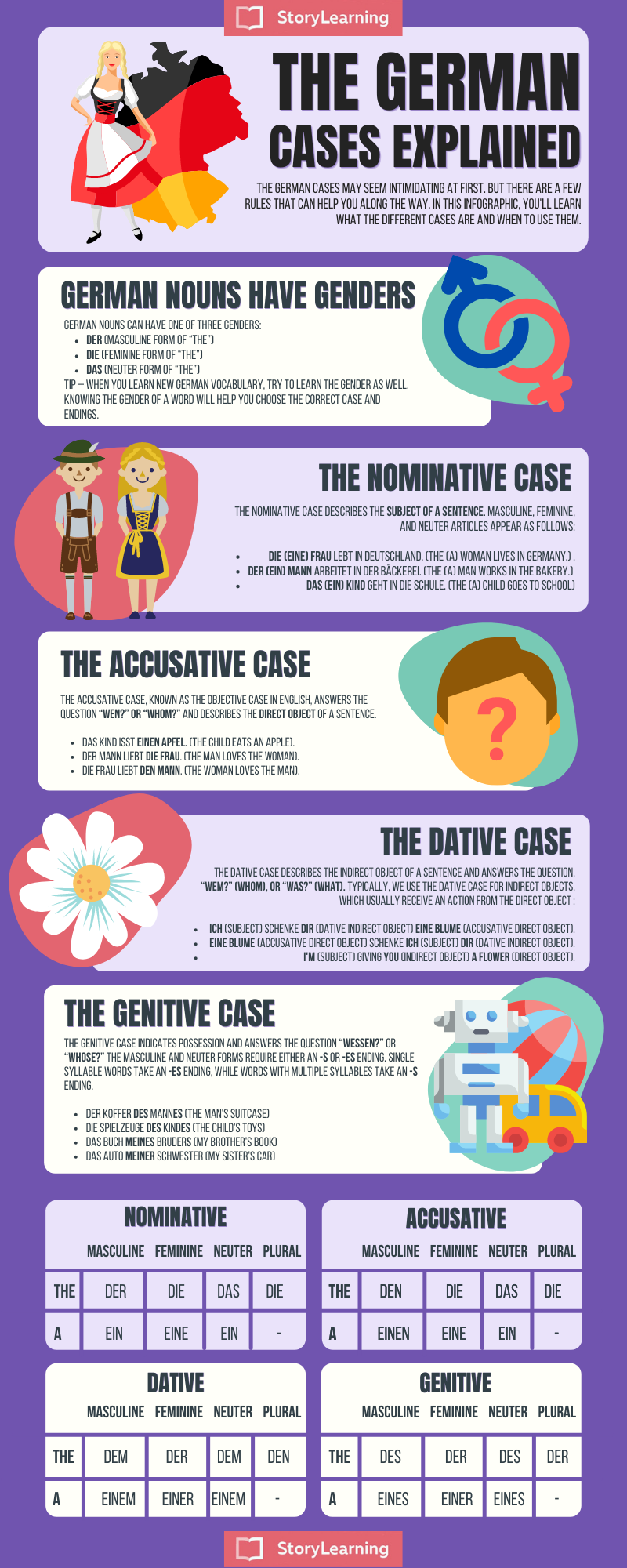
For now, just focus on the function described in the "THE DATIVE CASE" box. It describes the indirect object and answers the question "Wem?" (Whom?).
Conclusion
Sehr gut! You've just taken the first and most important step in mastering the dative case: understanding its primary job. You now know how to identify the indirect object in a German sentence.
Let's recap the key takeaways:
- The dative case marks the indirect object of a sentence.
- The indirect object is the recipient or beneficiary of the action.
- It answers the question Wem? (To whom? or For whom?).
- In a sentence with a person and a thing as objects, the person is usually the dative indirect object, and the thing is the accusative direct object.
You have probably noticed in the examples and charts that identifying the dative object is only half the battle. You also need to know which articles to use (dem, der, dem etc.). That is precisely what we will cover in our next lesson. Now that you understand the why, you are perfectly prepared to learn the how.
Bis bald!