Hallo! I hope you're ready to build on what we covered last time.
In our previous lesson, you learned how to talk about your hobbies, with a focus on your interests in gaming and digital media. We briefly touched upon the structure Ich [verb]e gern as a natural way to say you enjoy an activity. Today, we're going to expand on that significantly. This lesson will equip you with the essential tools to express likes and dislikes in German, moving beyond just activities to include things, people, and ideas. Mastering the nuances between gern, mögen, and gefallen is a fundamental step toward sounding more natural and precise, which will be invaluable for your social and academic life in Germany.
1. Gern: Expressing Joy in Action
Let's start with familiar territory. As we saw, gern is an adverb, not a verb. It modifies a verb to show that you enjoy doing that action. Think of it as adding the meaning "with pleasure" or "gladly" to the verb.
- Structure:
Subject + Verb + gern + ... - Use Case: Liking an activity.
You already know these from our last lesson:
Ich spiele **gern** Videospiele.(I like to play video games.)Ich schaue **gern** Vlogs.(I like to watch vlogs.)
To express that you don't like doing something, you simply add nicht before gern.
Ich spiele **nicht gern** Horrorspiele.(I don't like to play horror games.)
The video below offers a clear and quick recap of how gern is used for activities.
How to say 'LIKE' in German and the difference between "gefallen" & "mögen" 🎯
This video from "YourGermanTeacher" will be our guide today. It breaks down these concepts very clearly.
Let's start by watching the segment on 'gern'. Pay attention to how it's always paired with a verb to describe an activity. Watch the section from gern for activities.
2. Mögen: Liking People and Things
What if you want to say you like a thing, not an activity? For this, you need a verb, and the most direct one is mögen.
- Structure:
Subject (Nominative) + mögen (conjugated) + Direct Object (Accusative) - Use Case: Liking a noun (a person, place, or thing).
This structure should feel familiar. It's a standard sentence with a subject, verb, and a direct object in the accusative case.
Conjugation of mögenMögen is an irregular verb, which means you'll need to memorize its forms. Notice that the singular forms (ich, du, er/sie/es) have a vowel change from ö to a.
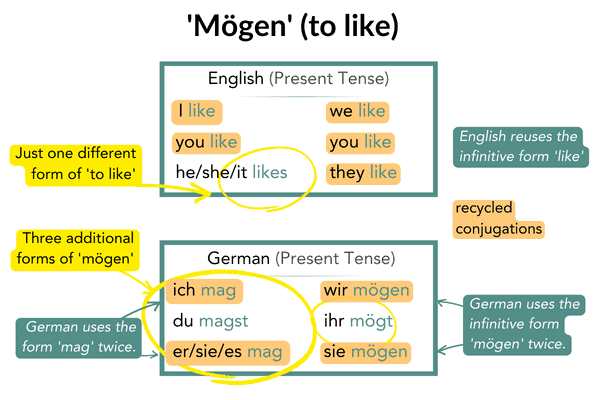
Let's apply this to your interests:
Ich **mag** dieses Videospiel.(I like this video game.)Sie **mag** den neuen Controller.(She likes the new controller.)**Magst** du deutsche Vlogs?(Do you like German vlogs?)
To express dislike, you use the negation words you've learned: nicht for specific nouns and kein/keine for general or indefinite nouns.
Ich mag den Endgegner **nicht**.(I don't like the final boss.)Er mag **keine** Strategiespiele.(He doesn't like strategy games.)
For a detailed explanation and more examples, the following article is very helpful.
This article from "German with Antrim" provides a thorough breakdown of these three words.
Please read the section titled "Mögen". It clearly explains the sentence structure and provides the full conjugation table.
3. Gefallen: When Something is Pleasing to You
Here is where German grammar offers a fascinating alternative. The verb gefallen also means "to like," but the sentence structure is completely different. It works like some other dative verbs you learned about in Module 4.
- Structure:
Thing Liked (Nominative Subject) + gefallen (conjugated) + Person Liking (Dative Object) - Use Case: Liking a noun, often based on aesthetic appeal.
The easiest way to think about gefallen is to translate it as "to be pleasing to" or "to appeal to." The thing you like is the subject of the sentence, and you become the indirect object in the dative case.
Let's look at this in action:
Das neue Design **gefällt mir**.(The new design is pleasing to me / I like the new design.)Die Grafik in diesem Spiel **gefällt mir** sehr gut.(The graphics in this game are very pleasing to me / I like the graphics in this game a lot.)**Gefällt dir** mein neuer Avatar?(Is my new avatar pleasing to you? / Do you like my new avatar?)
Notice that the verb gefallen conjugates to match the thing being liked, not the person. Since you're usually talking about one thing (gefällt) or multiple things (gefallen), you'll most often use only these two forms.
This structure can be tricky, as it flips the subject and object compared to English. The next video segment explains this "flip" perfectly.
How to say 'LIKE' in German and the difference between "gefallen" & "mögen" 🎯
Let's return to the "YourGermanTeacher" video.
Watch the section explaining 'gefallen' from gefallen. The host does an excellent job explaining the dative structure and the subject-object inversion that confuses many learners. The tip to think of it as "to appeal to" is particularly useful.
4. The Nuance: Mögen vs. Gefallen
So, if both mögen and gefallen are used to like nouns, when do you use which? This is where you can start to add real sophistication to your German.
-
Gefallenis often used for an immediate, first-impression, or sensory liking. It's about what you see or hear. It's the perfect verb to use when you're shopping, visiting a gallery, or commenting on the aesthetics of a game or a vlog.Die Cinematics in diesem Spiel **gefallen mir**.(I like the cinematics in this game - you're judging their visual appeal.)Der Stil von diesem Vlogger **gefällt mir**.(I like this vlogger's style - you're commenting on their fashion or editing.)
-
Mögenoften implies a deeper connection, familiarity, or an established opinion. It goes beyond just the surface appearance.Ich **mag** dieses Spiel.(I like this game - this implies you like the whole experience: the story, the gameplay, the feeling it gives you.)Ich **mag** diesen Vlogger.(I like this vlogger - you like their personality, their humor, their character, not just how they look.)
The final video segment illustrates this crucial difference with very clear examples.
How to say 'LIKE' in German and the difference between "gefallen" & "mögen" 🎯
One last look at our video for today.
This is the most important part. Watch the explanation of the difference between the two verbs from the difference. The examples using the t-shirt and a person make the distinction between emotional connection (mögen) and visual appeal (gefallen) very clear.
Summary & Practice
Let's consolidate this into a quick reference:
| To Like... | German choice | Example Sentence |
|---|---|---|
| An Activity | [verb] + gern |
Ich spiele **gern**. (I like to play.) |
| A Thing/Person (Deeper Liking) | mögen (+ Accusative) |
Ich **mag** das Spiel. (I like the game.) |
| A Thing/Person (Aesthetic Liking) | gefallen (+ Dative) |
Das Spiel **gefällt mir**. (The game appeals to me.) |
Now, try it yourself. How would you say the following in German?
- I like to edit videos.
- I like this fashion style. (Use
gefallen- it's about appearance) - I like my friends. (Use
mögen- it's an emotional connection)
(Pause and think before reading the answers below)
Ich bearbeite gern Videos.Dieser Modestil gefällt mir.Ich mag meine Freunde.
Conclusion
Excellent work today. You've just unlocked a very important and nuanced part of the German language. Understanding when and how to use gern, mögen, and gefallen will make your conversations much richer and more precise.
Key Takeaways:
- Use
gernwith a verb to say you like an activity. - Use
mögenwith an accusative object to say you like a thing or person, often implying a deeper familiarity or emotional connection. - Use
gefallenwith a dative object when a thing or person is visually/aesthetically pleasing to you. - The key to
gefallenis remembering the sentence structure is "backwards" from English: The thing you like is the subject.
In our next lesson, we will learn how to connect these opinions and ideas together using the conjunctions und (and), oder (or), and aber (but). This will allow you to build more complex and interesting sentences.
Bis zum nächsten Mal