Hello! Welcome to the final lesson of your course on General Relativity and Cosmology.
In our previous lessons, we've journeyed to the frontiers of fundamental physics, exploring candidate theories of quantum gravity like Loop Quantum Gravity and String Theory, culminating with the AdS/CFT correspondence. These are "top-down" approaches, attempting to build a complete theory from first principles. Today, we pivot to a different, more phenomenological strategy: we will explore Modified Gravity Theories.
The motivation is twofold. First, from a theoretical standpoint, we expect General Relativity to be an effective field theory, receiving corrections at high energies. Second, from a cosmological perspective, GR requires the existence of dark matter and dark energy—which together constitute 95% of the universe's energy content—to explain observations. This has led physicists to ask a profound question: could the phenomena we attribute to dark energy be a sign that GR itself needs to be modified on cosmological scales?
This lesson will address the learning outcome: Explore a class of modified gravity theories (e.g., f(R) gravity) as an alternative to dark energy. We will use gravity as our primary example to understand the promise, the structure, and the significant challenges of this approach.
1. The Principle of Modified Gravity: From Einstein-Hilbert to
The simplest way to modify General Relativity is to alter its foundation: the action principle. Recall the Einstein-Hilbert action (with ):
The geometric part of the Lagrangian is simply the Ricci scalar, . This is the simplest possible choice that is a scalar constructed from the metric and its first and second derivatives, leading to second-order field equations.
The idea of gravity is to generalize this to an arbitrary function of the Ricci scalar:
GR is recovered in the specific case where . This generalization seems minimal, but as we will see, it has profound consequences.
The action principle is a powerful and systematic way to derive and explore modifications to a theory. The following video gives an excellent overview of how the action principle for GR naturally opens the door to modifications like gravity.
13. The Einstein field equation (variant derivation).
This lecture from MIT OpenCourseWare discusses the derivation of the Einstein Field Equations from the action principle. It provides a perfect entry point by showing how this formalism makes it easy to contemplate and construct modified theories of gravity.
Watch the segment from 03:34 to 20:45. The first part (until 06:41) introduces the action principle as a route to the field equations and explicitly motivates its use for exploring modifications. The second part details the setup of the Einstein-Hilbert action. Pay close attention to the principle used to choose the Lagrangian: it must be a scalar built from curvature tensors. The Ricci scalar R is the simplest choice, but not the only one.
2. The Field Equations of Metric Gravity
To see the physical consequences of this new action, we must derive the field equations by varying the action with respect to the metric . This procedure is more involved than for the standard Einstein-Hilbert action because the variation introduces derivatives of the metric variation, , which must be handled with care.
The resulting field equations are:
where we have defined .
Notice two immediate and crucial differences from standard GR:
- The equations are now fourth-order differential equations for the metric, due to the and terms (since contains second derivatives of the metric).
- The familiar factor of 1 multiplying is replaced by .
The following resource provides a step-by-step derivation of this equation. Given your background, following this derivation is an essential exercise.
Implications of f(R) modification to gravity
This dissertation provides a clear, pedagogical derivation of the field equations for metric f(R) gravity.
Please read section 1.1, 'Metric f(R) gravity' (pages 5-9). Focus on the derivation in section 1.1.1. The key is understanding how the variation of the Ricci tensor, (\delta R_{\mu u}), leads to the higher-derivative terms involving F(R). The result is the field equation shown above.
A New Scalar Degree of Freedom
The complexity of the field equations hides a simpler underlying structure. To see it, let's take the trace of the field equations:
In GR, where and , this reduces to the algebraic relation . Here, however, we have a dynamical equation for . This tells us that gravity is not just a modification of GR's dynamics; it introduces a new propagating scalar degree of freedom, often called the "scalaron," .
In fact, metric gravity can be shown to be dynamically equivalent to a Brans-Dicke scalar-tensor theory with parameter and a specific potential determined by the form of . This equivalence is key to understanding its physical effects.
3. Gravity as an Alternative to Dark Energy
Now we come to the primary motivation: can gravity explain the accelerated expansion of the universe? The strategy is to design a function that approximates standard GR () when curvature is large (in the early universe and in dense regions like the solar system) but deviates significantly when is small (at late cosmological times) to drive acceleration.
A classic example is a model of the form:
where is a very small mass scale.
- High Curvature (): . The theory behaves like GR.
- Low Curvature (): The term becomes dominant and can lead to an effective negative pressure, driving acceleration.
To see this explicitly, one can derive the modified Friedmann equations for a flat FLRW cosmology. The field equations can be rearranged to look like the standard Friedmann equation but with an additional effective dark energy component whose density and pressure are constructed from the new curvature terms.
Implications of f(R) modification to gravity
The same dissertation you just read explains how to use f(R) models to generate a dark energy component.
Read section 2.3, 'Generating Dark Energy in metric f(R)' (pages 27-31). Focus on section 2.3.1. It shows how the modified field equations can be split into the standard Einstein tensor and an 'effective' stress-energy tensor for the curvature terms. It then derives the effective energy density (( ho_{ ext{eff}})) and equation of state (w_{ ext{eff}}) and discusses models that can achieve acceleration (w_{ ext{eff}} < -1/3).
Test your understanding!
Consider the model . The effective equation of state for this model in a vacuum-dominated universe can be shown to be . Does this model produce accelerated expansion? Does it solve the "coincidence problem" (why dark energy is becoming dominant only now)?
Show answer
Yes, an equation of state satisfies the condition for acceleration, .
This type of model provides a potential explanation for the coincidence problem. The modification is negligible at early times when the universe's density and thus its average curvature were high. Only recently, as the universe expanded and became small enough to be comparable to , did the modification become dominant and start driving acceleration. The timing is determined by the mass scale , which can be tuned to match observations.
4. Viability and Experimental Constraints: The Catch
So far, gravity seems like a promising alternative to dark energy. However, any modification of GR must survive the extremely precise tests performed within our solar system. This is where most simple models fail.
The new scalar degree of freedom, the scalaron, mediates a fifth force. In general, this fifth force would manifest as a Yukawa-type correction to the Newtonian potential:
where is the mass of the scalaron. Solar system experiments have ruled out such a force with incredible precision, unless its range is very short (sub-millimeter) or the force is somehow screened.
For an theory, the scalaron's mass in a background of curvature is given by:
For models like that are designed to cause acceleration at late times (low ), is very large, making the scalaron very light and the fifth force long-ranged. This would lead to large, unobserved deviations from GR in the solar system.
This illustrates the fundamental tension in gravity: models that successfully explain cosmic acceleration tend to fail solar system tests.
Introduction to Modified Gravity
The following paper provides a superb and rigorous analysis of the solar system constraints on f(R) gravity, formalizing the argument we just outlined.
Read section 3, 'Experimental determination of the gravity Lagrangian' (pages 12-18). This is a critical section. Pay close attention to the derivation of the spherically symmetric solution and the resulting effective Newton's constant and post-Newtonian parameter \gamma. The key conclusion, derived in eq. (47) and the subsequent analysis, is that models with nonlinear terms that become dominant at low curvatures are generally incompatible with solar system tests.
More sophisticated models (like those proposed by Hu-Sawicki or Starobinsky, see Table 2.1 in your previous reading) employ "chameleon mechanisms," where the scalaron's mass becomes large in dense environments (like the solar system), effectively screening the fifth force and allowing the theory to evade local constraints while still modifying cosmology.
5. The Broader Landscape: Palatini Formalism and Massive Gravity
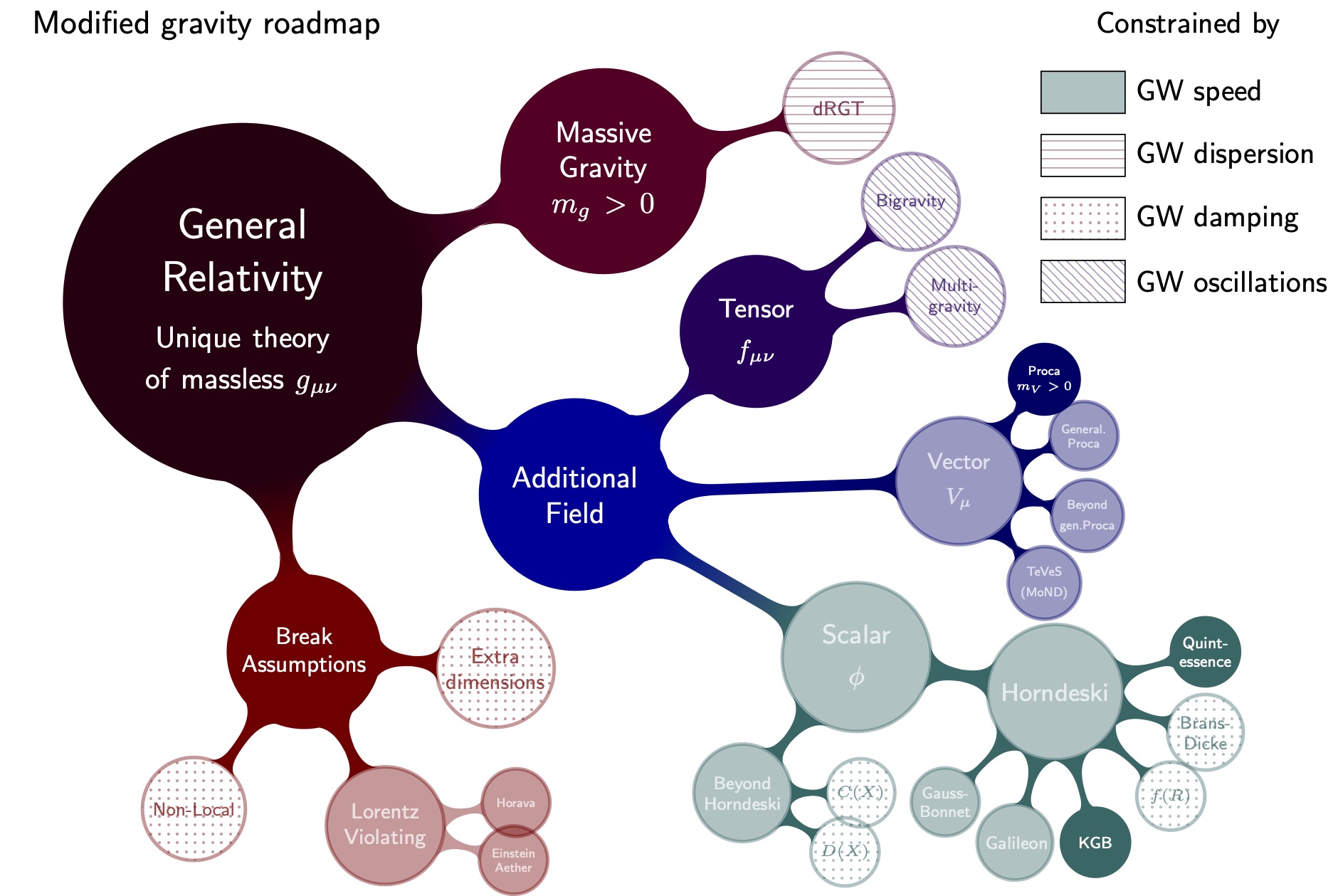
Metric gravity is just one of many ways to modify GR. Let's briefly touch upon two other prominent ideas.
Palatini Gravity
So far, we have used the metric formalism, where the connection is assumed from the start to be the Levi-Civita connection of the metric . In the Palatini formalism, the metric and the connection are treated as independent variables. When varying the action , one varies with respect to both.
For , both formalisms give the same equations. For a general , the Palatini approach yields a theory that is also equivalent to a Brans-Dicke theory, but with parameter . Crucially, this theory does not have a propagating scalar degree of freedom. The "scalaron" is non-dynamical, and its value is algebraically determined by the trace of the stress-energy tensor, . This means it does not mediate a fifth force in a vacuum, neatly avoiding the solar system problem. However, it introduces other issues, such as a problematic coupling to matter and singularities at the surface of stars.
Massive Gravity
Another profound idea is to give the graviton a mass. If the graviton has a tiny mass , the gravitational potential would fall off faster than at very large distances (), which could potentially mimic the effects of dark energy.
However, this seemingly simple idea is fraught with theoretical difficulties.
- The vDVZ discontinuity: In the 1970s, it was shown that the massless limit () of the linear theory of massive gravity does not reproduce GR. For instance, it predicts the wrong value for the bending of light by the sun by a factor of 3/4, regardless of how small the mass is.
- The Boulware-Deser ghost: In the full nonlinear theory, naively adding a mass term reintroduces a sixth, pathological degree of freedom (a "ghost") that renders the theory unstable.
It took until 2010 for a consistent nonlinear theory of massive gravity (de Rham-Gabadadze-Tolley, or dRGT theory) to be formulated, which avoids the ghost instability. The vDVZ discontinuity is resolved in the full theory by a screening mechanism (the Vainshtein mechanism), where nonlinearities become important at a certain "Vainshtein radius" around a source, restoring the GR predictions within this radius.
The following lecture gives a conceptual overview of the challenges and ideas in massive gravity. It is advanced, but the core physical concepts should be accessible.
Modified Gravity 1: Theory - lecture 1
This lecture by Claudia de Rham, a key figure in modern massive gravity, explains the motivations and theoretical challenges. We will focus on the concepts rather than the full mathematical apparatus.
Please watch two key conceptual segments: The vDVZ Discontinuity (27:45 - 41:51): The speaker first introduces the Fierz-Pauli theory for a massive spin-2 particle. Focus on the final result: the calculation of light bending gives a different answer from GR, even as the graviton mass goes to zero. This is the famous van Dam-Veltman-Zakharov (vDVZ) discontinuity. The Vainshtein Mechanism (59:13 - 1:11:57): This segment explains how nonlinearities can solve the vDVZ problem. The key takeaway is the concept of the Vainshtein radius. Inside this radius, nonlinear effects are strong and can 'screen' the extra scalar modes of the massive graviton, making the theory look like GR again. This reconciles massive gravity with solar system tests.
Course Conclusion
This lesson on modified gravity marks the end of our journey. We began with the essential mathematical language of differential geometry, built the majestic edifice of General Relativity, and used it to explore the universe—from black holes and gravitational waves to the Big Bang and the evolution of spacetime itself. Finally, we pushed beyond GR to the frontiers where it meets quantum mechanics and confronts cosmological puzzles, exploring ideas from Loop Quantum Gravity and String Theory to the phenomenological modifications we saw today.
Key Takeaways from this Lesson:
- Motivation: Modified gravity theories attempt to resolve cosmological puzzles like dark energy by altering GR itself, rather than by postulating new substances.
- Gravity: The simplest modification, replacing with in the action, introduces a new scalar degree of freedom (the scalaron).
- Promise and Peril: While some models can drive cosmic acceleration, they must also satisfy stringent solar system tests. The new scalar field mediates a fifth force that is often in conflict with observation.
- A Rich Landscape: gravity is just the beginning. The landscape of modified gravity is vast, including theories of massive gravity and higher-dimensional models, each with its own unique phenomenology and theoretical challenges. The central theme is a delicate balancing act between modifying cosmology and preserving the successes of GR at smaller scales.
You have navigated a course of considerable depth and difficulty. Your background in physics and mathematics has allowed us to pursue a "no compromise" path, emphasizing both formal rigor and physical intuition. From the tensor calculus of manifolds to the path integrals of quantum field theory in curved space, you have engaged with some of the most profound and beautiful ideas in modern science. Congratulations on this remarkable achievement! I hope this course serves as a solid foundation for your future explorations in theoretical physics.