Hello!
In our last lesson, we formally stated the four laws of black hole mechanics. We saw that they bear a striking resemblance to the laws of thermodynamics, with mass , surface gravity , and horizon area playing roles analogous to energy , temperature , and entropy .
Today, we will delve into the profound physical meaning behind this analogy. You will learn how the seeming paradox of entropy loss in black holes led Jacob Bekenstein to a revolutionary idea, and how Stephen Hawking's subsequent quantum calculations transformed a mathematical curiosity into a cornerstone of modern theoretical physics. We will solidify the identification between mechanical and thermodynamic quantities, revealing that black holes are not just like thermodynamic systems—they are thermodynamic systems.
1. The Analogy Summarized
Let's begin by explicitly laying out the direct correspondence between the laws of black hole mechanics and the laws of classical thermodynamics. This parallel is the central theme of our lesson.
| Law | Thermodynamics | Black Hole Mechanics |
|---|---|---|
| Zeroth | A system in thermal equilibrium has a constant temperature . | A stationary black hole has a constant surface gravity over its event horizon. |
| First | Energy is conserved: (e.g., ). | Mass-energy is conserved: . |
| Second | The entropy of a closed system never decreases: . | The area of an event horizon never decreases: . (Classically) |
| Third | It is impossible to reach absolute zero temperature () in a finite number of steps. | It is impossible to reach zero surface gravity () in a finite number of steps. |
At first glance, this seems too remarkable to be a coincidence. However, there was a glaring problem: a classical black hole is a perfect absorber and emits nothing. Its physical temperature should be absolute zero. If , how can this be more than a formal analogy?
2. Bekenstein's Insight: Saving the Second Law
The journey from analogy to physics began with a simple but profound question posed by Jacob Bekenstein in the early 1970s.
Introduction to Black Hole Thermodynamics - Edward Witten
In this lecture, the renowned physicist Edward Witten explains the conceptual problem that Bekenstein tackled. The apparent violation of the second law of thermodynamics was a serious challenge to fundamental physics.
Please watch from 01:34 to 11:59. Focus on Bekenstein's thought experiment: what happens to the entropy of a hot cup of tea when you throw it into a black hole? Pay close attention to his proposed solution: the Generalized Second Law of Thermodynamics (GSL).
As you just saw, the problem is this: if you drop an object with entropy (like a book, or a star) into a black hole, its entropy seems to vanish from the universe, violating the second law of thermodynamics. To resolve this, Bekenstein made a radical proposal:
- Black holes must have entropy.
- Drawing on Hawking's Area Theorem (), he proposed that a black hole's entropy must be proportional to the area of its event horizon: .
This led him to formulate the Generalized Second Law (GSL), which states that the sum of the ordinary entropy of matter and radiation outside the black hole () and the black hole's own entropy () can never decrease:
In this framework, when the cup of tea falls into the black hole, decreases, but the black hole's mass—and therefore its horizon area and —increases by a sufficient amount to ensure the total entropy does not decrease.
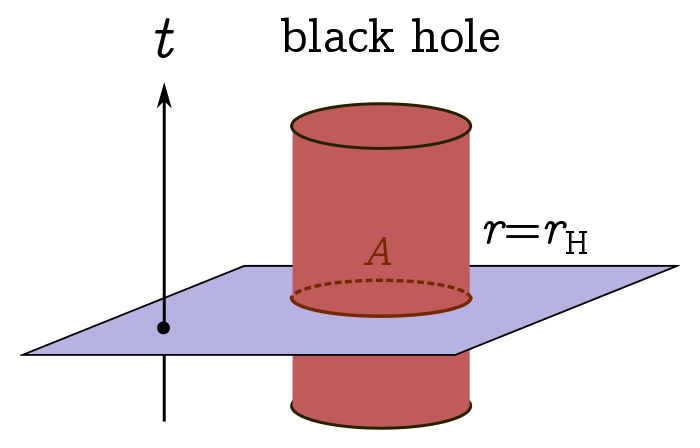
3. Hawking's Discovery: From Analogy to Identity
Bekenstein's idea was brilliant, but it lacked a mechanism. What could the temperature of a black hole possibly be? The definitive answer came, unexpectedly, from Stephen Hawking, who was initially a skeptic. By applying the principles of quantum field theory in the curved spacetime background of a black hole, he made one of the most important discoveries in theoretical physics.
Hawking found that quantum effects near the event horizon cause black holes to radiate particles as if they were a perfect blackbody. This lecture from MIT OpenCourseWare explains the result and its immediate consequences for Bekenstein's proposal.
Watch this segment from 59:32 to 01:03:48. It provides the historical context of Bekenstein's work and how Hawking's calculation provided the missing piece that turned the idea into accepted physics.
Hawking discovered that a black hole has a non-zero physical temperature, given by:
(in units where ). This phenomenon is known as Hawking radiation. The temperature is inversely proportional to the black hole's mass, meaning smaller black holes are hotter and radiate more intensely.
This was the key. With a real, physical temperature proportional to the surface gravity , the analogy was now a physical identity. It also allowed for a precise calculation of the constant of proportionality in Bekenstein's entropy formula.
Let's see how this is done by combining the first laws of thermodynamics and black hole mechanics.
With the Hawking temperature formula in hand, we can derive the exact expression for black hole entropy. The following clip walks through this straightforward but powerful calculation.
Watch from 37:36 to 41:56. Follow the integration of the first law, dE = TdS, to find the entropy S. Note how the identification of energy E with mass M, and temperature T with Hawking temperature T_H, leads directly to the famous area law.
Let's re-write the derivation for clarity. We start with two forms of the first law for a simple (non-rotating, uncharged) black hole:
- Thermodynamics:
- Black Hole Mechanics:
We make the physical identifications:
- Energy is the mass-energy of the black hole, .
- Temperature is the Hawking temperature, .
Substituting these into the first law of thermodynamics gives:
Now, we equate this with the mechanical law:
The surface gravity cancels out, which is a beautiful consistency check. Solving for yields:
Integrating this equation (assuming when ) gives the celebrated Bekenstein-Hawking entropy formula:
where is the Planck length. This equation is one of the most profound in physics, connecting gravity (), quantum mechanics (), thermodynamics (), and relativity (, hidden in ). It suggests that entropy—and by extension, information—is encoded not in the volume of the black hole, but on its two-dimensional surface area. This is a foundational idea for the holographic principle.
Test your understanding!
Calculate the Bekenstein-Hawking entropy of a one-solar-mass ( kg) Schwarzschild black hole. The Schwarzschild radius is and the horizon area is . Compare your result to the approximate thermodynamic entropy of the Sun, which is .
Constants: , , , .
Show answer
-
Calculate the Schwarzschild radius:
-
Calculate the horizon area:
-
Calculate the Bekenstein-Hawking entropy:
To express this in units of , we divide by :
So, . -
Compare:
The entropy of a solar-mass black hole () is twenty orders of magnitude larger than the entropy of the Sun itself (). This demonstrates that black holes are the most entropic objects possible for a given mass, packing an enormous amount of information, or "hidden microstates," within their horizons.
Conclusion
This lesson has bridged the gap between a formal analogy and a deep physical truth. By following the clues of a potential violation of the second law of thermodynamics, physicists were led to one of the most fruitful insights into the nature of spacetime and information.
Key Takeaways:
- The analogy between black hole mechanics and thermodynamics is not just formal; it is a physical identity.
- Bekenstein's Generalized Second Law () resolves the paradox of entropy loss by assigning an entropy to the black hole itself.
- Hawking's discovery that black holes have a physical temperature () due to quantum effects confirmed Bekenstein's idea and solidified the analogy.
- The Bekenstein-Hawking entropy is given by , demonstrating that a black hole's entropy is proportional to its surface area, not its volume.
- This connection between area and information is a cornerstone of the holographic principle and a crucial guidepost in the search for a quantum theory of gravity.
Preview of Next Lesson:
Having explored the thermodynamic nature of black holes, we will now turn our attention to one of the most powerful and general results in classical general relativity. We will derive the Raychaudhuri equation, which governs how congruences of geodesics expand or contract. This will be the key mathematical tool we need to prove the celebrated Penrose-Hawking singularity theorems, which show that under very general physical assumptions—assumptions reinforced by the thermodynamic stability we've just discussed—the formation of singularities is an inevitable consequence of gravitational collapse.