Hello! Welcome back to our journey into the quantum nature of black holes.
In our last lesson, we reached a major milestone by deriving the Hawking temperature, . We saw how the extreme gravitational redshift near a newly formed event horizon stretches quantum field modes, mixing positive and negative frequencies and leading to the creation of particles with a perfect thermal spectrum. This result provided, for the first time, a physical basis for the temperature that had appeared only formally in the "laws of black hole mechanics."
Today, we will build directly on that discovery to solidify the connection between gravity and thermodynamics. Our objective is to relate Hawking radiation to black hole thermodynamics, identifying the Bekenstein-Hawking entropy. We will use the physical temperature we derived to transform the analogous laws of black hole mechanics into genuine laws of thermodynamics. This will allow us to derive one of the most profound and enigmatic formulas in all of physics: the expression for black hole entropy.
1. From Analogy to Physics
Long before Hawking's discovery, physicists had noticed a striking formal analogy between the properties of black holes and the laws of thermodynamics.
| Law | Thermodynamics | Black Hole Mechanics (Classical GR) |
|---|---|---|
| Zeroth | Temperature is uniform for a system in thermal equilibrium. | Surface gravity is constant over the event horizon of a stationary black hole. |
| First | Energy is conserved: | The change in mass is related to changes in other parameters: . |
| Second | Entropy never decreases for a closed system: . | The area of an event horizon never decreases: (Hawking's Area Theorem). |
| Third | It is impossible to reach absolute zero temperature in a finite number of steps. | It is impossible to reduce surface gravity to in a finite number of steps. |
Despite these parallels, the analogy seemed flawed. A classical black hole absorbs everything and emits nothing, making its physical temperature absolute zero.
This classical picture was challenged by Jacob Bekenstein in the early 1970s. He argued, via a series of brilliant thought experiments, that for the second law of thermodynamics to hold true in the presence of black holes, the black hole itself must possess entropy proportional to its area. The following video by Edward Witten provides an excellent conceptual introduction to Bekenstein's ideas and the context into which Hawking's discovery arrived.
Introduction to Black Hole Thermodynamics - Edward Witten
Let's watch this segment from a lecture by Edward Witten. He discusses the concept of irreversibility in black hole physics and explains Jacob Bekenstein's groundbreaking proposal for black hole entropy and the Generalized Second Law of Thermodynamics.
Please watch from 1:34 to 13:08. Focus on: The analogy between black hole irreversibility and the irreversibility of everyday processes (like breaking an egg). Bekenstein's motivation: what happens to the entropy of matter thrown into a black hole? The proposal that black hole entropy is proportional to the horizon area, S_{BH} \propto A. The formulation of the Generalized Second Law (GSL): S_{gen} = S_{matter} + S_{BH} must never decrease. The problem Bekenstein faced when considering the absorption of very long-wavelength photons, which seemed to violate the GSL. This is the problem Hawking's work would later solve.
Bekenstein's proposal was radical: a geometric quantity, area, was being equated with a statistical quantity, entropy. However, he couldn't determine the constant of proportionality. It was Hawking's calculation of the black hole's physical temperature that fixed this constant and turned the analogy into a concrete physical theory.
2. Derivation of the Bekenstein-Hawking Entropy
We are now in a position to perform this pivotal derivation. We have two expressions for the change in a black hole's mass (energy):
-
From the First Law of Black Hole Mechanics: For a simple, non-rotating, uncharged Schwarzschild black hole (), the law is:
-
From the First Law of Thermodynamics: Assuming the black hole is a thermodynamic system, its change in energy is related to its change in entropy by:
We can now equate these two expressions:
In our previous lesson, we derived the Hawking Temperature, . Substituting this into our equation gives:
The surface gravity conveniently cancels out. We can now solve for the change in entropy, :
Integrating this equation (and assuming the entropy is zero for a zero-area black hole), we arrive at the celebrated Bekenstein-Hawking entropy formula:
In the system of natural units where , this formula takes its iconic simple form:
The following video provides a concise recap of this derivation.
Let's watch this segment from an MIT OpenCourseWare lecture. It provides a very clear, step-by-step derivation of the Bekenstein-Hawking entropy, exactly following the logic we just outlined.
Please watch from 36:54 to 41:56. This will reinforce the derivation and show the final result for the entropy expressed in terms of both mass and area.
This result is extraordinary. It establishes a deep and precise connection between three pillars of physics:
- General Relativity (through the horizon area and Newton's constant )
- Quantum Mechanics (through Planck's constant )
- Thermodynamics & Statistical Mechanics (through the entropy and Boltzmann's constant )
This formula is a cornerstone of quantum gravity research.
3. The Physical Meaning of Black Hole Entropy
What does it mean for a black hole—an object described in classical GR by just three numbers (mass, charge, spin)—to have such a vast entropy?
3.1 A Statistical Interpretation
In statistical mechanics, entropy is a measure of the number of accessible microscopic states () that correspond to a given macroscopic state: . The Bekenstein-Hawking formula suggests that a black hole has an enormous number of internal quantum states hidden from an outside observer. For a solar-mass black hole, the entropy is roughly , vastly greater than the entropy of the star that formed it.
Any successful theory of quantum gravity must be able to account for these microstates. The Bekenstein-Hawking formula thus serves as a crucial benchmark, a quantitative test that any candidate theory must pass.
3.2 The Holographic Principle
Perhaps the most startling feature of the formula is that the entropy is proportional to the area of the black hole's boundary (the event horizon), not its volume. This is radically different from conventional thermodynamic systems, where entropy is an extensive quantity that scales with volume.
This observation led 't Hooft and Susskind to propose the holographic principle. This principle conjectures that the maximum amount of information (or entropy) that can be contained within any region of space is not proportional to its volume, but to the area of its boundary. It's as if the information about the 3D interior is "encoded" on the 2D surface, much like a hologram.
The Bekenstein-Hawking entropy is the primary motivation for the holographic principle, which suggests a fundamental rethinking of locality and degrees of freedom in physics. The following article by Steven Carlip provides an excellent overview.
Please read Section 8, 'The holographic conjecture' (pages 26-28). Focus on the two thought experiments presented that argue for a holographic bound on entropy.
The holographic principle suggests that our usual picture of local quantum fields existing at every point in space might be a significant over-counting of the true fundamental degrees of freedom.
4. The Information Loss Paradox: A First Look
Hawking's discovery, while resolving one puzzle, created an even deeper one: the information loss paradox.
The paradox is as follows:
- Imagine forming a black hole from matter in a pure quantum state (e.g., a single, perfectly known wave function).
- The black hole then evaporates completely by emitting Hawking radiation.
- Our derivation showed that this radiation is perfectly thermal, meaning it is random and carries no information, corresponding to a mixed quantum state.
- This implies that a process exists in nature that turns a pure state into a mixed state. This violates a fundamental tenet of quantum mechanics: unitarity, which demands that information is always conserved.
Where does the thermal nature of the radiation come from? As discussed in the previous lesson, Hawking radiation originates from the creation of entangled pairs of particles near the horizon. One particle escapes to infinity, while its partner falls into the black hole.
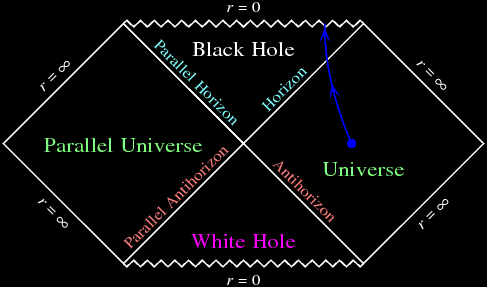
Because the escaping particle is entangled with its inaccessible partner behind the horizon, an observer at infinity who only collects the outgoing radiation will describe it with a thermal density matrix. The entropy of the radiation reflects this lack of information about the state of the interior.
If the black hole evaporates completely and disappears, what happens to the information that fell in? And what happens to the entanglement between the outgoing radiation and the now-nonexistent interior? Does the information truly vanish, forcing us to abandon quantum mechanics as we know it, or is there a subtle mechanism to preserve it?
This is the information loss paradox, one of the most profound and actively debated problems in theoretical physics today.
Conclusion
In this lesson, we have taken a monumental step, connecting the dynamics of spacetime geometry to the laws of thermodynamics.
Key Takeaways:
- Hawking's discovery that black holes have a physical temperature transformed the formal laws of black hole mechanics into genuine laws of thermodynamics.
- Using the first law, , we derived the Bekenstein-Hawking entropy: . This formula elegantly links concepts from general relativity, quantum mechanics, and thermodynamics.
- The entropy of a black hole is interpreted in statistical mechanics as counting a vast number of hidden internal microstates, providing a quantitative target for any theory of quantum gravity.
- The fact that entropy scales with area, not volume, gives rise to the holographic principle, a conjecture that the information in a volume is encoded on its boundary.
- The thermal nature of Hawking radiation leads to the information loss paradox, which challenges the principle of unitarity in quantum mechanics.
Preview of the Next Lesson:
We have just scratched the surface of the information loss problem. It represents a deep conflict between our understanding of general relativity and quantum mechanics. In our next lesson, we will discuss the black hole information paradox and its implications for quantum mechanics in much greater detail. We will examine the assumptions that lead to the paradox and explore the various proposed resolutions, such as remnants, firewalls, and black hole complementarity.