Hello! Welcome back to our investigation of gravitational waves.
In the previous lesson, we accomplished the significant task of deriving the quadrupole formula for gravitational wave luminosity. We established that the power radiated by a non-relativistic source is given by:
This formula connects the dynamics of a massive system, encapsulated by its trace-free quadrupole moment , to the energy it radiates away as ripples in spacetime. Today, we will put this powerful tool to work on its most important astrophysical application. Our objective is to apply the quadrupole formula to calculate the energy loss from a binary star system.
This calculation is not just a theoretical exercise; it lies at the very heart of gravitational wave astronomy. By modeling a binary system, we will derive the rate at which it loses orbital energy, causing the two bodies to spiral toward each other. This prediction, when compared with decades of observation, provided the first (indirect) and Nobel Prize-winning evidence for the existence of gravitational waves.
1. The Quadrupole Moment of a Binary System
Our first step is to build a simple but effective model of our source. Let's consider two point masses, and , in a circular orbit about their common center of mass. We'll place the orbit in the -plane for simplicity.
The total mass is , and the reduced mass is . Let the separation between the two masses be a constant, . From classical mechanics, their positions relative to the center of mass are and , where is the separation vector. If the system orbits with Keplerian angular frequency , the coordinates are:
- Mass 1: ,
- Mass 2: ,
The mass quadrupole moment tensor is defined as , where the sum is over the particles in the system. For our binary, this becomes .
The following resource performs this calculation explicitly.
Chapter 14 The Quadrupole Formalism
To begin, let's see how the quadrupole moment tensor is constructed for our binary system model. This document lays out the straightforward algebraic steps.
Please read Section 14.6, 'Gravitational wave emitted by a binary system in circular orbit,' starting from the beginning up to the summary of the q_ik components on page 197. (Note: The document uses q_ik for the quadrupole moment, which we are calling I_ik). Follow how the coordinates of the masses are used to find the components q_xx, q_yy, and q_xy.
After the algebra, you find that the components of the quadrupole moment tensor are:
And .
Notice that the gravitational wave signal will have a frequency of , twice the orbital frequency.
The luminosity formula requires the trace-free quadrupole moment, . The trace is , which is constant. The time-varying part of is what radiates, and it is given by:
with .
2. Calculating the Radiated Power
We now have the components of . The next step is to compute their third time derivatives, . Each time derivative with respect to time brings down a factor of and cycles the trigonometric functions:
Carrying this out explicitly:
Now we compute the sum of the squares required by the luminosity formula:
Since is symmetric, .
The luminosity formula involves an average over time, . In this case, the result is constant, so the average is trivial. Plugging this into the luminosity formula gives:
We can make this more physically transparent by using Kepler's third law, . Substituting for :
This is a remarkable result. It is the power radiated in gravitational waves by a binary system in a circular orbit. Notice the extremely strong dependence on the orbital separation, . This means that as the two bodies get closer, the energy they radiate increases dramatically.
Test your understanding!
Consider two binary systems. System A consists of two 10-solar-mass black holes. System B consists of two 1.4-solar-mass neutron stars. If both systems have the same orbital separation , which one radiates more power in gravitational waves, and by roughly what factor? You can assume and for an equal-mass binary.
Show answer
The luminosity is . For an equal-mass binary with individual mass , we have and .
So, .
The luminosity scales as the fifth power of the individual masses.
The ratio of luminosities will be:
The black hole binary radiates nearly 20,000 times more power than the neutron star binary at the same separation. This demonstrates the incredible sensitivity of gravitational wave emission to the mass of the source.
3. Orbital Energy Loss and Inspirals
The energy radiated away as gravitational waves must come from the binary's orbital energy. This means the orbit cannot be stable; it must decay. We can now quantify this effect. The total orbital energy (kinetic + potential) of a Newtonian binary is:
The principle of energy conservation dictates that the rate of change of the orbital energy must equal the negative of the power radiated away:
Let's see how this affects the orbit. The following resource walks through this final, crucial step.
Chapter 14 The Quadrupole Formalism
We now connect the radiated power L_GW to the change in the orbital energy of the system. This will show us precisely how the emission of gravitational waves causes the binary's orbit to shrink.
Please read Section 14.7, 'Evolution of a binary system...' from the beginning up to Equation (14.128) on page 202. Follow the logic connecting the orbital energy E_orb (Eq. 14.121), its time derivative (Eq. 14.122), and the gravitational wave luminosity L_GW (Eq. 14.119) to find the rate of change of the orbital separation, dl₀/dt.
By differentiating the expression for with respect to time, we get:
Now, we set this equal to :
Solving for , we find the rate of orbital decay:
The negative sign confirms our intuition: the separation between the two objects decreases over time. The system inspirals.
4. Observational Confirmation: The Hulse-Taylor Pulsar
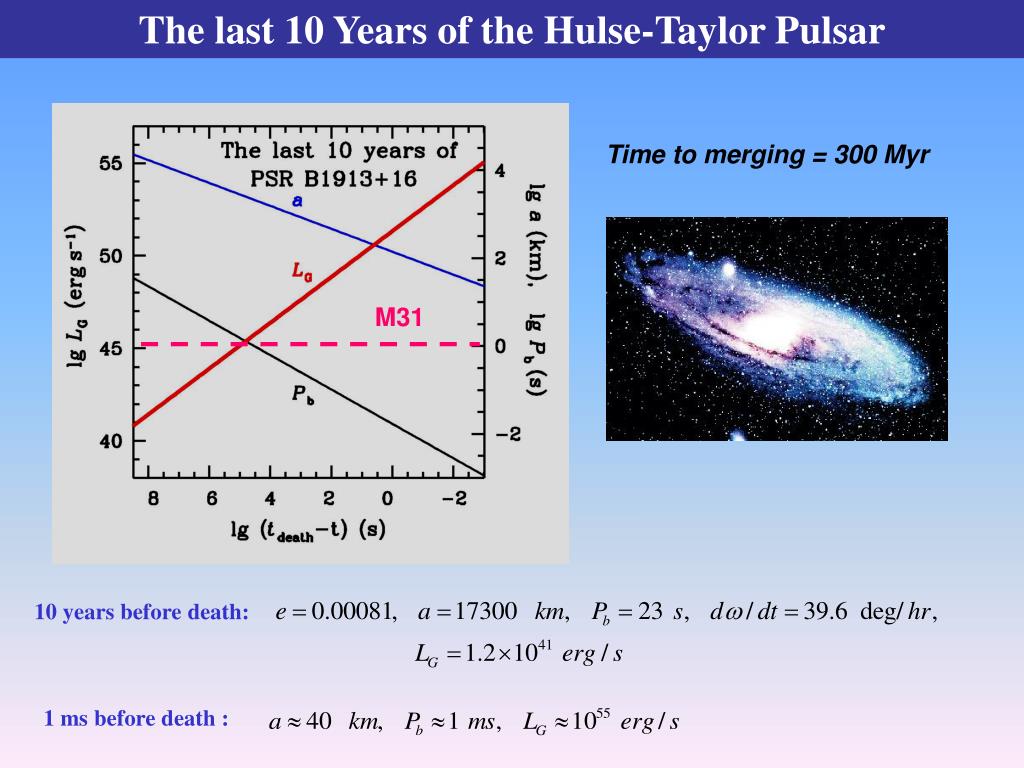
This prediction of orbital decay remained a purely theoretical result until 1974, when Russell Hulse and Joseph Taylor discovered a binary system perfectly suited to test it: PSR B1913+16. The system consists of two neutron stars, one of which is a pulsar, a rapidly rotating star that emits beams of radio waves like a cosmic lighthouse. The incredible regularity of the pulsar's "ticks" allowed for extraordinarily precise measurements of the orbit.
Over years of observation, Hulse and Taylor measured a steady decrease in the orbital period. This decrease was a direct consequence of the shrinking orbital separation we just calculated. The measured rate of orbital decay matched the prediction from General Relativity to within 1%. This was the first indirect detection of gravitational waves and provided stunning confirmation of Einstein's theory. For this discovery, Hulse and Taylor were awarded the 1993 Nobel Prize in Physics.

As the two bodies spiral closer, the rate of energy loss accelerates, as seen from the dependence of . This leads to a characteristic "chirp" signal where both the frequency and amplitude of the gravitational waves increase rapidly just before the final merger.
Conclusion
Today, we have bridged the gap between the abstract formalism of gravitational waves and a concrete, measurable astrophysical phenomenon. By applying the quadrupole formula to a binary star system, we have not only quantified the energy it radiates but also understood the profound consequences for its evolution.
Key Takeaways:
- The mass quadrupole moment of a binary system oscillates at twice the orbital frequency, leading to gravitational wave emission at that frequency.
- The power radiated by a binary system is given by .
- This energy loss causes the orbital separation to shrink (), leading to an inspiral.
- The predicted rate of orbital decay from this energy loss mechanism has been confirmed with extraordinary precision by observations of binary pulsars, most famously the Hulse-Taylor system.
Preview of Next Lesson:
We have derived the instantaneous rate of orbital decay, . In the next lesson, we will integrate this equation to estimate the orbital decay and gravitational wave signal from a binary system like the Hulse-Taylor pulsar. This will allow us to calculate quantities like the "time to merger" and understand the evolution of the "chirp" signal's frequency, which is what ground-based detectors like LIGO actually measure.