Hello! Welcome back to our exploration of gravitational waves.
In our last lesson, we successfully identified the two fundamental modes of gravitational radiation that emerge from the vacuum Einstein equations: the plus (+) and cross (×) polarizations. We saw that in the Transverse-Traceless (TT) gauge, the metric perturbation for a wave traveling in the -direction takes the form of a simple 2x2 matrix acting on the plane.
Today, we will build directly on that result to achieve this lesson's learning outcome: to analyze the effect of a passing gravitational wave on a ring of test particles. We will move from the mathematical form of the wave to a concrete, physical, and visual understanding of the "ripples in spacetime." This involves tackling a crucial question: in a theory where coordinates are just labels, how do we identify a real, measurable physical effect?
1. What is a "Real" Effect? Proper Distance vs. Coordinates
Before we begin, we must address a subtlety that lies at the heart of General Relativity. If we see the coordinates of a particle oscillating, is that a real physical effect, or are we just using a "wavy" coordinate system in flat spacetime? To be sure we are observing gravity at work, we need to measure a quantity that is independent of our choice of coordinates.
The relative motion between freely falling objects is just such an effect. This can be quantified in two primary ways:
- Proper Distance: The physical distance between two particles, as measured by a ruler. This is calculated using the metric tensor, .
- Geodesic Deviation: The acceleration of the separation vector between two nearby geodesics, governed by the Riemann curvature tensor.
We will see that both methods give the same physical result.
Relativity 109e: Gravitational Waves - How Gravitational Wave Affect Free Particles
The following video from the 'eigenchris' channel clearly explains why we must rely on coordinate-independent quantities to verify the physical reality of gravitational waves.
Watch the segment from 1:37 to 3:56. The video contrasts 'real' gravitational waves with 'wavy' coordinates and emphasizes that geodesics and proper length are the correct tools for a coordinate-independent analysis.
2. The Motion of Particles in the TT Gauge
One of the most elegant and initially perplexing features of the TT gauge is how it describes the motion of test particles. As we are about to see, in this specific gauge, freely falling particles that are initially at rest remain at fixed spatial coordinates.
This seems to suggest that nothing is happening! However, this is a feature of the coordinate system, which is essentially "attached" to the falling particles. The real physics is hidden in the oscillation of the metric itself.
Relativity 109e: Gravitational Waves - How Gravitational Wave Affect Free Particles
Let's rigorously verify that test particles remain at constant spatial coordinates in the TT gauge. This is a crucial first step in our analysis.
Please watch from 3:56 to 7:24. The video demonstrates that a four-velocity U^\mu = (c, 0, 0, 0) (representing a particle at rest) is a valid solution to the geodesic equation. This is because the relevant Christoffel symbols, \Gamma^\alpha_{00}, are zero in the TT gauge.
The paradox is resolved when we calculate the proper distance between two of these particles. Even if their coordinate separation is constant, the physical distance between them will change because the metric components are oscillating.
Let's consider two particles in the plane, separated by a coordinate vector . The square of the proper distance between them is:
Substituting and using the Minkowski metric components (, in our spatial metric), we get:
This equation is the key to our analysis. It directly relates the physical distance between particles to the oscillating components of the gravitational wave.
3. Deforming the Ring: Plus and Cross Polarizations
Now we can apply this formula to analyze the effect of each polarization on an initial ring of particles of radius in the plane. A particle on this ring can be described by its initial coordinate position .
Plus (+) Polarization
For a pure plus-polarized wave traveling in the -direction, we have and . The proper distance from the origin to a particle becomes:
Let's look at specific particles:
- Particle on the x-axis (): The distance is stretched and squeezed along the x-axis.
- Particle on the y-axis (): The distance is squeezed and stretched along the y-axis, exactly out of phase with the x-axis.
- Particle on the diagonal (): Here . The distance to particles on the diagonals remains unchanged.
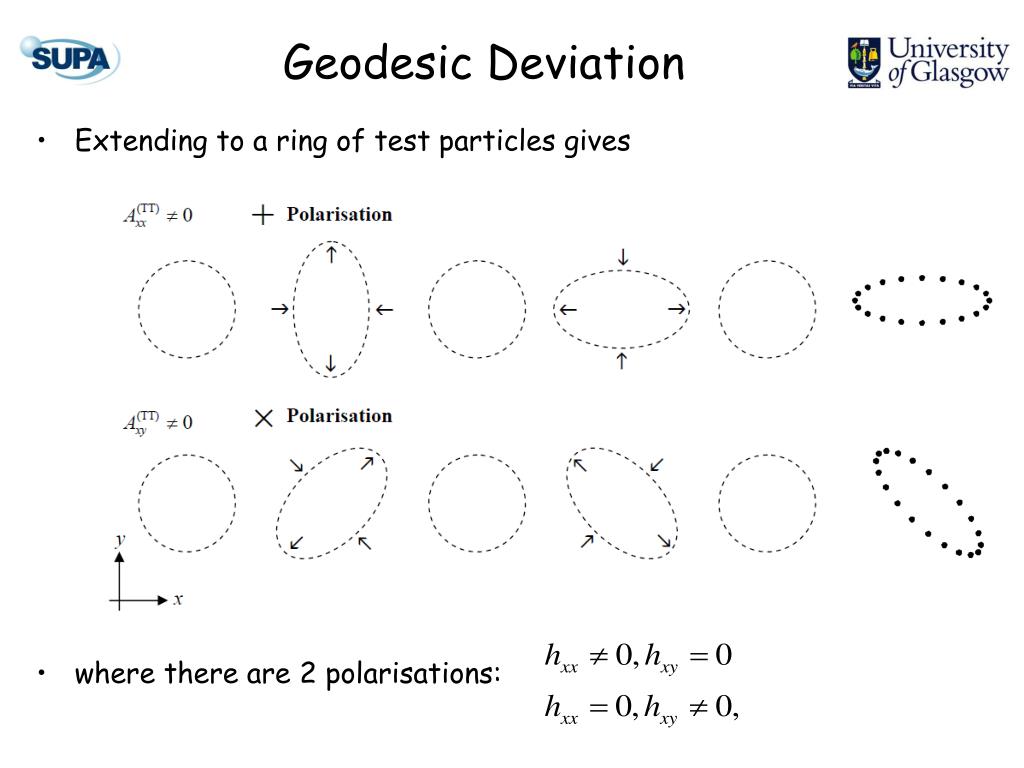
This creates the characteristic '+' shape: the ring is stretched vertically while squeezed horizontally, and vice-versa.
Cross (×) Polarization
For a pure cross-polarized wave, and . The proper distance is:
Let's analyze this case:
- Particle on the x-axis or y-axis ( or ): . The distance to particles on the main axes remains unchanged.
- Particle on the diagonal (): . The distance is stretched and squeezed along the line.
- Particle on the anti-diagonal (): . The distance is squeezed and stretched along the line, out of phase with the other diagonal.
This creates the '×' shape, which is identical to the '+' shape but rotated by 45 degrees.
The following resource provides a detailed derivation and the definitive visualization of this effect.
An Introduction to General Relativity, Gravitational Waves ...
To solidify our understanding, let's study a formal derivation for a particle at an arbitrary angle heta. The lecture notes by Martin Hendry provide an exceptionally clear analysis.
Please read Section 8.3, 'Ring of test particles: polarisation of gravitational waves' (pages 66-69). Follow the derivation of the separation vectors \xi_x and \xi_y. Pay special attention to Figure 9, which shows the time evolution of the ring's distortion for both '+' and '×' polarizations.
The image below summarizes these two fundamental modes of distortion.
Test your understanding!
A gravitational wave detector like LIGO has two long, perpendicular arms. Imagine a detector is oriented with one arm along the x-axis and the other along the y-axis. A pure 'cross' () polarized gravitational wave, propagating along the z-axis, passes through the detector.
Based on our analysis, would this detector register a signal? Why or why not?
Show answer
The detector would not register a signal.
As we derived, a pure cross-polarized wave has . The physical effect is entirely contained in the off-diagonal component, .
The length of the arm along the x-axis only depends on . Since , its length does not change.
The length of the arm along the y-axis only depends on . Since , its length also does not change.
Since the lengths of the arms do not oscillate, there is no change in the light travel time, and no interference pattern is produced. A detector must be oriented at 45 degrees to the principal axes of a cross-polarized wave to achieve maximum sensitivity.
Conclusion
In this lesson, we have dissected the physical impact of a gravitational wave. By focusing on the coordinate-invariant concept of proper distance, we have seen precisely how the two polarization states distort spacetime.
Key Takeaways:
- The physical effect of a gravitational wave is measured by the change in proper distance between freely falling objects, not by their coordinate positions.
- In the TT gauge, free particles remain at fixed coordinate positions, while the spacetime metric itself oscillates, causing the physical distance between the particles to change.
- Plus (+) polarization causes a quadrupolar stretching and squeezing along the horizontal and vertical axes.
- Cross (×) polarization causes an identical quadrupolar distortion, but oriented along the diagonal axes (45 degrees from the plus polarization).
- Any gravitational wave can be described as a linear superposition of these two fundamental polarization states.
Preview of Next Lesson:
We now have a complete picture of what a gravitational wave is and what it does. The final piece of the puzzle in the weak-field limit is to understand how these waves are generated. In the next lesson, we will answer this by deriving one of the most important results in gravitational wave physics: the quadrupole formula for the power radiated by a non-relativistic source. This will connect our theoretical waves to their real-world astrophysical sources, like orbiting binary stars.