Hello! This is the first lesson in a course that begins with everyday electrical safety and later moves to low-voltage circuits. Today, you will learn to read the information already printed on appliances and power adapters. By the end, you should be able to tell what an appliance needs from a supply, what an adapter delivers, and whether a barrel connector’s polarity matches—without plugging anything in to find out.
Allow about 35–40 minutes for the lesson, including the short videos and reading. For now, inspect labels only on unplugged equipment. Do not open an adapter or use an uncertain one as a test.
Start with the direction: input or output?
An appliance label tells you what electrical supply the appliance takes in. A power adapter has two sides: its input is what it takes from a wall outlet, while its output is what it supplies to a device. Labels may abbreviate these as I/P and O/P.
The distinction matters because the two sides can have very different ratings. An adapter might take household alternating current (AC) at its input and supply lower-voltage direct current (DC) at its output. The word adapter alone does not tell you its output type: some devices require a low-voltage AC output instead.
In Turkey, the nominal household supply is 230 V AC at 50 Hz. AC reverses direction repeatedly; the frequency in hertz (Hz) describes how often its cycle repeats. DC maintains one polarity, which is why a DC barrel connector can have a positive center and a negative outer contact—or the reverse. On labels, AC may also be marked with a tilde-like symbol (~); DC may be marked by a solid line above a dashed line.
Electricity 101 - Volts/Amps/Watts etc - Choosing the Correct AC-DC Power Adapter
Watch “Electricity 101 - Volts/Amps/Watts etc - Choosing the Correct AC-DC Power Adapter” from TutorialGenius.com for its comparison of AC and DC adapter outputs.
Watch AC versus DC. Focus on the two adapters whose outputs are both labeled 12 V but differ in AC versus DC. Their matching voltage numbers do not make them interchangeable.
Consider an appliance marked 230 V ~ 50 Hz, 2000 W. It is specifying a household AC input and a power rating. It has no separate output rating or barrel-connector polarity to interpret. We will use appliance power ratings for calculations in the next lesson; today, the goal is to recognize what each number describes.
Read an adapter one line at a time
Imagine a label with these two lines:
INPUT: AC 100–240 V, 50/60 Hz, 0.4 A
OUTPUT: DC 12 V, 2 A
The input line says the adapter is rated for AC supplies from 100 to 240 V and for either listed frequency. Those ratings include Turkey’s nominal 230 V, 50 Hz supply. The 0.4 A is an input-current rating—not the current it always draws and not the current it supplies to the device.
The output line says the adapter supplies 12 V DC and is rated to deliver up to 2 A. Input and output current numbers need not be equal: they refer to different sides of the adapter, at different voltages. Some labels also state watts (W), a unit of power. Keep track of which side a watt figure describes.
Read the following manufacturer guide to see how these markings appear on a real label:
UNIFIVE’s guide shows a sample adapter label and explains its input and output markings. Use it to practice locating the markings rather than trying to memorize a particular adapter’s numbers.
Under “How to Read the Label on an AC/DC Power Adapter,” read the “Model Name, Input, and Frequency” subsection. In its table, begin with the explanation of the model number and continue through the input ratings. Then read the “Output” subsection, including its explanation of O/P and the output ratings; stop before “LPS.” Notice that the input-current figure and output-current figure belong to different sides.
When reading a label, ask in order: Which line is this? Is it AC or DC? What voltage does it specify? What do the current and power figures rate? That order prevents a common mistake: spotting a familiar voltage somewhere on an adapter and assuming it is the voltage delivered to the device.
Match the device’s requirements to the adapter’s output
A device’s marking near its power socket might say DC 12 V, 1 A. That describes what the device requires. An adapter marked OUTPUT: DC 12 V, 2 A describes what the adapter can provide. For a conventional fixed-output adapter, the checks are:
- Type: The device requires DC, and the adapter outputs DC. Do not substitute AC merely because the voltage number matches.
- Voltage: The nominal output voltage matches the device’s specified voltage. Do not assume that “close enough” is safe unless the device documentation gives an allowed range.
- Current capacity: The adapter is rated for at least the current the device requires. A correctly matched device normally draws the current it needs; a 2 A capacity does not, by itself, force 2 A through a 1 A device. An undersized adapter may overheat, shut down, or operate unreliably.
- Connector: The plug must be the correct type and size, with the correct contact arrangement. A plug that looks similar—or can be forced into a socket—is not proof of compatibility.
The next video puts these checks beside actual device and adapter markings.
202: Power Adapters. Finding the right one for your device. Voltage, Plug, Polarity & Power
Watch the selected parts of “202: Power Adapters. Finding the right one for your device. Voltage, Plug, Polarity & Power” from The Tech Doctor Network. The device shown alongside its adapter makes the distinction between required input and available output concrete.
Watch the four checks for voltage, connector size, polarity, and current. Then watch the label example, especially the markings on the device and its corresponding adapter. The intervening portion discusses altering a cord; that is not a step to follow.
Current may be printed in milliamps (mA) rather than amps (A):
Thus, an adapter rated 1000 mA has a 1 A output-current rating. If either the device’s requirements or the adapter’s output markings are missing, do not fill in the gap by guessing.
Decode barrel-connector polarity
For a common cylindrical barrel connector, two metal contacts are separated by insulation. The center contact is represented by a small dot in the polarity symbol; the outer contact is represented by a C-shaped ring. Lines connect those shapes to + and −. Follow the line from the dot to its sign. Do not decide polarity by whether a plus sign happens to be printed on the left or the right.
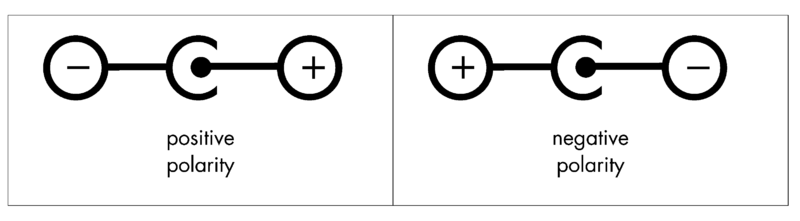
An adapter and device can agree on DC voltage and still be incompatible if one is center-positive and the other center-negative. Read the markings on both. Barrel polarity symbols apply to this connector style; do not use them to infer the pin arrangement of a different connector.
Return to UNIFIVE’s guide for its illustrated comparison of center-positive and center-negative plugs.
Find the “Plug Polarity” subsection, immediately after “Double Insulation.” Read the polarity explanation and inspect both illustrations beneath it. Trace the line from the inner contact to its sign in each illustration; you can stop before “Other Symbols and Indications.”
Put the whole label together
This photographed adapter is a useful final check because its output looks suitable for some low-voltage devices, but its input is not suitable for a 230 V, 50 Hz household outlet.
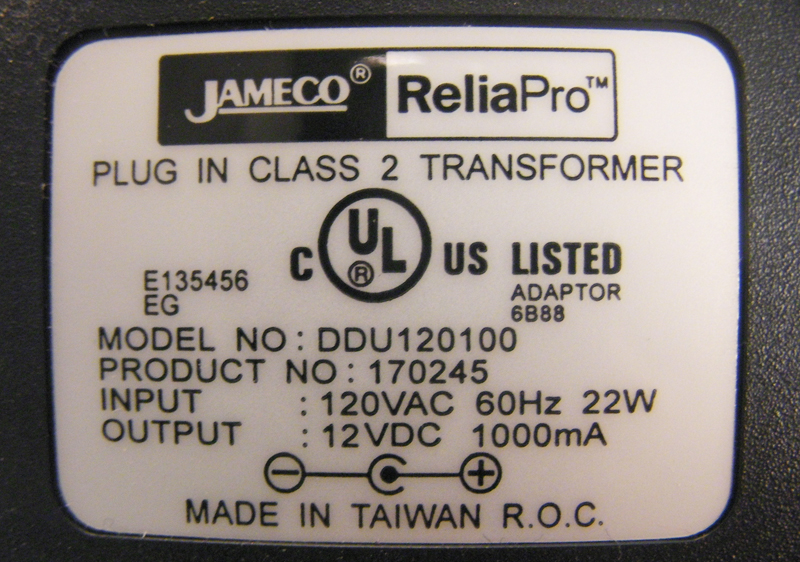
Read it from the wall side toward the device side:
- INPUT: 120 VAC, 60 Hz, 22 W. This is a specified 120 V AC input, not a 100–240 V range. The label also specifies 60 Hz. Do not plug this adapter into a 230 V household outlet, even if a plug arrangement appears to fit. The 22 W figure is on the input line.
- OUTPUT: 12 VDC, 1000 mA. The adapter’s rated output is 12 V DC, up to 1 A. Do not mistake the input’s 22 W for the output’s power rating.
- Polarity symbol: The center dot connects to
+, so this barrel output is center-positive. Its outer contact is negative.
Even if a device asks for 12 V DC, 1 A, center-positive, those matching output details cannot override the adapter’s incompatible input rating. To assess a different adapter, you would check both ends: its input rating against the available AC supply, then its output type, voltage, current capacity, polarity, and connector against the device. When a marking is unclear, leave the equipment unconnected and consult its documentation rather than testing by trial and error.
Key takeaways
An appliance label describes what the appliance takes in; an adapter label separates what it takes in from what it supplies. Read AC or DC before voltage, and keep input ratings separate from output ratings. For a DC barrel-powered device, matching voltage alone is not enough: check current capacity, connector fit, and center polarity as well.
In the next lesson, you will use an appliance’s power rating and Turkey’s nominal 230 V supply to estimate its current draw.