Welcome back! In our last session, we focused on the letters you don't pronounce in French, particularly those silent letters at the end of words. This is a huge step toward understanding spoken French and reading subtitles.
Today, we'll explore the flip side of that coin: a phenomenon called liaison, where those same silent letters suddenly come back to life. Mastering liaison is one of the keys to making your French flow naturally, moving you from speaking word-by-word to linking phrases together like a native speaker. This is essential for your goal of being able to chat fluently and understand the rapid pace of modern spoken French.
The Secret to French Fluency
French speakers don't pronounce words as separate blocks; they connect them into "sound blocks" or blocs sonores. This creates a musical rhythm that can be hard to follow at first. Two key mechanisms create this flow: elision (shortening words, like je ai becoming j'ai) and liaison.
Let's get a feel for why this is so important.
The French Accent: Mastering Elision and Liaisons
This article from Ohlala French Course introduces the concept of speaking in "flows" rather than isolated words.
Start by reading the introduction, where the author explains that French is spoken in a flow. Then, skip down to the section titled "LIAISONS: the magic chaining of French". Read the definition and the examples provided, like these common phrases. Finally, read the short section on musicality to understand how these links form the rhythm of the language.
As the article explains, a liaison happens when the final, normally silent consonant of a word is pronounced to link it to the next word, but only if that next word begins with a vowel sound (a, e, i, o, u) or a silent 'h'.
For example:
les(the) is pronounced [le]. The 's' is silent.amis(friends) is pronounced [ami].- But when you say
les amis, you make a liaison: the 's' is pronounced as a 'z' sound, linking the two words: [le-z-ami].
The Three Flavors of Liaison
The trick with liaison is knowing when to do it. In French, there are three categories:
- Obligatory liaisons (liaisons obligatoires): You must make these. Not doing them sounds wrong, even in the most casual slang.
- Optional liaisons (liaisons facultatives): You can make these, but you don't have to. This is where register comes in—making more of these liaisons sounds formal and literary, while dropping them is characteristic of casual, everyday speech.
- Forbidden liaisons (liaisons interdites): You must never make these. Doing so is a clear pronunciation mistake.
Let's start with the ones you absolutely need to know.
Obligatory Liaisons: The Must-Do's
These liaisons are the bedrock of spoken French. The video below breaks down the most common situations where liaison is required.
When do you pronounce the end of the word in French? LES LIAISONS OBLIGATOIRES!
Alexa from "Learn French With Alexa" gives a clear and structured explanation of the most important compulsory liaisons.
First, watch her initial explanation of what a liaison is from the beginning, using the example les oranges. Then, focus on these key groups of obligatory liaisons: Article/Adjective + Noun (watch here): This is the most common type. Pay attention to examples like un ami (a friend), les olives (the olives), and petits enfants (little children). Pronoun + Verb (watch here): This is also extremely common. Notice how nous avons (we have) and ils sont (they are) are linked.
The core takeaway is that you almost always make a liaison after determiners (un, les, des, mon, mes), short adjectives placed before a noun (petit, grand, bon), and subject pronouns (nous, vous, ils, elles, on).
Sound Changes in Liaison
As you might have noticed, the letter's sound can change during liaison. Here are the most common transformations:
s,x,z→ sound like [z]vous_êtes(you are) → voo-zetdeux_ans(two years) → deu-zan
d→ sounds like [t]un grand_arbre(a big tree) → un gran-tarbre
f→ sounds like [v]neuf_heures(nine o'clock) → neu-veures
n→ pronouncedmon_ami(my friend) → mon-nami
The following video provides more examples of these sound changes.
Sound Like a Native with the French Liaison
This video from FrenchPod101.com is great for hearing how different letters change their sound during liaison.
You can skim through these sections to hear the specific sounds: S, X, and Z making the [z] sound. T and D making the [t] sound. F making the [v] sound.
Optional Liaisons and Sounding "Street"
This is where we get to your goal of learning modern, informal French. The key to sounding casual is knowing which liaisons to drop. The more optional liaisons you omit, the more informal and relaxed your speech will sound.
Optional French Liaisons - Lawless French Pronunciation
This article from Lawless French is fantastic because it categorizes optional liaisons from most common to least common and provides audio for both pronunciations (with and without liaison).
First, read the introductory paragraph which states the main principle: more liaisons equals more formal. Then, look at the numbered list. You don't need to memorize it, but listen to a few examples to get a feel for the difference. Listen to #2: "Between two-part verbal structures". For example, click the audio for je suis allé and notice how the formal version [zheu swee zah lay] becomes the more common, informal [zheu swee ah lay]. Listen to #3: "être + adjective". Hear how il est ici can be [ee lay tee see] (formal) or [ee lay ee see] (informal). In casual chat, you'll hear the versions without the liaison far more often. Getting used to dropping these is a step toward sounding more natural.
Liaison vs. Enchaînement
One final, important distinction. Liaison is when a normally silent consonant is pronounced. But sometimes, a consonant that is always pronounced just links to the next word. This is called enchaînement (linking).
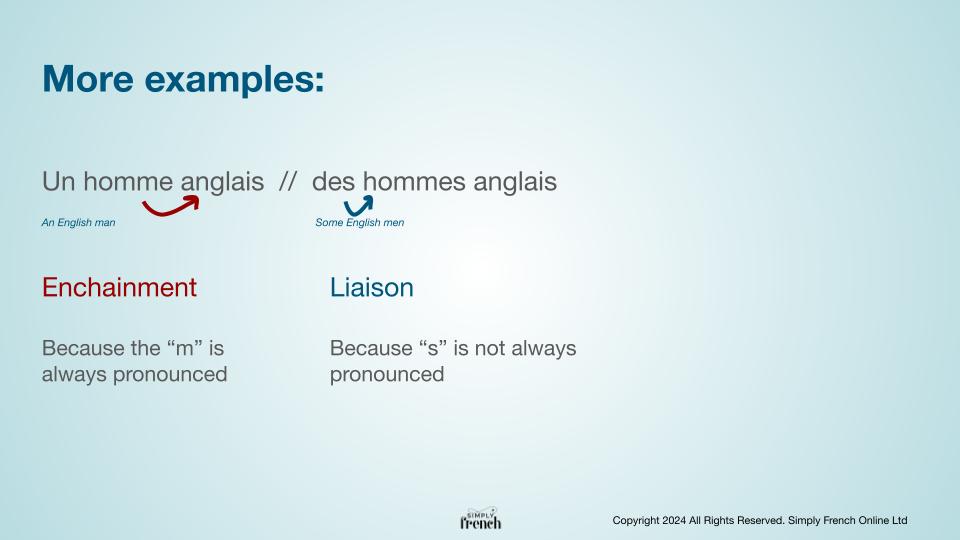
- Enchaînement:
un homm(e)‿anglais(the 'm' is pronounced anyway) - Liaison:
de(s)‿hommes(the 's' is silent until it links)
Key Takeaways
- Liaison is the pronunciation of a normally silent final consonant to link to a following word that starts with a vowel sound.
- It is the key to the smooth, flowing rhythm of spoken French.
- Obligatory liaisons (e.g.,
les_amis,vous_avez) are essential and must always be made. - Optional liaisons are where you can adjust your level of formality. Dropping them makes you sound more casual and is typical of modern, spoken French.
- Forbidden liaisons (e.g., after
et- "and") are never made.
Next Steps
We have now covered the essential building blocks of French pronunciation: vowels, consonants, silent letters, and liaison. You're well-equipped to start tackling real words and phrases. In the next module, we'll do just that, beginning with one of the most fundamental aspects of French conversation: greetings and the crucial difference between the informal tu and the formal vous.