Hello! Welcome back to our second lesson.
In our last session, we established the auditor's overall objectives as defined in SA 200: to obtain reasonable assurance and to report on the financial statements. We also highlighted that achieving these objectives requires the auditor to comply with relevant ethical requirements. Today, we'll explore exactly what those requirements are.
This lesson addresses the second learning outcome in our foundational module: to describe the fundamental principles of professional ethics and their role in an audit.
You've likely encountered ethical dilemmas during your articleship. This lesson will provide the formal framework—the ICAI Code of Ethics—that guides an auditor's professional conduct. Understanding this isn't about memorizing rules; it's about grasping the very foundation of the public's trust in our profession. Without a strong ethical compass, the auditor's opinion would be worthless.
1. The Bedrock of the Profession: Why Ethics Matter
Before we list the principles, let's understand their context. As a professional, a Chartered Accountant's primary asset is credibility. Stakeholders—investors, lenders, and the public—rely on the auditor's work precisely because they trust the auditor to be independent, honest, and competent.
The ICAI's Code of Ethics provides the standards of behavior expected of all CAs to command this respect and confidence. It's not just a guide; it regulates the conduct of members under the Chartered Accountants Act, 1949.
As this summary from an ICAI publication notes, the Code of Ethics is essential for building public trust.
[PDF] Auditing Standards & Code of Ethics - Kochi ICAI
To start, let's look at a concise explanation of what professional ethics are and why they are crucial for a CA.
Please read the section titled 'Ethics and professional ethics' on page 102. Focus on the definition of professional ethics and the stated reason for its importance: 'commanding the respect and confidence of the regulators and public at large.'
2. The Five Fundamental Principles
The ICAI Code of Ethics, which is based on the global code from the International Ethics Standards Board for Accountants (IESBA), is built upon five fundamental principles. These are the non-negotiable pillars of professional conduct.
This diagram gives a simple visual representation of these core principles.
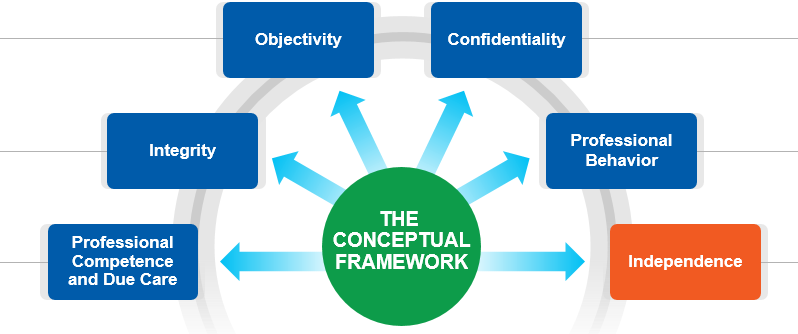
To understand what each of these principles means in practice, let's watch a video that explains them with clear definitions and examples.
Professional Ethics - ACCA Audit and Assurance (AA)
This video from OpenTuition provides an excellent and practical explanation of the five fundamental principles. Although it's for an ACCA course, the principles are identical to those in the ICAI Code as both are based on the IESBA code.
Watch the segment from 00:02:31 to 00:09:43. As you watch, think about how each principle—Integrity, Professional Competence and Due Care, Confidentiality, Professional Behaviour, and Objectivity—would apply to situations you may have seen during your articleship.
Now that you have a conceptual understanding, it's crucial to connect it to the precise language used by ICAI. Your ability to do this is key for the exam. The following resource is directly from an ICAI publication and provides the official definitions.
[PDF] PROFESSIONAL ETHICS - ICAI
Let's reinforce your understanding with the official ICAI text. Compare these formal definitions with the explanations you just saw in the video.
Read the section 'Fundamental Principles – IO-PCP' on page 2. Pay close attention to the specific wording used for each of the five principles (Sub-sections 111 to 115). This is the technical language you'll need to reproduce in your exams.
To summarize and consolidate:
- Integrity: Being straightforward and honest. It means not just telling the truth but also standing up for what is right, even under pressure.
- Objectivity: Not allowing bias, conflict of interest, or the undue influence of others to override your professional judgment.
- Professional Competence and Due Care: Having the necessary skills and knowledge to perform your duties diligently and in accordance with technical and professional standards. This principle also requires a commitment to lifelong learning to stay updated.
- Confidentiality: Respecting the privacy of information acquired during your work. You must not disclose it to third parties without proper authority, unless there's a legal or professional right or duty to do so.
- Professional Behaviour: Complying with relevant laws and regulations and avoiding any action that discredits the profession. This includes how you represent yourself and your services.
3. Upholding the Principles: The Conceptual Framework
It's one thing to know the principles, but how do you apply them in the real world, which is full of pressures and complex situations? The Code of Ethics provides a conceptual framework to help with this. It's a three-step process:
- Identify threats to compliance with the fundamental principles.
- Evaluate the significance of those threats.
- Address the threats by applying safeguards to eliminate them or reduce them to an acceptable level.
This framework moves you away from a simple "rules-based" approach to an "ethics-based" one, requiring you to think through situations.
First, let's understand what threats are. The Code categorizes them into five types. This short summary provides a clear list of these threats.
[PDF] Auditing Standards & Code of Ethics - Kochi ICAI
This section of the Kochi ICAI presentation clearly defines the five categories of threats to ethical compliance.
Read the section 'Threats and safeguards' on page 106. Focus on the definitions of the five categories of threats: Self-interest, Self-review, Advocacy, Familiarity, and Intimidation.
Now, let's see some practical examples of these threats. The same video we watched earlier provides excellent illustrations.
Professional Ethics - ACCA Audit and Assurance (AA)
This video gives memorable examples that bring the five types of threats to life. Understanding these will help you spot ethical risks in exam scenarios.
Watch from 00:09:43 to 00:34:46. Don't worry about memorizing every example. Instead, focus on understanding how each scenario creates a specific type of threat and which fundamental principle it challenges. Self-interest: How might overdue fees or owning shares in a client affect your Objectivity? Self-review: What's the risk if you audit financial statements your own firm prepared? This challenges both Objectivity and Professional Competence. Familiarity: How can a long-standing relationship with a client erode your professional skepticism, which is a key part of maintaining Objectivity? Advocacy: If you promote a client's shares to investors, how does that compromise your future Objectivity when auditing? Intimidation: How can a threat of litigation from a client pressure you to compromise your Integrity and Objectivity?
When you evaluate a threat, the key question to ask is whether it is at an "acceptable level." The ICAI Code defines this using the "reasonable and informed third party test": Would a well-informed third person, weighing all the facts, likely conclude that you are complying with the principles? This is a critical thinking tool for justifying your ethical decisions.
If a threat is not at an acceptable level, you must apply safeguards. Safeguards are actions that reduce the threat. Examples include:
- Rotating the senior audit personnel off the engagement (safeguard for a familiarity threat).
- Having a second partner review the work (safeguard for a self-review threat).
- Resigning from the engagement if the threat cannot be reduced (the ultimate safeguard).
Key Takeaways
Great job! We've unpacked the ethical core of the auditing profession.
- The credibility of an audit rests entirely on the auditor's adherence to professional ethics.
- The five fundamental principles are Integrity, Objectivity, Professional Competence and Due Care, Confidentiality, and Professional Behaviour.
- The conceptual framework (Identify, Evaluate, Address) is the practical process for upholding these principles.
- Auditors must be alert to five types of threats: Self-interest, Self-review, Advocacy, Familiarity, and Intimidation.
- The goal is to apply safeguards to reduce any identified threats to an acceptable level, using the "reasonable and informed third party test" as a guide.
Preview of the Next Lesson
In this lesson, we saw how threats from familiarity or intimidation can compromise an auditor's objectivity. To counter this, an auditor needs a specific mindset. Our next lesson will focus on exactly that: professional skepticism and professional judgment. We will explore how an auditor maintains a questioning mind and uses their experience to make critical decisions, which are essential for applying these ethical principles in practice.