Hello! Welcome to the first lesson in our module on "Forming the Opinion and Standard Reporting."
In our previous lesson on SA 580, we discussed how obtaining the Management Representation Letter is one of the final, crucial steps in gathering audit evidence. We established that the entire audit process—planning, risk assessment, evidence gathering—builds towards one ultimate goal: forming an opinion.
Today, we delve into that culmination with SA 700 (Revised), Forming an Opinion and Reporting on Financial Statements. Our learning outcome is to describe the process of forming an opinion on the financial statements based on the audit evidence obtained as per SA 700.
You've mentioned that understanding the logical flow is crucial for you. This lesson is the lynchpin connecting all the audit work you've notionally performed with the final product—the audit report. We will break down the structured, methodical process an auditor follows to move from a mountain of evidence to a clear, defensible opinion.
1. The Foundation: Concluding on Reasonable Assurance
The process of forming an opinion isn't arbitrary; it's a logical conclusion based on a fundamental audit concept you've already mastered from SA 200: reasonable assurance.
The first step in the process is for the auditor to step back and conclude whether they have obtained reasonable assurance that the financial statements as a whole are free from material misstatement.
To do this, the auditor must synthesise all the evidence and evaluations performed throughout the audit. This involves concluding on three critical points:
- Sufficiency and Appropriateness of Audit Evidence: Has enough high-quality evidence been gathered to support a conclusion? (Relates to SA 500 series).
- Materiality of Uncorrected Misstatements: Are the misstatements found during the audit (and not corrected by management) material, either individually or when added together? (Relates to SA 450).
- Compliance with the Financial Reporting Framework (FRF): Are the financial statements prepared, in all material respects, in accordance with the applicable FRF (e.g., Ind AS)?
Let's read a short section that formalises this initial phase of the process.
This document from the CA Test Series, based on ICAI material, clearly lays out the initial steps an auditor takes to form an opinion. It directly addresses the need to conclude on reasonable assurance.
Please read section 1.2 To Form Opinion – Auditor to Obtain Reasonable Assurance on page 8.5. Note how it explicitly links forming an opinion to obtaining reasonable assurance and lists the three key considerations mentioned above.
This first step is essentially a gatekeeper. If the auditor hasn't obtained sufficient appropriate evidence, the process halts, and more audit work is required.
The flowchart below visualises this iterative nature of the audit process. The auditor continually evaluates evidence before moving to the final stage of forming an opinion.

2. The Core of the Process: Specific Evaluations
Once the auditor is satisfied with the overall body of evidence, SA 700 mandates a series of specific, detailed evaluations. This is the analytical heart of the opinion-forming process. It's not enough that the numbers add up; the auditor must assess the quality and appropriateness of the accounting itself.
A video from Sachin Agarwal provides a great overview of these points.
SA 700, 701, 705, 706, 710, 720 Revision | CA Final AUDIT | Complete Coverage |Sachin Agarwal AIR 16
This short video provides a practical and quick summary of the key evaluations an auditor must perform before finalising their opinion.
Watch the segment from 03:14 to 05:06. The speaker breaks down the auditor's evaluation of disclosures, accounting estimates, policies, and even the terminology used in the financial statements.
Now, let's dive into the technical details of these evaluations. For your exam preparation, knowing these specific points and the correct terminology is vital.
The auditor shall evaluate whether the financial statements are prepared in accordance with the FRF. This includes:
- Qualitative Aspects of Accounting Practices: The auditor looks for indicators of possible management bias. For example, is management selectively correcting misstatements that increase reported earnings but ignoring those that decrease them? This goes beyond just accuracy and into the realm of professional skepticism.
- Specific Evaluations (The SA 700 "Checklist"): The auditor must specifically assess whether:
- The significant accounting policies are adequately disclosed.
- The selected accounting policies are consistent with the FRF and appropriate for the entity.
- The accounting estimates made by management are reasonable.
- The information presented is relevant, reliable, comparable, and understandable.
- Adequate disclosures are provided to help users understand the effect of material transactions and events.
- The terminology used, including the titles of financial statements (e.g., "Statement of Profit and Loss"), is appropriate.
To get the precise wording for these points, which will be very useful for your exam answers, please read the following text.
This resource provides a detailed, structured list of the evaluations required by SA 700. It's an excellent guide for understanding the technical requirements.
Read sections 1.3 Evaluations by the Auditor and 1.4 Specific Evaluations by the Auditor (pages 8.5 to 8.7). Pay special attention to the examples of management bias and the checklist of specific evaluations.
3. The Decision Point: Choosing the Opinion
After performing all these evaluations, the auditor arrives at the final step in the process: making a decision. Based on the conclusions drawn, the auditor decides which type of opinion is appropriate for the circumstances.
This decision creates two distinct paths:
- Path 1: Unmodified Opinion: If the auditor concludes that the financial statements are prepared, in all material respects, in accordance with the applicable FRF, they will issue an unmodified (or "clean") opinion.
- Path 2: Modified Opinion: If the auditor concludes that the financial statements are materially misstated, OR if they were unable to obtain sufficient appropriate audit evidence, they must modify the opinion.
The flowchart below provides a clear visual map of these reporting options. Our focus today is on the process leading to this split.
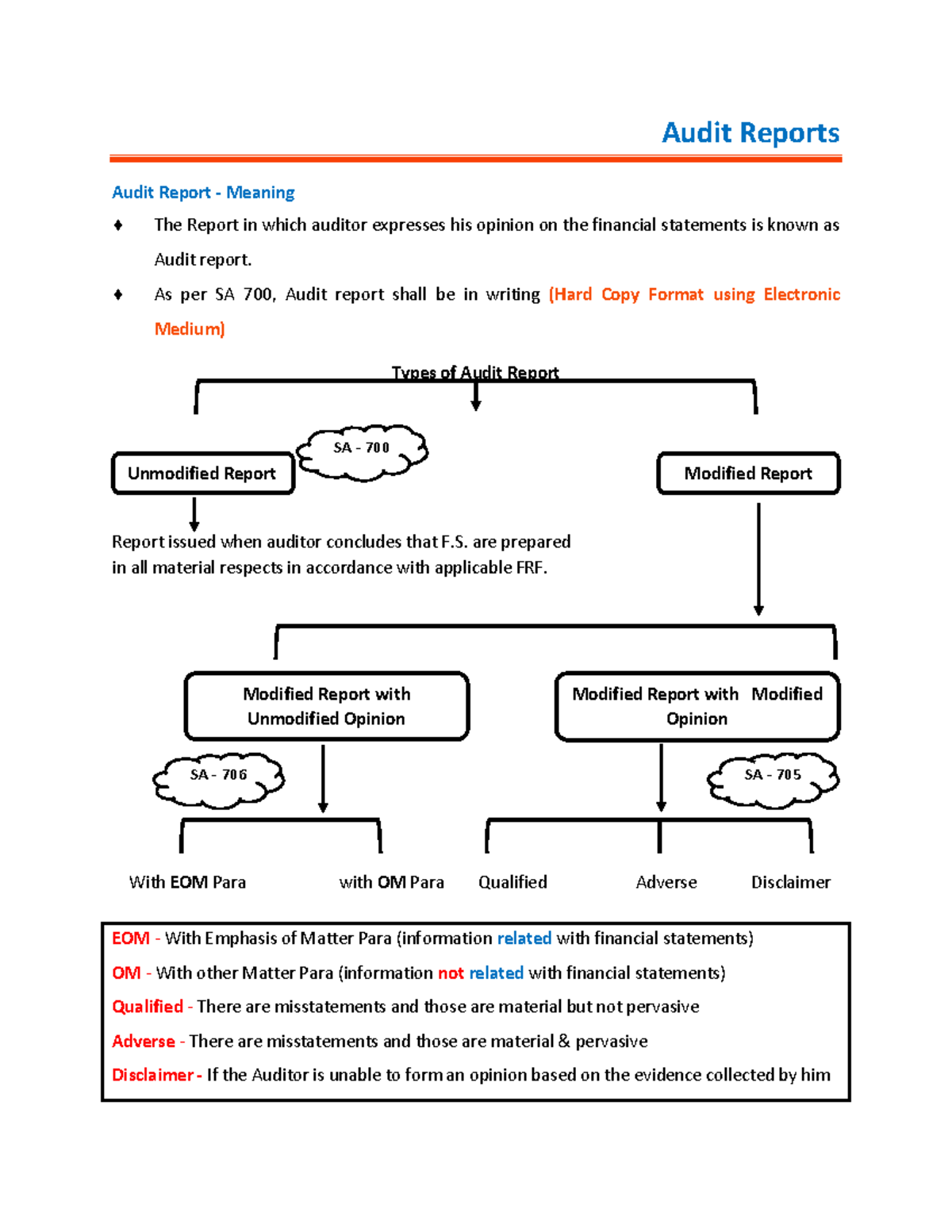
Let's watch a brief video that explains this crucial decision point.
SA 700, 701, 705, 706, 710, 720 Revision | CA Final AUDIT | Complete Coverage |Sachin Agarwal AIR 16
This segment clearly distinguishes the conditions that lead to an unmodified opinion versus a modified opinion. This is the final outcome of the opinion-forming process.
Watch from 05:06 to 06:19. Note the two distinct reasons for a modified opinion: the presence of a material misstatement or the inability to obtain sufficient appropriate audit evidence.
It is important to remember that this lesson focuses on the process of reaching this decision. The specifics of how to write the report and the different types of modified opinions (Qualified, Adverse, Disclaimer) are detailed in SA 700, 705, and 706, which we will cover in the upcoming lessons.
Conclusion
Today, we have deconstructed the methodical process an auditor undertakes to form an opinion. It's a journey from evidence to conclusion, guided by professional judgment and the specific requirements of SA 700.
Key Takeaways:
- Systematic Process: Forming an opinion is not a subjective judgment but a structured process that begins with concluding whether reasonable assurance has been obtained.
- Critical Evaluations: The core of the process involves specific evaluations of the qualitative aspects of accounting, the appropriateness of policies, the reasonableness of estimates, and the clarity of disclosures.
- The Final Decision: This entire process culminates in a crucial decision: whether the evidence supports an unmodified opinion or necessitates a modification.
Preview of the Next Lesson
Now that we understand the rigorous process of forming an opinion, our next lessons will focus on the output of that process—the audit report itself.
In the next lesson, we will identify the specific conditions required to issue an unmodified (clean) audit opinion. We will then follow that by breaking down the key elements of an unmodified auditor's report, ensuring you have the precise technical language required to draft and interpret these sections for your exams.