Hello! Let's get started on our final lesson for this module.
Introduction
In our last session, we established a strong foundation by exploring why Key Audit Matters (KAMs) are communicated and how an auditor determines which matters are of "most significance." We used the funnel analogy to understand the process of filtering from all matters communicated with Those Charged with Governance (TCWG) down to the few that are ultimately included in the audit report.
Today, we transition from identification to communication. Our focus will be on the practical skill of drafting a KAM paragraph. This is where your conceptual understanding meets the precise technical wording required by the ICAI. By the end of this lesson, you will be able to draft a sample KAM paragraph for a given scenario, clearly explaining the matter and how the audit addressed it, fulfilling the final learning outcome of this module.
This lesson is designed to directly help with the challenge you mentioned: translating your practical understanding into the specific format and language that examiners expect.
Part 1: The Anatomy of a Key Audit Matter Communication
Before we draft an individual KAM, let's look at how the entire KAM section is structured within the audit report. It's not just a block of text; it has a clear, prescribed format.
- Main Heading: The section begins with the heading "Key Audit Matters".
- Introductory Paragraph: This is a mandatory, standard paragraph that sets the context for the reader. It explains what KAMs are and clarifies the scope of the auditor's communication.
- Individual KAMs: Each Key Audit Matter is then presented separately, under its own descriptive subheading.
Let's focus on the introductory paragraph first. It must state two crucial points:
- A definition of KAMs (i.e., matters of most significance in the audit).
- A clarification that these matters were addressed in the context of the audit of the financial statements as a whole, and that the auditor does not provide a separate opinion on these matters.
CA Final Audit Revision Session & QnA Discussion-SA 701 for May 26 exam & onwards by CA Rishabh Jain
To see how this structure is presented, let's watch a brief segment from CA Rishabh Jain's revision session. He clearly outlines the drafting requirements.
Watch from 11:46 to 13:05. Focus on the three components: the main heading, the standard introductory language, and the separate subheadings for each matter.
To ensure you have the precise wording, here is the illustrative introductory paragraph from the ICAI's implementation guide.
Implementation Guide to Standard on Auditing (SA) 701
This ICAI guide provides the exact wording you should be familiar with for your exams. Memorizing the structure and key phrases of this paragraph is highly beneficial.
Please read Question 17, focusing on the 'Illustrative paragraph of key audit matters' (page 12 of the PDF). Notice how it perfectly aligns with the two crucial points mentioned earlier.
Part 2: The Two Pillars of a KAM Description: "Why" and "How"
This is the core of today's lesson. Each individual KAM description must be structured to answer two fundamental questions for the user:
- Why was this matter considered a Key Audit Matter?
- How was this matter addressed in the audit?
Let's break down what goes into each part.
Implementation Guide to Standard on Auditing (SA) 701
The ICAI's Implementation Guide offers an excellent, detailed breakdown of what to include in the description of an individual KAM. This is the most important resource for mastering the drafting skill.
Read the section titled 'Description of individual key audit matters' (starts on page 25 of the PDF). Pay close attention to the bullets under 'Why was the matter considered to be a key audit matter' and 'How the matter was addressed in the audit'.
Based on that reading, let's summarize the key components:
1. The "Why" Section (The Key Audit Matter description)
This part explains the nature of the matter and why it was significant. Your description should be entity-specific and avoid generic language. It should include:
- A reference to the related disclosures in the financial statements (e.g., "Refer to Note X to the financial statements").
- A description of the situation and the specific area of complexity or high risk.
- An explanation of why it involved significant management judgment or posed a challenge to the auditor.
2. The "How" Section (The Auditor's Response)
This part provides a brief overview of the audit procedures performed to address the risk identified in the "Why" section. The key is to be specific enough to demonstrate a clear response without revealing confidential details or overwhelming the user. It should include:
- A brief overview of the procedures performed (e.g., tested key controls, involved an auditor's expert, challenged key assumptions).
- An indication of the outcome or key observations from the procedures.
- A clear link between the procedures performed and the risks described.
This two-column approach is very common in actual audit reports. Look at this example:
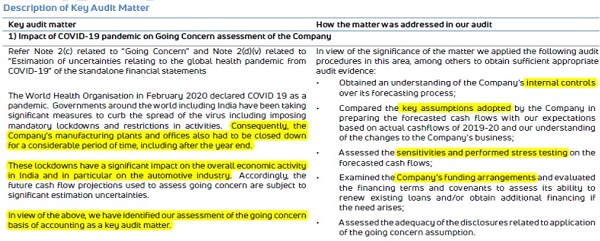
Part 3: Learning from Examples
The best way to master drafting is to study well-crafted examples. You've already seen one above. Now, let's analyze a few more to see how the "Why" and "How" structure is applied in different scenarios.
Implementation Guide to Standard on Auditing (SA) 701
The Appendix of the ICAI's Implementation Guide contains several excellent, illustrative examples. These are written in the precise style expected in exams.
Please read the examples in the Appendix: Illustrative Examples of Key Audit Matters (starting on page 33). I suggest focusing on Example A (Lease rental income) and Example E (Carrying value of goodwill). For each, identify: The 'Why': What specific risks or judgments made this a KAM? The 'How': What specific audit procedures were performed in response?
To see how these principles apply to prominent Indian companies, you can also explore real-world examples.
SA 701 – Key Audit Matter – Evaluation with actual examples
This article from Taxguru.in analyzes the KAMs from the audit reports of major companies like TCS, Maruti Suzuki, and Tata Motors. This provides excellent practical insight.
Quickly scan through the KAMs for Tata Motors Limited, focusing on 'Impairment testing of long-life property, plant and equipment...' (Section A). Compare the 'Details of matter discussed' (the 'Why') with the detailed list of audit procedures (the 'How'). Notice how the auditor involved valuation specialists to challenge management's assumptions.
Part 4: Your Turn to Draft
Now it's time to put this into practice. This exercise will directly test the learning outcome for this lesson.
Scenario:
You are the auditor of "Chaitanya Manufacturing Ltd.", a listed company. The company holds a significant amount of inventory valued at ₹150 crores, which represents 30% of its total assets. During the year, a new, more efficient technology emerged in the market, posing a risk that a significant portion of the company's finished goods could become obsolete.
Management has assessed this risk and recorded a provision for inventory obsolescence of ₹10 crores. This assessment involved significant judgment and was based on complex estimates of future demand, potential selling prices, and disposal costs. You have identified the valuation of inventory as a significant risk due to the high estimation uncertainty.
Your Task:
Based on the scenario above, draft a complete Key Audit Matter paragraph that would be included in the auditor's report.
Your draft should include:
- A suitable subheading (e.g., "Valuation of Inventory").
- A reference to a fictional note in the financial statements.
- The "Why" section: Explain the context, the significant judgment involved, and why it's a KAM.
- The "How" section: Describe the key audit procedures you would have performed to address this risk.
Take about 10-15 minutes to construct your answer. Think about the procedures you might have performed during your articleship in a similar situation.
...
Model Answer:
Here is a sample answer drafted based on the principles of SA 701. Compare it with your draft.
Key Audit Matters
(Introductory Paragraph as discussed in Part 1)
Valuation of Inventory
Key Audit Matter (The "Why")
The company’s inventory is carried at ₹150 crores as at 31st March 20XX, as disclosed in Note 12 to the financial statements.
During the year, the emergence of a new technology has created a significant risk of obsolescence for the company's finished goods. Management has recognised a provision for inventory obsolescence of ₹10 crores.
We identified the valuation of inventory as a key audit matter due to the significant management judgment and high degree of estimation uncertainty involved in determining the provision. The key assumptions underpinning the provision relate to forecasting future customer demand, estimating the net realisable value of potentially obsolete stock, and assessing the impact of the new technology on the market.
How the matter was addressed in our audit (The "How")
Our audit procedures to address the valuation of inventory included, among others:
- Understanding and evaluating the design and implementation of the company's controls over inventory valuation, including the process for identifying obsolete stock.
- Challenging the key assumptions used by management in their obsolescence provision calculation. This included comparing management's forecasts of future demand to historical trends, market analysis reports, and the company’s order book.
- Attending the physical inventory count to identify slow-moving or potentially obsolete items.
- Testing the net realisable value of a sample of inventory items by examining sales orders and invoices subsequent to the year-end to verify the actual selling prices achieved.
- Assessing the adequacy and completeness of the company’s disclosures regarding inventory valuation and the estimation uncertainty in Note 12 to the financial statements.
Conclusion
Excellent work today! We have bridged the gap between theory and practice, focusing on the critical skill of drafting a Key Audit Matter paragraph that is both compliant with SA 701 and communicates effectively to users.
Key Takeaways:
- Structure is Key: A KAM description has two parts: the 'Why' (describing the matter and its significance) and the 'How' (describing the audit response).
- Be Specific: Generic descriptions are unhelpful. The power of a KAM lies in its entity-specific detail, explaining the unique challenges of that audit.
- Link Response to Risk: The audit procedures described in the 'How' section must directly address the judgments, risks, and uncertainties outlined in the 'Why' section.
- Official Wording Matters: The overall KAM section has a mandatory heading and introductory paragraph that you should know for your exams.
Preview of the Next Lesson
We have now completed our deep dive into the standard audit report and the communication of Key Audit Matters. In our next module, we will explore what happens when the auditor concludes that the financial statements are not free from material misstatement, or when the auditor cannot obtain sufficient appropriate evidence.
Our next lesson will introduce SA 705, Modifications to the Opinion in the Independent Auditor's Report. We will begin by explaining the foundational concept of pervasiveness, which is critical for determining whether to issue a qualified opinion, an adverse opinion, or a disclaimer of opinion.