Hello! Welcome to our final lesson in this module on audit reporting.
Introduction
In our last lesson, we focused on SA 710, detailing your reporting responsibilities when a predecessor auditor was involved. We established the importance of using an Other Matter paragraph to clearly communicate the facts of the prior period audit without taking responsibility for it. This was a crucial step in understanding how auditors manage responsibilities across different reporting periods.
Today, we shift our focus from the numbers in previous periods to the words that accompany the numbers in the current period. Our learning outcome is to explain the auditor's responsibility to read and consider 'other information' included in documents containing audited financial statements, as per SA 720.
The financial statements don't exist in a vacuum. They are usually presented as part of a larger package, the Annual Report, which includes narratives like the Director’s Report and Management's Discussion & Analysis (MD&A). As you know from your articleship experience, these narrative sections are read carefully by stakeholders.
The 'why' behind SA 720, which will be our focus, is to protect the integrity of the audit. If the Director's Report claims record-breaking profits while the audited financial statements show a loss, it undermines the credibility of the entire annual report, including your audit report. This standard sets out a clear, logical process for the auditor to address such risks.
Part 1: Defining 'Other Information'
First, let's be precise about what SA 720 covers. The standard defines 'Other Information' as financial or non-financial information (other than the financial statements and the auditor's report) that is included in an entity’s annual report.
To understand the scope, it's helpful to see what typically is and isn't considered 'Other Information'.
[PDF] Implementation Guide to Standard on Auditing (SA) 720(Revised)
The ICAI's Implementation Guide for SA 720 provides an authoritative list of what constitutes 'Other Information' and, just as importantly, what does not. This clarity is essential for applying the standard correctly.
Please read the section under the heading '‘Other information’' (starts around page 4). Focus on the two lists provided: the documents that may form part of the annual report (e.g., Director's Report, Corporate Governance Report) and the documents that are not considered 'Other Information' (e.g., standalone sustainability reports).
To summarize, 'Other Information' generally includes documents intended to provide context to the financial statements, such as:
- Director’s Report
- Management Discussion & Analysis (MD&A)
- Chairman’s Statement
- Corporate Governance Report
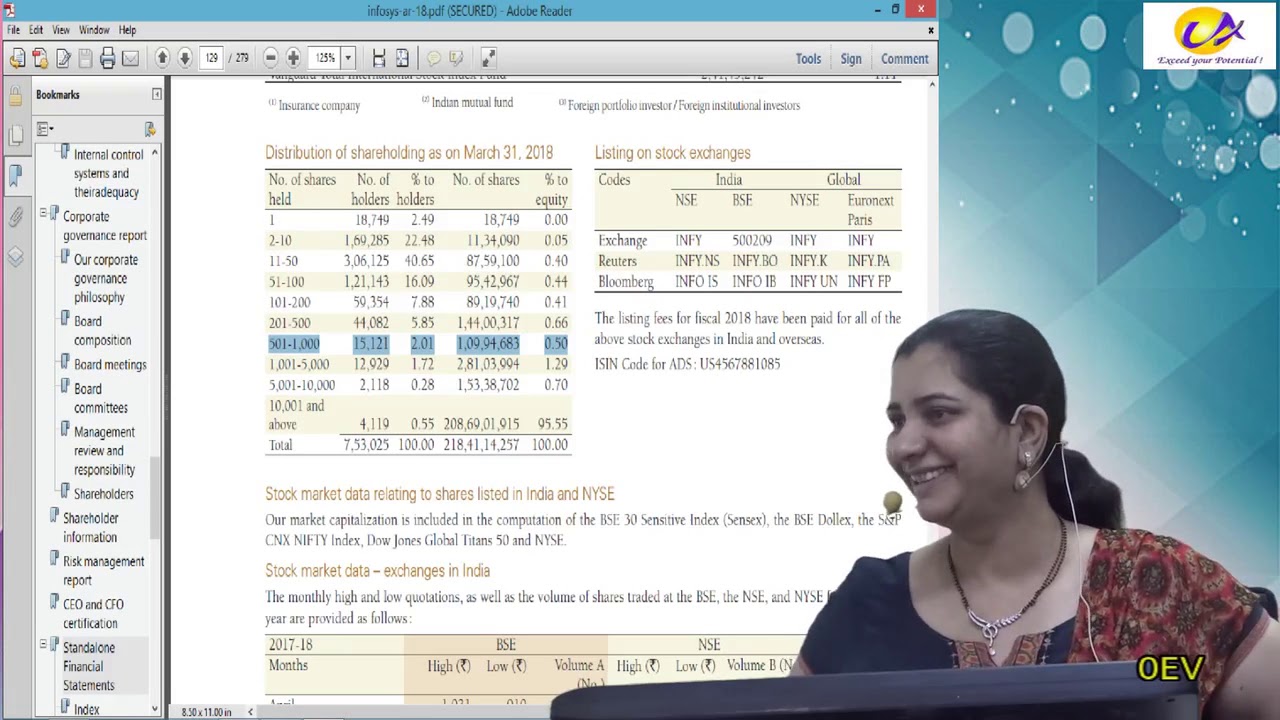
A practical example helps make this tangible. An annual report for a company like Infosys contains extensive information beyond the core financial statements.
For a more structured list of examples you might encounter, please review the notes below.
[PDF] Chapter – 7 “Audit Reports” - ALT CLASSES
These notes from ALT CLASSES provide a clean breakdown of examples, categorizing them into financial amounts/ratios and other descriptive items. This structure is very useful for exam recall.
Please read section (iv), 'Examples of Amounts or Other Items that May Be Included in Other Information'. Note the distinction between '(a) Amounts' (like EPS, key ratios) and '(b) Other Items' (like explanations of accounting estimates, business outlook).
Part 2: The Auditor's Core Responsibility—Read and Consider
This is the most critical conceptual point of SA 720: Your responsibility is to read and consider the other information, not to audit it or express an opinion on it.
Your objective is to identify potential contradictions that could mislead a user. Specifically, you are looking for two things:
- A material inconsistency between the other information and the audited financial statements. (e.g., The MD&A states revenue is ₹500 crores, but the P&L shows ₹450 crores).
- A material inconsistency between the other information and your knowledge obtained during the audit. (e.g., The Chairman's Statement claims a successful launch of a new product line, but from your audit procedures, you know the launch was delayed and faced significant operational issues).
The following video explains this core responsibility and the rationale behind it.
Revise SA 700 Series with Past Exam Qs
The speaker in this video from FAST Education clearly explains the auditor's duty and the logic behind it—that a misstatement in the Director's Report can 'undermine the reliability of the whole annual report'.
Please watch from 01:08:06 to 01:12:38. Focus on the distinction the speaker makes: you don't audit the other information, but you read it and compare it against the financial statements and your own knowledge.
Part 3: The Process: Responding to Inconsistencies
So, what do you do when you find what appears to be a material misstatement in the other information? SA 720 prescribes a clear, logical escalation process. Your preference for logical flows will be well-served here.
The diagram below from the ALT Classes notes provides an excellent visual summary of this process.
This flowchart illustrates the step-by-step process for responding to material inconsistencies: first discuss with management, then escalate to TCWG if unresolved, and finally consider the implications for the audit report.
To understand the nuances of this process, especially the critical difference in your response based on when you receive the information, the following video provides a detailed walkthrough.
SA 700, 701, 705, 706, 710, 720 Revision | CA Final AUDIT | Complete Coverage |Sachin Agarwal AIR 16
This detailed revision lecture by Sachin Agarwal breaks down the auditor's response. He clearly explains the different actions you take depending on whether the issue is identified before or after you sign the audit report.
Watch the segment from 01:25:14 to 01:29:40. Pay close attention to the distinction between two scenarios: The other information is received and found to be misstated before the audit report is signed. The other information is received and found to be misstated after the audit report is signed.
In essence, if you identify an uncorrected misstatement before signing your report, you have the power to modify your report. If you discover it after, your report is already issued, so you must take other appropriate actions to inform users, which could involve legal advice or communication at the AGM.
Part 4: Reporting on Other Information
All the work we've discussed culminates in a specific section in the audit report titled "Other Information". This section is required for all corporate entities.
The structure of this section is standardized and must contain a few key elements.
[PDF] Chapter – 7 “Audit Reports” - ALT CLASSES
These notes clearly list the required components of the 'Other Information' section in the audit report. Knowing these points is crucial for drafting answers in the exam.
Please read sub-section (d) titled 'Reporting'. Focus on the list of six items that the 'Other Information' section must include, from stating management's responsibility to describing the outcome of your review.
The key elements are:
- A statement that management is responsible for the other information.
- Identification of the other information.
- A statement that your opinion does not cover the other information.
- A description of your responsibilities (to read, consider, and report).
- Finally, the conclusion:
- If no issues were found: A statement that you have nothing to report.
- If an uncorrected material misstatement exists: A description of it.
To see how this applies to an exam-style question, watch the final clip.
Revise SA 700 Series with Past Exam Qs
This clip from FAST Education discusses a past exam question (from an MTP) related to SA 720. This will help you connect the theory directly to how it is tested.
Watch from 01:24:19 to 01:26:32. The instructor discusses a scenario where the gross profit margin reported in the annual report moves in the 'reverse direction' to what the financial statements suggest, highlighting a clear inconsistency.
Conclusion
You have now covered the essentials of SA 720. This standard is increasingly important as annual reports become more complex and narrative-driven. Understanding your role here is key to maintaining the credibility of your audit.
Key Takeaways:
- 'Other Information' refers to financial and non-financial information in the annual report, excluding the financial statements and your audit report.
- Your responsibility is not to audit, but to read and consider this information for material inconsistencies with the financial statements or your audit knowledge.
- If you find a material misstatement, you must follow a clear escalation path: Management -> TCWG -> Report.
- Your findings are reported in a dedicated "Other Information" section in the audit report, which clearly states your responsibilities and conclusions.
Preview of the Next Lesson
This concludes our module on audit reporting. We have journeyed from the basics of audit opinions all the way through specialized reporting matters like comparatives and other information.
In our next lesson, we will begin a new and important module focusing on Audit of Public Sector Undertakings (PSUs). We will start by exploring the unique audit environment of government companies and the central role played by the Comptroller and Auditor General of India (C&AG).