Hello! Let's get started with our next lesson.
Introduction
In our last lesson, we explored how auditors use Emphasis of Matter (EOM) and Other Matter (OM) paragraphs to provide crucial context in their reports. We specifically looked at an example of an OM paragraph used when the prior year's financial statements were audited by a different auditor. This situation directly leads us into today's topic, as it involves reporting on information from a prior period.
This lesson focuses on the learning outcome: Distinguish between 'corresponding figures' and 'comparative financial statements' and explain the auditor's responsibilities for each under SA 710.
You've mentioned that your goal is to move beyond rote memorization and understand the logic behind the standards. That's exactly our approach today. We will break down why these two different methods for presenting prior-period information exist and, most importantly, how they change the auditor's responsibilities and the resulting audit report. This is a core concept in the SA 700 series, which is one of your priority areas.
Part 1: The Foundation - Comparative Information
Before we can distinguish between the two approaches, let's establish what we're talking about. When you look at a company's financial statements, you'll almost always see two columns of figures: one for the current year and one for the previous year. This prior-period information, included for context and comparison, is collectively known as comparative information.
To see this in a practical context, let's watch a short introductory clip.
SA 710 (English) | COMPARATIVE INFORMATION | CA inter &Final | CA Mahamood
The instructor in this video, CA Mahamood Shaik, uses the financial statements of a real company to illustrate what 'comparative information' looks like and why it's presented.
Please watch from the beginning until 07:55. Focus on how the instructor defines comparative information and shows its presence across the balance sheet, P&L, and notes to accounts. This will ground the concept in the documents you've worked with during your articleship.
As the video explained, SA 710 defines comparative information as "the amounts and disclosures included in the financial statements in respect of one or more prior periods in accordance with the applicable financial reporting framework."
Now, the crucial part is how this information is treated in the audit. This leads to two distinct approaches: corresponding figures and comparative financial statements.
Part 2: The Core Distinction - Corresponding Figures vs. Comparative Financial Statements
The difference between these two approaches boils down to one fundamental question: What is the scope of the auditor's opinion?
Does the opinion cover only the current year's figures, or does it cover all the periods presented in the financial statements? The answer to this question determines which approach is being used.
The next segment of the video explains this distinction perfectly.
SA 710 (English) | COMPARATIVE INFORMATION | CA inter &Final | CA Mahamood
This clip gets to the heart of the learning outcome. It clearly explains the difference between the two approaches based on the auditor's reporting responsibility.
Watch from 07:55 to 15:03. Pay close attention to the key difference he highlights: Corresponding Figures: Opinion refers only to the current period. Comparative Financial Statements: Opinion refers to each period for which financial statements are presented. Also, note the critical point he makes about which approach is followed in India.
Let's consolidate this with the formal definitions from the standard, as using this precise language is key for your exams.
This PDF contains the official text of SA 710. Reading the definitions will help you master the technical wording.
Please read section 6, 'Definitions'. Focus on the definitions for (b) 'Corresponding figures' and (c) 'Comparative financial statements'. Notice the key phrases that distinguish them, such as 'intended to be read only in relation to the current period' for corresponding figures, versus 'referred to in the auditor’s opinion' for comparative financial statements.
To summarize this critical distinction, here is a helpful visual.
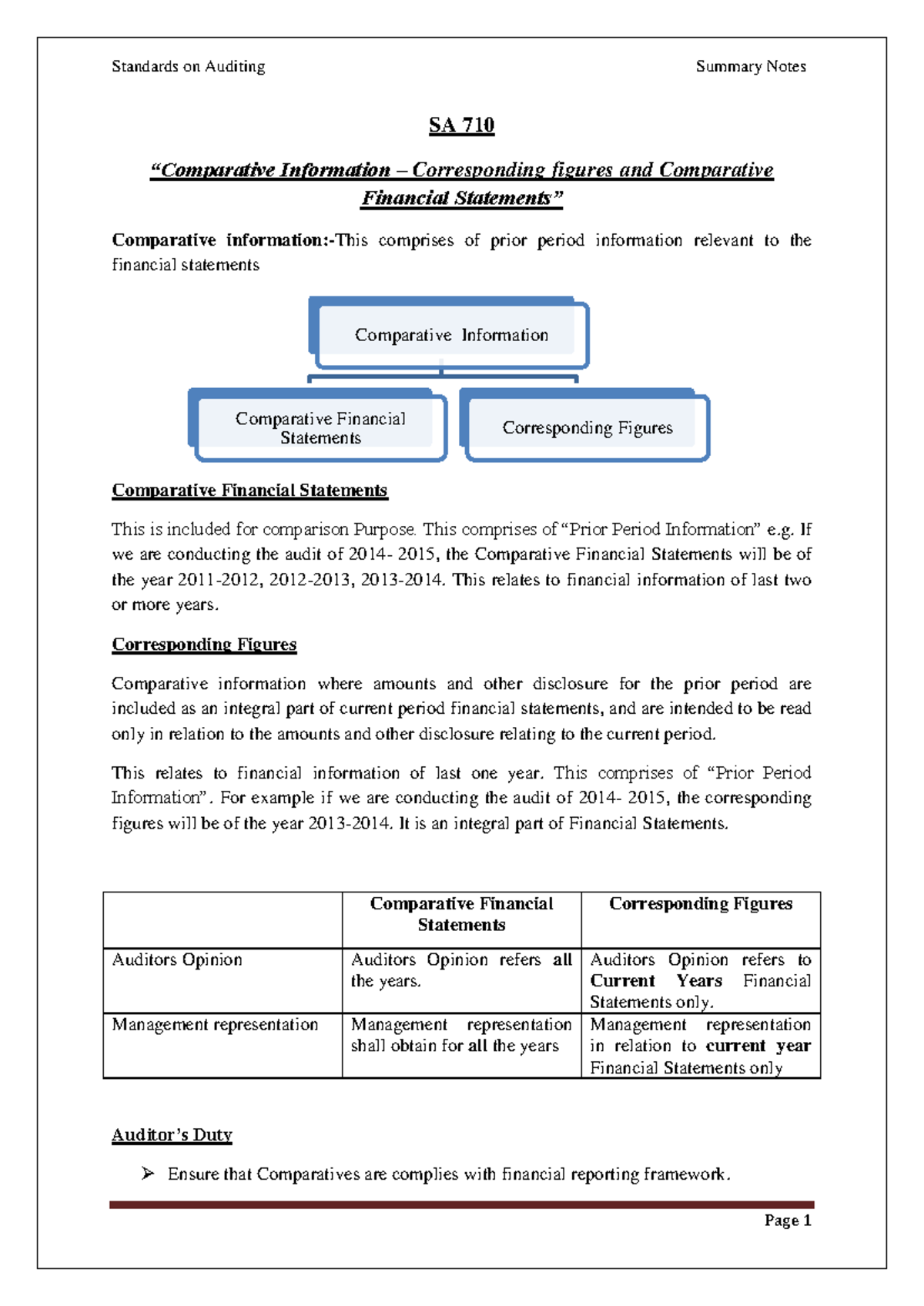
The most important takeaway for your exams is what the video highlighted: In India, the 'corresponding figures' approach is the standard practice. Therefore, your responsibilities as an auditor will primarily be governed by the rules for corresponding figures.
Part 3: Auditor's Reporting Responsibilities for Corresponding Figures
Since India follows the corresponding figures approach, we need to understand the reporting responsibilities in detail.
The General Rule
The general rule is simple and logical: If your opinion is only on the current period, your report should not refer to the corresponding figures. The prior year figures are there for comparison only; you are not expressing an opinion on them.
The Exceptions to the Rule
This is where the complexity lies and where examiners often focus. There are three specific situations where, despite following the corresponding figures approach, you must refer to the prior period in your audit report. The logic is that something related to the prior period is so significant that it impacts the user's understanding of the current period's audit or financial statements.
This next video segment is the most important part of our lesson. It explains these three exceptions with exceptional clarity.
SA 710 (English) | COMPARATIVE INFORMATION | CA inter &Final | CA Mahamood
This is a detailed walkthrough of the three exceptions to the general rule. The instructor uses a chart to explain the logic of when and why you must refer to the corresponding figures in your report. This is crucial for your conceptual understanding.
Watch from 36:34 to 1:03:29. This is a longer clip, but it's vital. Focus on understanding the 'if-then' logic for each of the three exceptions: Prior period opinion was modified, and the matter is unresolved. (How does this affect the current opinion and what do you write in the Basis for Modification paragraph?) Prior period opinion was unmodified, but you now find a material misstatement. (What happens if management doesn't correct it, and how does that affect your report?) Prior period was not audited. (What paragraph do you add to your report, and what does it say? This connects directly to our last lesson on Other Matter paragraphs.)
Let's briefly recap and formalize the three exceptions discussed in the video. When any of these occur, you must modify your report to refer to the corresponding figures:
-
Unresolved Prior Period Modification:
- Situation: The auditor's report on the prior period had a qualified, adverse, or disclaimer of opinion, and the issue causing it is still not resolved.
- Auditor's Response: Modify the opinion on the current period as well. In the Basis for Modification paragraph, you must refer to both the current period figures and the corresponding figures to explain the ongoing issue.
-
Misstatement Discovered in Prior Period:
- Situation: The prior period had an unmodified opinion, but during the current audit, you discover a material misstatement in those prior period figures. You inform management, but they do not account for it correctly as per the financial reporting framework.
- Auditor's Response: Express a qualified or adverse opinion on the current period's financial statements. The modification is specifically "with respect to the corresponding figures included therein." The Basis for Modification paragraph will explain the misstatement in the prior year figures.
-
Prior Period Was Not Audited:
- Situation: The financial statements for the prior period were never audited.
- Auditor's Response: State in an Other Matter paragraph that the corresponding figures are unaudited. This doesn't relieve you of your duty under SA 510 to get evidence about opening balances, but it informs the user that the comparative numbers carry no audit assurance.
For precise wording on these exceptions, paragraphs 11, 12, and 14 of the SA 710 PDF (resource_id: [LINK](https://ftp.caalley.com/eqc/18793annex1SA710.pdf)) are your authoritative guide for exam answers.
Part 4: Auditor's Reporting Responsibilities for Comparative Financial Statements
While not the common practice in India, you still need to understand the alternative approach. The primary responsibility here is straightforward.
Let's briefly look at the reporting requirements for the 'comparative financial statements' approach to complete our understanding.
Please read paragraphs 15 through 19. The key takeaway is in paragraph 15: 'the auditor’s opinion shall refer to each period for which financial statements are presented'. Note how the standard addresses scenarios like differing opinions or unaudited prior periods, and compare this to the rules for corresponding figures.
The key responsibility under the comparative financial statements approach is that the auditor's opinion must explicitly refer to every period presented. This means if the 2023 and 2024 financial statements are presented, the auditor gives an opinion on both years. This is fundamentally different from the corresponding figures approach, where the opinion is only on 2024.
Conclusion
Today we've deconstructed SA 710, focusing on the underlying logic rather than just rules. By understanding the 'why' behind the different treatments of comparative information, you can derive the 'how' in an exam situation.
Key Takeaways:
- Core Distinction: The difference between 'corresponding figures' and 'comparative financial statements' lies in the scope of the audit opinion.
- Indian Context: In India, we use the corresponding figures approach, where the opinion covers the current period only.
- General Rule (Corresponding Figures): The auditor's opinion does not refer to the corresponding figures.
- The Three Exceptions: You must refer to the corresponding figures if:
- A prior period modification is unresolved.
- A new misstatement is found in the prior period and not dealt with correctly.
- The prior period was unaudited.
Preview of the Next Lesson
Our discussion today on handling prior period information, especially when it was audited by someone else or not audited at all, sets the stage perfectly for our next lesson. We will continue in Module 10 and address the learning outcome: "Describe the auditor's reporting responsibilities when the prior period was audited by a predecessor auditor." This will be a deeper dive into one of the specific scenarios we touched upon today.