Introduction
Welcome to our first lesson on the audit of Public Sector Undertakings (PSUs), a topic you've highlighted as a key area of interest. In our previous lessons, we covered the audit reporting framework for corporate entities under the SA 700 series. We will now shift our focus to the unique audit environment of government entities, where public funds and accountability take center stage.
Today's lesson addresses the learning outcome: Explain the role and powers of the Comptroller and Auditor General of India (C&AG) in the audit of government companies and PSUs.
We will explore the constitutional foundation that makes the C&AG the supreme audit institution of India. You'll learn why this office exists, the scope of its authority, and the specific powers it wields, particularly under the Companies Act, 2013. Understanding the C&AG's role is not just about memorizing rules; it's about appreciating the robust mechanism designed to ensure the proper use of public money.
1. The Constitutional Mandate of the C&AG
To understand the C&AG's powers, we must first look at their source: the Constitution of India. The C&AG is not merely a government-appointed official; it is an independent constitutional authority tasked with upholding financial accountability on behalf of the Parliament and State Legislatures. This independence is the bedrock of public sector audit.
The video below provides an excellent overview of the C&AG and the key constitutional articles that define its existence and purpose.
PSU Audit English Revision | CA Final Audit | CA Shubham Keswani (AIR 8)
This video by CA Shubham Keswani introduces the 'why' of government audits and walks through the constitutional articles that establish the C&AG's role, appointment, and reporting responsibilities.
Watch the video from 00:41 to 04:09. As you watch, focus on understanding the purpose of each article: Article 148: How is the C&AG's independence secured (appointment, removal, salary)? Article 149 & C&AG's DPC Act, 1971: Where do the C&AG's duties and powers come from? Article 150: Who prescribes the form of accounts for the Union and States? Article 151: What is the reporting process for C&AG's audit reports?
To help you recall the sequence and purpose of these articles, another video offers a simple mnemonic.
PSU Audit | Exam oriented | CA Final New Syllabus
This short clip from The Audit Academy provides a logical way to remember the flow of Articles 148 to 151, linking them as a story.
Watch from 01:50 to 02:24. The key idea is the sequence: Appointment (148) -> Rights & Duties (149) -> Accounts Preparation (150) -> Audit Report (151).
Key Constitutional & Statutory Provisions:
- Appointment & Independence (Art. 148): The C&AG is appointed by the President of India and can only be removed through a process similar to that for a Supreme Court Judge. This ensures they can function without fear or favour. Their term is 6 years or up to 65 years of age, whichever is earlier.
- Duties & Powers (Art. 149): The C&AG's duties and powers are defined by Parliament through the C&AG's (Duties, Powers and Conditions of Service) Act, 1971.
- Reporting (Art. 151): The C&AG submits audit reports on Union accounts to the President (who lays them before Parliament) and on State accounts to the Governor (who lays them before the State Legislature).
2. The Scope of C&AG's Audit
Now that we know who the C&AG is, let's define what entities fall under their audit jurisdiction. The scope is broad, covering virtually every entity that uses public funds.
PSU Audit English Revision | CA Final Audit | CA Shubham Keswani (AIR 8)
This next clip clearly categorizes the four main types of organizations subject to C&AG audit. The examples provided will help solidify your understanding.
Watch from 04:09 to 06:22. Note down the four categories and an example for each.
As the video explains, the C&AG's audit purview covers:
- Government Departments and Offices: E.g., Indian Railways, Department of Posts.
- Public Commercial Enterprises: These are primarily Government Companies where the government holds at least 51% of the paid-up share capital (e.g., State Bank of India, BHEL). We will focus on these for the rest of the lesson.
- Non-commercial Autonomous Bodies: Entities owned or controlled by the government that don't operate for profit (e.g., Delhi University, various research institutes).
- Substantially Financed Bodies: Authorities or bodies that receive significant funding from the government, even if they aren't directly owned or controlled.
3. The C&AG's Powers over Government Companies
This is a critical and frequently examined area. While the C&AG's overall mandate comes from the Constitution, its specific powers concerning the audit of Government Companies are detailed in the Companies Act, 2013, primarily under Section 143.
These powers create a multi-layered oversight structure, which is very different from the audit of a private sector company.
The following video provides a structured explanation of these powers, which we will then break down further.
PSU Audit | Exam oriented | CA Final New Syllabus
The Audit Academy provides a very clear, section-by-section breakdown of the C&AG's powers under the Companies Act, 2013. This is essential knowledge for your exam.
Watch from 06:35 to 09:05. Focus on the distinct powers granted by subsections (5), (6), and (7) of Section 143.
Let's dissect these powers logically:
1. Power to Appoint the Auditor [Section 143(5) read with Sec 139]
Unlike in the private sector where shareholders appoint auditors at the AGM, the statutory auditor of a Government Company is appointed by the C&AG. This is the first and most fundamental power, ensuring that the auditor is chosen by an independent body.
2. Power to Direct the Audit [Section 143(5)]
The C&AG can instruct the appointed statutory auditor on the manner in which the audit should be conducted. This may involve directing them to examine specific transactions, schemes, or areas of high risk. The statutory auditor must then submit a copy of their report to the C&AG, which includes details on:
- The directions given by the C&AG.
- The action taken by the auditor on those directions.
- The impact of these actions on the financial statements.
3. Power to Conduct Supplementary Audit [Section 143(6)(a)]
Within 60 days of receiving the statutory auditor's report, the C&AG has the right to conduct a supplementary audit if they deem it necessary. This is essentially an additional audit to re-examine certain areas or delve deeper into issues that the C&AG feels were not adequately covered.
4. Power to Comment on the Audit Report [Section 143(6)(b)]
The C&AG can also comment upon or supplement the statutory audit report. These comments are not mere suggestions; they must be sent to all members of the company and be placed before the AGM, just like the main audit report. This gives the C&AG's findings significant weight.
5. Power to Conduct Test Audit [Section 143(7)]
The C&AG has the power to conduct a test audit of the accounts of a Government company. This is distinct from a supplementary audit and allows the C&AG to check the quality and effectiveness of the audit work by examining selected transactions or areas.
For a formal reinforcement of these concepts, you can refer to the ICAI's material.
[PDF] AUDIT OF PUBLIC SECTOR UNDERTAKINGS
This PDF from the ICAI provides the official text and explanation of the C&AG's powers under the Companies Act, 2013. Reading this will help you get comfortable with the precise language required for your exams.
Review the section titled '4. AUDIT OF GOVERNMENT COMPANIES' (starts on page 19). Pay close attention to the headings for (a) Appointment of Auditors, (b) Supplementary audit, and (d) Test audit, and see how they map directly to the subsections of Section 143 we just discussed.
4. The C&AG’s Wider Role: A 'Friend, Philosopher, and Guide'
The C&AG's role and powers extend beyond the legal framework of the Companies Act. The audit reports produced by the C&AG are not just filed away; they form the primary basis for the work of parliamentary financial committees, most notably the Public Accounts Committee (PAC) and the Committee on Public Undertakings (COPU).
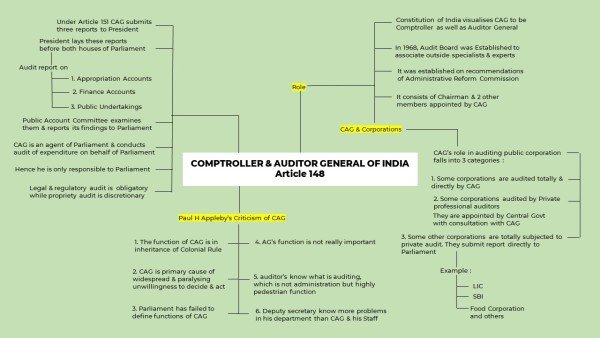
By scrutinizing C&AG reports, these committees hold the government and PSUs answerable for their financial management and performance. In this capacity, the C&AG is often described as a "friend, philosopher, and guide" to these committees, providing expert analysis and insights that drive public accountability.
Furthermore, the C&AG's scope of audit is determined by the C&AG itself and is not limited to just checking financial figures. It often includes:
- Compliance Audit: Checking adherence to laws and regulations.
- Performance Audit: Assessing the economy, efficiency, and effectiveness of projects and undertakings.
- Propriety Audit: Examining the justification and wisdom of executive actions and expenditures.
We will explore these different types of audits in more detail in a future lesson.
Conclusion
In this lesson, we established the fundamental role and extensive powers of the C&AG. You have learned that the C&AG is an independent constitutional authority whose mandate is to ensure the financial accountability of the government and its entities.
Key Takeaways:
- The C&AG's independence is guaranteed by the Constitution of India (Articles 148-151).
- Its powers are primarily exercised through the C&AG's (DPC) Act, 1971, and for government companies, through Section 143 of the Companies Act, 2013.
- The C&AG has the power to appoint statutory auditors for government companies, direct the manner of their audit, and conduct supplementary or test audits.
- The C&AG's role transcends financial audit, acting as a crucial link in the chain of parliamentary oversight by guiding committees like the PAC and COPU.
Preview of the Next Lesson
Now that we have a clear understanding of the C&AG's overarching authority, our next lesson will focus on the ground-level dynamics. We will explore the learning outcome: Describe the relationship and coordination between the statutory auditor and the C&AG. We'll look at how these two parties work together in practice to complete the audit of a Public Sector Undertaking.