Hello! Welcome to your next lesson in the "Concluding the Audit" module.
In our last session on SA 450, we focused on how to evaluate misstatements identified during the audit, right up to the financial statement date. This was about assessing the impact of what you've found on the financial statements. Now, we move forward in time. An audit doesn't just stop on the balance sheet date. A crucial period exists between that date and the day you finally sign your audit report. Events in this window can have a significant impact on the financial statements you are about to opine on.
This lesson is dedicated to SA 560, Subsequent Events. This standard guides your responsibilities for events that occur after the reporting period. Your goal is to explain the auditor's responsibilities related to subsequent events occurring between the financial statement date and the auditor's report date.
To give you a complete and practical understanding essential for your CA Final exams, we will explore the full scope of SA 560, which breaks down the auditor's responsibilities across three distinct time periods:
- Events occurring between the financial statement date and the auditor's report date.
- Facts discovered after the auditor's report is signed but before the financial statements are issued to shareholders.
- Facts discovered after the financial statements have already been issued.
Understanding the "why" behind the different procedures in each period is key, and this lesson is designed to provide that conceptual clarity.
Let's begin.
1. The Foundation: What Are Subsequent Events?
Before diving into audit procedures, it's critical to distinguish between the accounting and auditing perspectives of subsequent events. You've encountered this in your accounting studies (AS 4 / Ind AS 10), which focus on how to account for these events. SA 560, on the other hand, focuses on the auditor's responsibility to verify that management has done this correctly.
To build this foundational understanding, let's watch the first part of a detailed video on SA 560.
SA 560 (English) | SUBSEQUENT EVENTS | CA inter &Final | CA Mahamood Shaik
This video by CA Mahamood Shaik starts by brilliantly clarifying the difference between accounting for subsequent events (AS 4) and auditing them (SA 560). This distinction is fundamental to understanding your role as an auditor.
Watch the video from the beginning until 10:54. Pay close attention to how he separates the management's responsibility under Accounting Standards from the auditor's responsibilities under Standards on Auditing.
Key Dates and Time Periods
As the video explained, the auditor's responsibilities change depending on when an event occurs or becomes known. To understand SA 560, you must be crystal clear on the timeline, which is defined by four key dates.
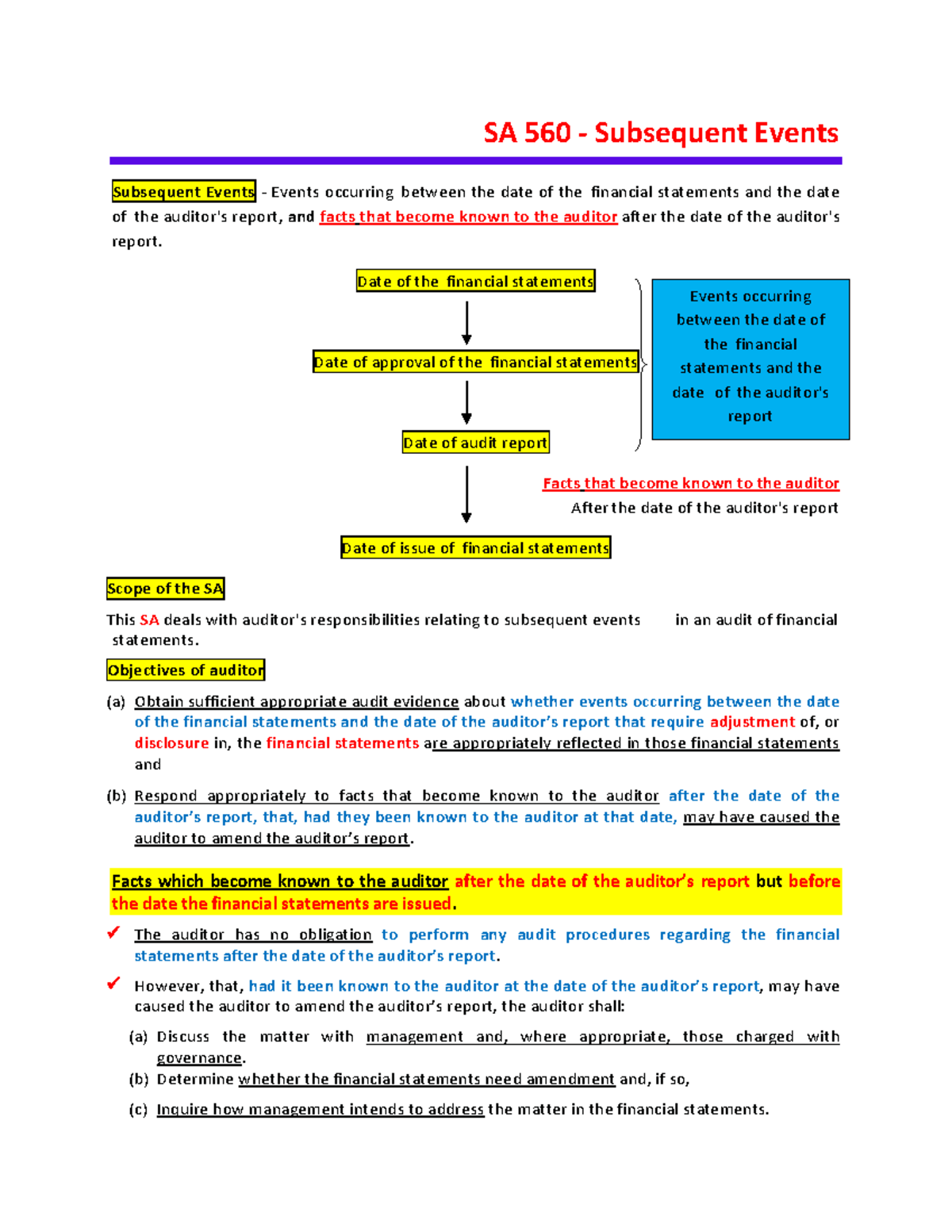
Let's watch a segment that explains these dates and formally defines subsequent events from an auditing perspective.
SA 560 (English) | SUBSEQUENT EVENTS | CA inter &Final | CA Mahamood Shaik
The same video provides a very clear walkthrough of the four crucial dates that define the periods in SA 560 and then gives the precise definition of a subsequent event according to the standard.
Continue watching from 11:17 to 25:31. Focus on understanding: The Four Key Dates: Date of Financial Statements, Date of Approval, Date of Auditor's Report, and Date of Issue of Financial Statements. The Definition of Subsequent Events under SA 560: Note the specific and somewhat counter-intuitive definition—an event happening between the FS date and report date, but the fact becoming known to the auditor after the report date. The video explains the logic behind this, which is crucial.
So, to recap the timeline:
- Date of Financial Statements: The balance sheet date (e.g., 31st March 2023).
- Date of Approval of FS: The date the Board of Directors approves and signs the financial statements.
- Date of Auditor's Report: The date the auditor signs the audit report. This date cannot be earlier than the date of approval of the FS.
- Date of Issue of FS: The date the audited financial statements are made available to third parties (e.g., sent to shareholders for the AGM).
SA 560 covers your responsibilities in three distinct periods based on this timeline, which we will now explore one by one.
2. Period 1: Events Between Financial Statement Date and Auditor's Report Date
This first period directly addresses our learning outcome. Here, your primary objective is to perform procedures to identify all events that might require adjustment or disclosure in the financial statements. You are proactively looking for these events before you sign your report.
So, what procedures do you perform?
Implementation Guide to SA 560
The ICAI's Implementation Guide to SA 560 provides an authoritative list of the audit procedures you are expected to perform. Let's review it.
Please read Question 9 on page 8 of the PDF. This section lists the illustrative procedures an auditor should perform to identify subsequent events in this first period. You may recognise many of these from your articleship.
As you read, the core procedures include:
- Understanding Management's Process: First, understand what system management has in place to identify subsequent events.
- Inquiry: Inquire of management and Those Charged with Governance (TCWG) if any subsequent events have occurred.
- Reading Minutes: Read minutes of meetings (of shareholders, board, key committees) held after the balance sheet date.
- Reviewing Interim Financials: Read the company’s latest subsequent interim financial statements, if available.
In addition to these general procedures, you should also make specific inquiries about matters that are prone to subsequent event risk.
SA 560, SA 570, SA 580 Revision | CA Final AUDIT | Complete ICAI Coverage | CA Sachin Agarwal AIR 16
Let's watch a short clip that provides excellent examples of the specific inquiries an auditor might make. This helps translate the procedural requirement into practical questions.
Watch this video from 14:27 to 18:38. The instructor gives concrete examples of what to ask management about, such as new borrowings, sale of assets, and developments in existing contingencies.
If your procedures identify a subsequent event, you must then determine if it's an adjusting event (provides evidence of conditions that existed at the balance sheet date) or a non-adjusting event (indicative of conditions that arose after the balance sheet date). Based on this, you ensure management makes the appropriate adjustment or disclosure. If they refuse, it would lead to a modified opinion, just as we discussed under SA 450.
3. Period 2: Facts Known After Report Date, but Before FS Are Issued
This is where things get more complex. You have already signed your audit report, but the financial statements haven't been issued to shareholders yet. At this point, you have no obligation to perform any further audit procedures.
However, if a fact comes to your knowledge that, had you known it before signing, would have caused you to amend your report, you have a responsibility to act.
The logical steps are as follows:
- Discuss the matter with management and TCWG.
- Determine if the financial statements need amendment.
- Inquire how management intends to address the matter.
From here, the path splits based on management’s response.
SA 560 (English) | SUBSEQUENT EVENTS | CA inter &Final | CA Mahamood Shaik
Let's return to CA Mahamood Shaik's video. His flowchart-style explanation is perfect for understanding the decision-making process in this scenario.
Watch the video from 27:15 to 44:37. This segment meticulously covers the two branches: (1) what happens if management agrees to amend the financial statements, and (2) what happens if they refuse. Pay close attention to the implications for your audit report in each case.
To summarize the key paths from the video:
- If Management Amends the FS: You must perform audit procedures on the amendment. You will then issue a new audit report. The date of this new report cannot be earlier than the date the amended financial statements are approved.
- If Management Does NOT Amend the FS:
- If you haven't yet given your original report to the entity, you simply modify your opinion (as per SA 705) and issue the modified report.
- If the entity already has your report, you must notify them not to issue it to third parties. If they issue it anyway, you must take appropriate action to prevent users from relying on your report (e.g., by informing regulatory bodies, seeking legal advice).
4. Period 3: Facts Known After the Financial Statements Have Been Issued
This is the most critical scenario. The financial statements and your audit report are already in the hands of shareholders and the public. As in Period 2, you have no obligation to search for new facts.
However, if a significant fact comes to your attention that existed at the date of your report, your response is similar to Period 2 but with an added layer of complexity: you must consider the users who are already relying on the original report.
SA 560 (English) | SUBSEQUENT EVENTS | CA inter &Final | CA Mahamood Shaik
The final segment of this video explains your responsibilities when a fact is discovered after the financial statements have been publicly issued.
Watch from 44:37 to 53:40. Focus on the key differences from the previous scenario, especially the role of an Emphasis of Matter (EOM) or Other Matter (OM) paragraph in the new audit report to alert users about the revision.
The key differences in this period are:
- Informing Users: Your first step is to review the steps management has taken to ensure anyone who received the old financial statements is informed of the situation.
- If Management Amends the FS: When you issue your new, unmodified audit report on the amended financial statements, you must include an EOM or OM paragraph. This paragraph's purpose is to draw the reader's attention to the note in the financial statements that explains the reason for the revision and refers to your earlier report. This prevents confusion for users who now have two different reports.
- If Management Does Not Act: You must take appropriate action to prevent future reliance on your original report, notifying management and TCWG first.
Conclusion
Today, we've navigated the complexities of SA 560. The standard provides a logical framework for handling events that occur after the balance sheet date, with the auditor's responsibilities evolving as time progresses and information is distributed.
Key Takeaways:
- Three Distinct Periods: Your responsibilities are defined by three periods: before the report date, after the report date but before issue, and after the issue date.
- Proactive vs. Reactive: In Period 1, you are proactive, performing procedures to find subsequent events. In Periods 2 and 3, you are reactive, responding only to facts that come to your attention.
- Management's Cooperation is Key: Your actions are heavily dependent on whether management agrees to amend the financial statements. Refusal to amend a material issue will always lead to a modified opinion or other action to prevent reliance on your report.
- Communication is Crucial: As the financial statements are more widely distributed (Period 3), your communication in the audit report (via an EOM/OM paragraph) becomes critical to avoid confusing users.
Preview of the Next Lesson
Some subsequent events can be so significant that they call into question the very ability of the entity to continue operating. In our next lesson, we will delve into one of the most critical judgments an auditor makes: assessing management's use of the going concern assumption, as guided by SA 570, Going Concern.