Hello! This course begins with a question that will recur throughout electromagnetism: when an object becomes electrically charged, where did that charge come from? In this first module, you will build the ideas of charge, force, and energy before using them to study electric and magnetic fields.
Today’s focus is conservation of electric charge. You will use it as an accounting rule: identify which objects can exchange charge, track their signed charges, and check whether your explanation balances.
What does it mean for an object to be charged?
Ordinary matter contains positively charged protons and negatively charged electrons. An object is electrically neutral when its positive and negative charges balance. Neutral does not mean that it contains no charges.
In the situations we will consider, protons remain bound within atoms, while electrons can move between objects. An object that gains electrons becomes more negative; one that loses electrons becomes more positive. Its net charge is the positive charge minus the magnitude of the negative charge, with the result expressed as a signed number.
The unit of charge is the coulomb, abbreviated . You can track either coulombs or numbers of electrons. Each electron carries charge , where is the magnitude of the elementary charge.
Watch the balloon example before putting the rule into an equation:
Conservation of electric charge | AP Physics | Khan Academy
Watch “Conservation of electric charge” from Khan Academy for a visual account of charging by rubbing and, especially, of how choosing a system determines what stays constant.
Watch balloon and fur. Follow the electrons as they move between the objects. At about 1:10, pay particular attention to the choice of the balloon and fur as the system, rather than either object alone.
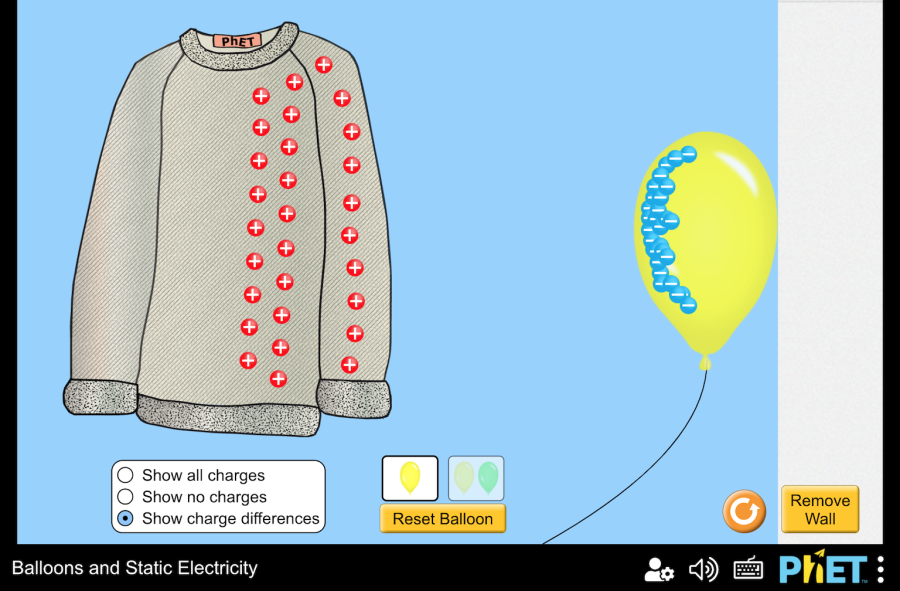
The image captures the distinction between transferring charge and creating charge. The positive symbols on the sweater do not mean rubbing produced new protons. They indicate that electrons have left the sweater, so its remaining positive and negative charges no longer balance.
The conservation rule—and its boundary
For a collection of objects that exchanges no charge with its surroundings, the sum of their net charges is the same before and after an interaction. If the collection contains objects and , write:
Equivalently, their changes must cancel:
The word system matters. If an electron moves from to , the charge of each object changes, but the total charge of the two-object system does not. If you choose alone as your system, its charge has changed because charge crossed its boundary. There is no contradiction: conservation applies to the full accounting, including what entered or left.
Read the corresponding explanation and a short account of how electrons transfer:
18.1 Electrical Charges, Conservation of ...
Read OpenStax’s account of conservation and charge transfer. It supplies the physical meaning behind the accounting equation, particularly the difference between moving electrons and leaving an excess of positive charge.
In “Conservation of Charge,” skip the teacher-support notes. Start with “Because the fundamental positive and negative units of charge are carried on protons and electrons” and read the conservation explanation through the condition that no charge enters or leaves the system. Later, after the worked example about two spheres, find the paragraph beginning “Most objects we deal with are electrically neutral.” Read the transfer discussion through the example in which two metal spheres finish with 75 excess electrons each. Focus on why losing electrons makes an object positive and on what contact allows to move.
A useful bookkeeping rule follows immediately. If electrons move from to , then has lost negative charge and has gained it:
The signs describe changes in net charge. They do not say that positive particles traveled from to .
Accounting for a transfer
Suppose two objects are isolated together from everything else. Initially, has and has , where . After they interact, is measured at . What must ’s final charge be?
The initial total is , so the final total must also be :
Thus . Check the changes as well: changed by , while changed by . In an ordinary transfer between these objects, that is consistent with electrons moving from to . Notice that went from positive to negative: an object can gain enough electrons not merely to become neutral, but to pass through neutrality.
Conservation tells you the total and, when enough other charges are known, the missing charge. By itself, it does not tell you how two objects will share charge. That requires information about the objects and their interaction.
The next video shows a case where that additional information is available: two identical metal spheres touch.
Closer Look: Friction, Conduction, and Induction | Physics in Motion
Watch the metal-sphere example in “Closer Look: Friction, Conduction, and Induction” from GPB Education. It distinguishes the electron movement from the numerical charge accounting.
Watch identical spheres. Follow the explanation of why electrons, rather than protons, move. Then note the two separate ingredients in the result: conservation fixes the spheres’ combined final charge, while their being identical permits an equal final share.
Do not generalize “split the charge in half” to every pair of touching objects. The conservation equation still holds for unlike objects, but an equal split need not follow.
When charge seems to disappear
Imagine a negatively charged object touching a path to the ground and ending up neutral. Looking only at the object, its excess negative charge appears to have vanished. Widen the system to include the ground: electrons left the object and entered its surroundings. The object’s net charge changed; charge was not destroyed.
This gives you a reliable way to analyze a charge-transfer story:
- Choose the system. Include every object whose charge you intend to account for.
- Ask whether charge can cross its boundary. If it can, include that incoming or outgoing charge in the accounting, or enlarge the system.
- Add signed net charges before and after. A positive and a negative charge can cancel in the sum without either ceasing to exist.
- Interpret the changes physically. For the ordinary solid objects considered here, gaining electrons makes net charge more negative; losing them makes it more positive.
The equation is an accounting constraint, not a complete prediction of an interaction. It can tell you that a proposed set of final charges is impossible for an isolated system. It cannot, without more physical information, tell you exactly how much charge will transfer.
Looking ahead
The central takeaway is simple but powerful: electric charge can move between objects, while the total charge of an isolated system remains constant. Keeping track of signed changes and of the system boundary prevents many apparent paradoxes about charging.
In the next lesson, you will turn from tracking charge to combining forces. That vector skill will later let you predict what charged objects do in electric fields.