Hello, and welcome to the first lesson in your course on film soundscapes.
This initial module, "Foundations of Soundscape Theory," will establish the core theoretical vocabulary for our entire study. Your long-term goal of analyzing soundscapes in Moroccan cinema requires a robust and precise theoretical foundation, and this is where we begin to build it.
Today, we will address the very first learning outcome: Define the concept of 'soundscape' as introduced by R. Murray Schafer and explain its key components (keynote sounds, signals, and soundmarks). We will explore who Schafer was, how he conceptualized the sonic environment, and the analytical tools he developed to study it. These concepts will become the building blocks for all subsequent analysis, from production choices to cultural identity.
1. The Idea of the 'Soundscape'
The term 'soundscape' is now common, but it originates from a specific theoretical and philosophical movement. Its principal architect was the Canadian composer, writer, and acoustic ecologist R. Murray Schafer. Schafer was concerned with the degradation of the sonic environment—what he saw as an increase in 'noise'—and proposed a new way of listening to and thinking about our world of sound.
To begin, let's hear from Schafer himself as he introduces his core idea.
R. MURRAY SCHAFER: LISTEN | Full Documentary | National Film Board of Canada
In this short excerpt from a National Film Board of Canada documentary, R. Murray Schafer explains his fundamental concept of the soundscape, comparing it to a visual painting and framing the world as a 'huge musical composition'.
Please watch from the beginning until 02:48. Pay close attention to the analogies he uses (like painting and musical composition) and his view on our role as 'composers' of this soundscape.
Schafer’s vision is both analytical and ethical. He doesn't just describe the sounds around us; he frames our relationship to them as a responsibility. He argues that we actively shape our acoustic environment, for better or worse.
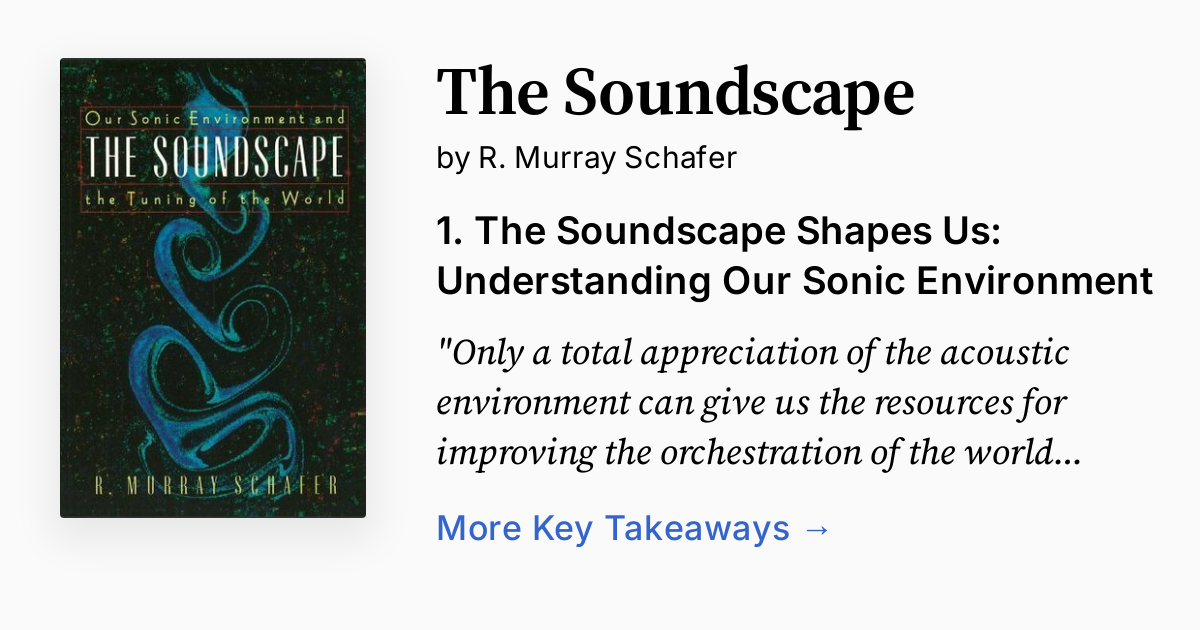
To move from this poetic introduction to a more formal definition, let's turn to Schafer's own writing. The following reading selection is from the first chapter of his book.
[PDF] R. Murray Schafer - THE SOUNDSCAPE
This reading from Schafer's book, "The Soundscape," provides his formal definition and discusses the challenges and goals of studying the sonic environment. It establishes the academic basis for soundscape studies.
Please read the section titled 'The Notation of Soundscapes (Sonography)'. It begins with the sentence, 'The soundscape is any acoustic field of study.' Focus on how he defines the term and contrasts the study of soundscapes with the study of visual landscapes.
As you've read, Schafer defines the soundscape broadly as any "acoustic field of study." This can be a real-world environment, like a city square, or a mediated one, like a film soundtrack.
It is an important academic point that while Schafer is the figure who popularized and theorized the concept, the term itself was first used in a 1969 paper by city planner Michael Southworth. Schafer, however, took this term and, through his World Soundscape Project (WSP), developed it into a comprehensive field of study.
2. The Components of the Soundscape
To analyze a soundscape effectively, Schafer proposed a classification system for its primary elements. He broke the soundscape down into three main components: keynote sounds, signals, and soundmarks. Understanding these categories is essential for moving from general listening to critical analysis.
Let's examine each component, using Schafer's primary text and then clarifying with a more concise summary.
Keynote Sounds
First, read Schafer's own definition of keynote sounds.
[PDF] R. Murray Schafer - THE SOUNDSCAPE
We'll now examine the first of Schafer's three components. This excerpt from the same PDF provides the original definition of keynote sounds.
In the section titled 'Features of the Soundscape', please read the paragraph that begins, 'Keynote is a musical term...'. Focus on the analogy to music and the relationship between keynote sounds and conscious listening.
As Schafer explains, keynote sounds are analogous to the key in a piece of music. They are not always consciously perceived, but they create the fundamental character of a place. They are the 'ground' against which the 'figure' (other sounds) is heard.
For a clearer, summary definition, let's look at another resource.
Shaping the Soundscape of the Cyberpunk World | Part 1
This article, while focused on game audio, provides excellent, succinct definitions of Schafer's terms. It can help solidify your understanding.
Please read the section 'a.) Keynote Sounds'. Notice the concrete examples it provides.
Examples of Keynote Sounds:
- The sound of the sea in a coastal town.
- The constant, low-frequency hum of traffic in a metropolis.
- The sound of wind on an open plain or in the high Atlas Mountains.
- The pervasive sound of insects in a tropical jungle.
As a sound professional, you can think of keynote sounds as being similar to a location's fundamental room tone or ambient bed, but on a macro, environmental scale.
Signals
Next, we have signals. These are sounds that sit in the foreground of the soundscape.
Return to Schafer's text for the primary definition.
[PDF] R. Murray Schafer - THE SOUNDSCAPE
Now for the second component, signals. Let's see how Schafer defines sounds that are meant to be consciously heard.
In the 'Features of the Soundscape' section, find and read the short paragraph that begins, 'Signals are foreground sounds...'.
Unlike keynotes, signals must be listened to consciously. They are designed to convey information and demand our attention.
Now, read the corresponding section in the summary article.
Shaping the Soundscape of the Cyberpunk World | Part 1
This will provide a concise definition and examples for sound signals.
Please read the section 'b.) Sound Signals'.
Examples of Signals:
- Bells (church, school, bicycle).
- Sirens (police, ambulance, air-raid).
- Horns and whistles (car, train, factory).
- The Islamic call to prayer (Adhan).
Signals are acoustic commands or announcements. In your future film analysis, identifying the signals within a scene will be key to understanding the explicit social and narrative information being communicated through sound.
Soundmarks
Finally, Schafer identifies soundmarks. This concept is particularly vital for your research into place and cultural identity.
First, the primary definition from Schafer.
[PDF] R. Murray Schafer - THE SOUNDSCAPE
The final component is the soundmark. This is perhaps the most culturally significant of the three.
In the 'Features of the Soundscape' section, read the paragraph that begins, 'The term soundmark is derived from landmark...'.
A soundmark is a sound that is unique and specially regarded by the community in which it is heard. It is the acoustic equivalent of a landmark.
And now the summary definition.
Shaping the Soundscape of the Cyberpunk World | Part 1
This section will clarify the concept of a soundmark.
Please read the section 'c.) Soundmarks'. Note the emphasis on uniqueness and cultural value.
Examples of Soundmarks:
- The specific chime of London's Big Ben.
- The sound of the cable cars in San Francisco.
- The particular call to prayer from the Koutoubia Mosque in Marrakech, which is distinct in its timbre and acoustic presence from others.
- The unique sound of a specific market or artisan at work in a city's medina.
Soundmarks are crucial because they tie sound directly to community identity. They are sounds that a community values and which would be missed if they disappeared.
3. A Holistic Model
These components—keynotes, signals, and soundmarks—are not isolated. They exist in a dynamic relationship with each other, the environment, and the listener. This diagram helps visualize the interdisciplinary nature of soundscape studies.

This model aligns well with the four pillars you identified for your research:
- Production relates to the creation of the Sound and its placement in the Environment.
- Perception focuses on the Listener's cognitive and affective processing of that Sound.
- Immersion and Cultural Identity emerge from the rich interplay between the Listener and their total sonic Environment, shaped by all three soundscape components.
Conclusion
In this first lesson, we have established the foundational theory of the soundscape.
Key Takeaways:
- The soundscape, a concept theorized by R. Murray Schafer, is the total acoustic environment, considered as a composition that can be analyzed, preserved, and improved.
- The soundscape is composed of three main elements:
- Keynote Sounds: The ubiquitous background sounds that define the character of a location but are not always consciously heard.
- Signals: Foreground sounds that are consciously listened to and are designed to convey specific information.
- Soundmarks: Unique, community-valued sounds that function as sonic landmarks, contributing to a sense of place and identity.
- Analyzing a soundscape means identifying these components and understanding their interplay within a specific environmental and cultural context.
This vocabulary gives us the initial tools needed to deconstruct a sonic environment. As you begin to think about Moroccan cinema, you can start to frame your listening in these terms: What are the keynote sounds of Casablanca? What are the signals in a rural village scene? What soundmarks might a Moroccan filmmaker use to anchor the story in a specific city or culture?
Preview of the Next Lesson:
In our next lesson, we will build directly on this foundation by exploring two more of Schafer's critical concepts: hi-fi and lo-fi soundscapes. This will add a qualitative dimension to our analysis, allowing us to discuss the clarity, complexity, and information quality of different sonic environments.