Hello! Welcome back to our study of film sound theory.
In our last lesson, we established the crucial distinction between diegetic, non-diegetic, and meta-diegetic sound, which helps us classify sounds based on their relationship to the film's story world. We briefly touched on a diagram by Michel Chion that subdivided the diegetic realm into sounds with a visible source (son in) and sounds whose source exists in the story world but beyond the frame (hors-champ). Today, we will delve deeply into this distinction.
This lesson directly addresses the learning outcome: Analyze how the relationship between on-screen and off-screen sound constructs filmic space. We will move from simply classifying sounds to analyzing their spatial function. Understanding this dynamic is fundamental to grasping how filmmakers build immersive worlds, direct audience attention, and generate narrative meaning through sound. For your work on cinematic soundscapes, this is a core skill for deconstructing how a sense of place is created and perceived.
Defining the Sonic Territories: Chion's Spatial Registers
The foundational theorist for understanding sonic space in cinema is Michel Chion. He provides a precise vocabulary for mapping where sounds are located relative to the visual frame.
To begin, please read the following excerpt from an academic paper that clearly lays out Chion's framework.
[PDF] Ariel - Sound of Silence
This reading is from Ariel Harrod's paper, 'The Sound of Silence.' It provides an excellent, concise explanation of Michel Chion's three spatial registers, which form the theoretical backbone of our lesson today.
Please read the section that begins with 'Michel Chion proposes in Le son au cinema...'. It's on the second page of the PDF. Focus on understanding the definitions and differences between the three registers: 'in', 'hors-champ', and 'off'.
As the text explains, Chion maps the audio-visual territory into three distinct but permeable zones:
- In (On-screen Sound): This is the most straightforward category. The source of the sound is visible within the frame. Chion calls this the "visualized zone." We see a character speaking, a car driving by, a door closing, and we hear the corresponding sound.
- Hors-champ (Off-screen Diegetic Sound): This term, literally "out-of-field," refers to sounds whose sources are not visible on screen but are understood to be part of the film's narrative space (the diegesis). This could be the sound of footsteps approaching from around a corner, traffic noise outside a window, or a character speaking from another room. These sounds are crucial because they suggest that the world of the film extends beyond the borders of the frame.
- Off (Non-diegetic Sound): As we covered in our last lesson, this refers to sounds whose source is outside the diegesis, such as the musical score or a narrator's voiceover.
The critical insight here is that diegetic sound itself is split into two spatial categories: the seen (in) and the unseen but implied (hors-champ). It is the dynamic interplay between these two that constructs the auditory environment of the film.
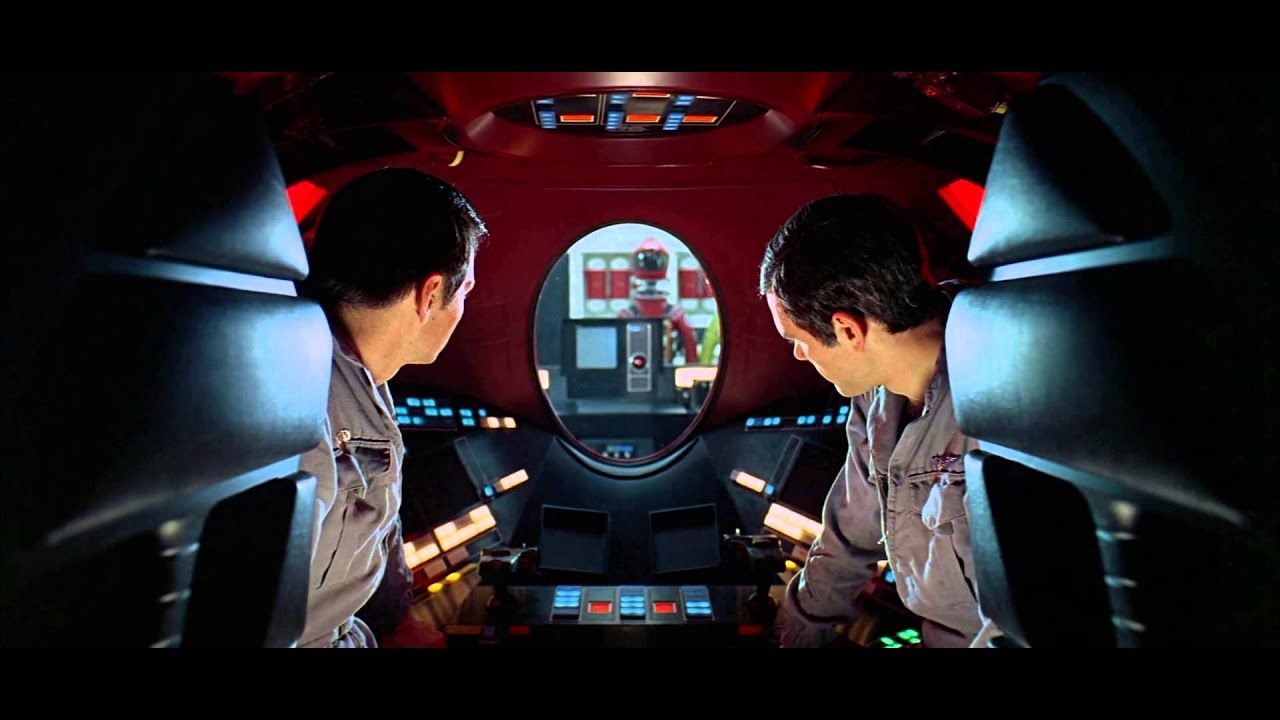
Activating Off-Screen Space with Sound
While the visual frame is finite, sound has the unique power to make us perceive an infinite space extending in all directions. The theorist Noël Burch argued that off-screen space only has a "fluctuating existence" and that structuring this fluctuation is a powerful tool for filmmakers. Sound is arguably the most important element in bringing this off-screen space to life.
The following video, while focused on the visual concept of off-screen space, contains excellent examples where sound plays the decisive role.
This video from Film & Media Studies, 'What is Off-Screen Space?', explores how filmmakers manipulate the area beyond the frame. We will focus on scenes where sound is the primary agent in this manipulation.
Please watch two segments: The analysis of Poltergeist (07:27 - 11:43), paying attention to how sound from an unexpected off-screen location creates shock. The analysis of Robert Bresson's A Man Escaped (17:10 - 23:35). Focus on how the film deliberately restricts the visuals and forces the viewer to rely almost entirely on off-screen sound to understand the action and the character's world.
These examples powerfully illustrate the function of hors-champ sound:
- In Poltergeist, the sound of the chairs scraping on the floor is hors-champ. Because the sound emanates from a space we have just seen and assumed to be static, its presence is deeply unsettling. It activates the off-screen space with a sense of menace.
- In A Man Escaped, Bresson provides a masterclass in the power of off-screen sound. By refusing to follow the character visually during his escape attempt, the film forces us to construct the event entirely from auditory cues—running footsteps, shouts, the eventual sounds of capture. The soundscape becomes the narrative space. The trolley bell is a recurring hors-champ sound that constantly reminds the character (and the viewer) of a world of freedom that exists just beyond the prison walls, a world that is heard but not seen.
Point of Audition: From Where Do We Hear?
Building on the spatial registers, Chion introduces another crucial concept: point of audition. This idea refines our analysis by asking not just where a sound is, but from what perspective it is heard.
Sound and Silence in Gravity: Fidelity vs Intelligibility
The video 'Sound and Silence in Gravity' clearly explains Chion's concept of 'point of audition' and its two distinct meanings, using the film's innovative sound design as a case study.
Watch the segment from 07:19 to 09:44. Focus on the distinction Chion makes between the 'spatial sense' and the 'subjective sense' of point of audition.
As the video outlines, "point of audition" has two meanings:
-
Spatial Point of Audition: This concerns the physical location from which we seem to be hearing. Is our auditory perspective aligned with the camera? Or is it located somewhere else in the scene? In Gravity, when the camera moves inside the astronaut's helmet, the sound quality shifts dramatically. We hear her breathing and the radio communications from inside the helmet. The point of audition has shifted from an external, "objective" position in space to a specific, enclosed location.
-
Subjective Point of Audition: This asks which character we are hearing with. The sound is filtered through a character's perception. This relates to the concept of meta-diegetic sound we discussed previously, but focuses on perspective. The muffled sounds of impacts transmitted as vibrations through the spacesuit in Gravity are a perfect example. We are not hearing the "real" sound in space (which would be silence), but rather the sound as the character would experience it through bone conduction. Our hearing is aligned with her body.
This concept is essential for analyzing immersion and perception. By manipulating the point of audition, filmmakers can place us inside a character's head, anchor us to an objective viewpoint, or shift between the two to shape our spatial and psychological relationship to the events on screen.
Synthesis: Constructing Silence by Moving Sound
Filmmakers don't just place sounds in these different registers; they actively move them between registers to create complex effects. The construction of filmic space is a dynamic process.
The paper on Gus Van Sant's Gerry provides a sophisticated analysis of this process in action.
[PDF] Ariel - Sound of Silence
We return to Ariel Harrod's paper, 'The Sound of Silence,' to see how these theoretical concepts can be applied to a detailed analysis of a film sequence.
Please read the analysis of the 'sunrise sequence' in Gerry. This section begins on page 5 ('The sequence I would like to examine...'). Focus on how the author describes the sound of footsteps migrating from the 'in' register to the 'off' register, and what effect this has on the diegetic space.
The analysis of Gerry demonstrates a profound use of spatial relationships.
- The sound begins with footsteps that we attribute to the on-screen characters (son in).
- However, the sound designer intentionally creates a loose, weak synchronization between the footfalls we see and the crunches we hear.
- Due to this temporal disconnect, our brain eventually severs the link. The crunching sound is no longer perceived as diegetic footsteps. It detaches from its on-screen source and migrates to the non-diegetic (off) register, becoming an abstract, rhythmic element.
- The result is powerful: the on-screen, diegetic space is effectively emptied of its sound. A profound silence is constructed not by removing sound, but by displacing it from the story world. The barren sonic landscape mirrors the desolate visual landscape and the characters' inner state.
This shows how sound design, through the sophisticated manipulation of on-screen and off-screen relationships, becomes an act of world-building—or in this case, world-dismantling.
Conclusion
Today we have built a spatial dimension onto our understanding of film sound. By moving beyond a simple diegetic/non-diegetic binary, we can analyze the intricate ways sound constructs, defines, and gives life to the world of the film, both within and beyond the visual frame.
Key Takeaways:
- Chion's Spatial Registers provide a precise vocabulary: in (on-screen diegetic), hors-champ (off-screen diegetic), and off (non-diegetic).
- Off-screen diegetic sound (hors-champ) is a powerful tool for expanding the film world beyond the frame, suggesting a larger environment and creating effects like suspense and surprise.
- Point of Audition refines our analysis by asking from where and with whom we are hearing, introducing spatial and subjective perspectives.
- The relationship between these registers is dynamic. Sound can move between them, and this movement is a key technique for constructing meaning and atmosphere, as seen in the analysis of Gerry.
Preview of the Next Lesson:
We have focused on sound's relationship to the narrative world (the diegesis) and the visual frame. In our next lesson, we will explore a different perspective offered by theorist Rick Altman. Altman critiques what he sees as an over-emphasis on the image and the diegesis in film theory. He urges us to consider sound not just as a signifier of space, but as a 'material event' that acts directly on the body of the spectator. This will shift our focus toward a more phenomenological and embodied understanding of film sound.