Hello! Welcome to the first lesson of our course on differential equations.
Given your background, you're likely familiar with how mathematical models describe dynamic systems. This course aims to broaden your understanding of the different types of differential equations that form the bedrock of these models. We'll start with one of the most fundamental and widely applicable types: first-order linear differential equations.
Today's lesson focuses on a crucial first step: identifying the standard form of a first-order linear differential equation. Mastering this will lay the foundation for the powerful solution techniques we'll explore in the upcoming lessons.
What Makes a Differential Equation "First-Order Linear"?
Before we can standardize an equation, we need to be sure we're dealing with the correct type. A differential equation is called first-order if the highest derivative present is the first derivative (like or ).
It is called linear if the dependent variable () and its derivative () both appear only to the first power and are not part of other functions (like or ). The functions multiplying and can be any functions of the independent variable, .
To get a formal definition and see clear examples of what is and isn't a linear equation, please read the first part of the following resource.
8.5: First-order Linear Equations
This text from LibreTexts Math provides a formal definition of a first-order linear differential equation and contrasts it with non-linear examples.
Please read from the beginning of the page down to the end of the list of 'nonlinear differential equations'. Focus on the definition box and the examples that follow to understand the distinction between linear and non-linear equations.
A key point to note is that linearity depends on the dependent variable (), not the independent variable (). For instance, an equation like is linear, even though and are not linear functions of .
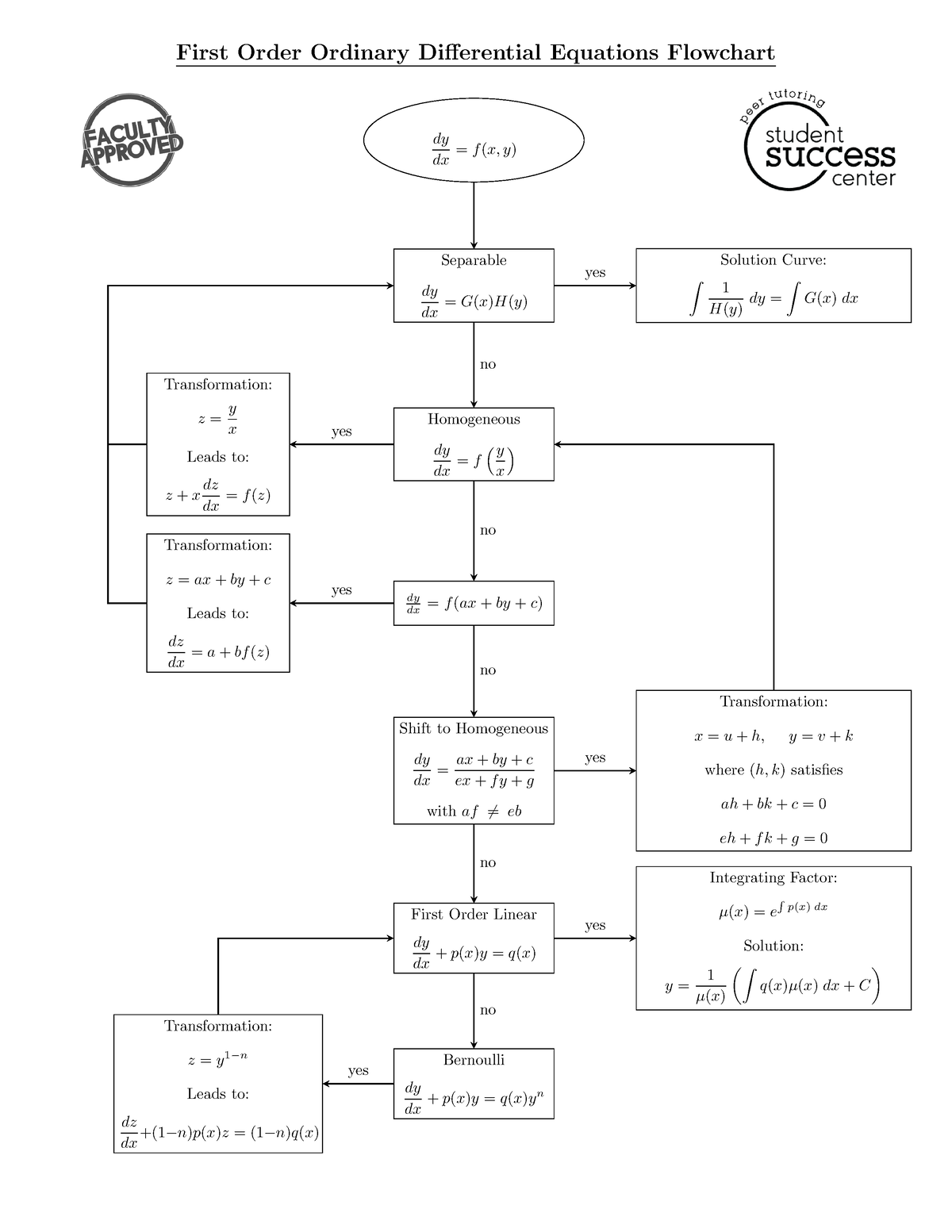
To give you a bird's-eye view, here is a flowchart that shows how first-order linear equations fit into the broader family of first-order differential equations. We will be focusing on the path leading to the "First Order Linear" box.
The Standard Form
Now that we can identify a first-order linear equation, our next step is to write it in a consistent, predictable format. This is known as the standard form.
The standard form for a first-order linear differential equation is:
or, using prime notation:
Here:
- The coefficient of the derivative is exactly 1.
- is the function of that multiplies .
- is the function of on the other side of the equation.
Any first-order linear differential equation can be rearranged into this form. Just as standardizing a data format is crucial for processing it with a consistent algorithm, putting a differential equation into its standard form is the necessary first step before applying a general solution method.
The following reading explains this process and shows how to derive the standard form from the more general form .
8.5: First-order Linear Equations
Let's return to the LibreTexts resource to see how the standard form is defined and derived.
Please read the section titled 'Standard Form'. Pay close attention to how the equation is divided by the coefficient of y' to achieve the standard form, and how p(x) and q(x) are defined.
Practice: Converting to Standard Form
The best way to get comfortable with this concept is through practice. The process usually involves simple algebraic manipulation to isolate with a coefficient of 1.
The following video provides several excellent examples. For each one, the presenter starts with an equation that is not in standard form, manipulates it, and then identifies and .
First Order Linear Differential Equations
This video from The Organic Chemistry Tutor demonstrates how to convert several different equations into standard form. We will watch a few key examples.
Watch the following two segments: From 04:41 to 05:48, where the equation xy' + 4y = 2x^3 is rearranged. From 13:51 to 16:03, which shows how to handle an equation given in differential form: (4y - 3x)dx + 5x dy = 0. For each example, focus on the algebraic steps used to get a coefficient of 1 for y' and how p(x) and q(x) are identified afterward.
After watching, let's break down the general steps:
- Arrange the terms: Move all terms involving and to one side of the equation and all other terms to the other side.
- Isolate the term: Ensure the term with the derivative stands alone on one side or is grouped with the term.
- Normalize the equation: Divide the entire equation by the coefficient of . The resulting equation will be in the standard form .
- Identify and :
- is the term multiplying . Be sure to include any negative signs.
- is the term on the right-hand side of the equation.
Let's try one more example. Consider the equation:
- Arrange: Move the term to the left side.
- Normalize: Divide the entire equation by to make the coefficient of equal to 1. Simplifying gives us the standard form:
- Identify:
Test your understanding!
Put the following differential equation into standard form and identify and .
Show answer
- The equation is already arranged correctly. All terms with or its derivative are on the left.
- Normalize the equation. Divide everything by to make the coefficient of equal to 1.
- Simplify and Identify. Knowing that and , the standard form is:
From this, we can identify:
Conclusion
In this lesson, we established the groundwork for an entire class of differential equations. You are now equipped to tackle the first and most important step in solving them.
Here are the key takeaways:
- A first-order linear differential equation can be written as . Linearity applies to the dependent variable and its derivative , not necessarily the functions of .
- The standard form is , where the coefficient of is 1.
- To convert an equation to standard form, you must perform algebraic manipulations—primarily division—to isolate with a coefficient of 1.
- Identifying and correctly is essential for the next steps in the solution process.
Preview of the next lesson:
In our next session, we will answer the question: "Why is identifying so important?" We will introduce a concept called the integrating factor, which is derived directly from and is the key to unlocking the solution to these equations.