Welcome to your first Korean lesson! This course is designed to help you reach a foundational A1 level with a vocabulary of around 300 words, specifically tailored to your goal of understanding K-pop news and entertainment media.
Today, we'll start with the absolute essentials of communication in any language: greetings and courtesy phrases. By the end of this lesson, you will be able to use about 20 common phrases to start and end simple conversations politely. Mastering these is the first step toward the confidence you'll need to engage with Korean-language content and, eventually, people within the entertainment industry.
Since you already know Hangul, we can dive right into speaking and understanding. We'll focus on the polite forms of speech, as these are crucial for professional and public interactions.
1. First Impressions: Greetings
The most fundamental phrases are for greeting someone. In Korean, how you greet someone depends on the situation and your relationship with them. Politeness is key, and it's often shown not just with words, but with a slight bow.
Let's watch a short video to see how this works in practice.
🤗Greeting Expressions - Essential for Korean Beginners
The video "🤗Greeting Expressions" by Hailey _Your Korean Friend will introduce the most common ways to say "Hello," "Goodbye," and "Nice to meet you." Hailey provides clear examples and demonstrates the accompanying gestures.
Please watch the first part of the video covering Hello and Goodbye and then the section on Nice to meet you. Pay close attention to the three different ways to say "Nice to meet you" and the specific contexts for each.
As you saw, there are several ways to say "Nice to meet you." Here’s a quick breakdown of the phrases from the video:
- 안녕하세요 (annyeonghaseyo): The standard, all-purpose polite "Hello."
- 안녕히 가세요 (annyeonghi gaseyo): "Goodbye," said to a person who is leaving.
- 만나서 반갑습니다 (mannaseo bangapseumnida): The standard polite way to say "Nice to meet you."
- 처음 뵙겠습니다 (cheoeum boepgetseumnida): A more formal version, emphasizing that it's the first time you are meeting. This is excellent for business or professional settings.
- 만나 뵙게 되어 영광입니다 (manna boepge doeeo yeonggwang-imnida): "It is an honor to meet you." This is a very respectful phrase you could use when meeting a senior figure or someone you greatly admire, like an artist you're interviewing.
Your background in linguistics will likely make the concept of different speech levels, or 'honorifics,' an interesting feature of the language. To formalize this idea, let's look at a quick reading on cultural etiquette.
Introduce Yourself in Korean - How To Start A Conversation
This article from 90daykorean.com provides a clear explanation of different speech levels and the cultural norms around introductions.
Please read the sections titled "Formal vs. Informal Korean: What Should You Use?" and "Korean Cultural Etiquette for Self-Introductions." Focus on the table that shows which speech level to use in different situations and the points about bowing.
2. Essential Courtesy Phrases
Beyond greetings, a few key phrases of courtesy like "Thank you" and "I'm sorry" are indispensable.
This next video covers these essentials, again highlighting the difference between formal speech you would use in your work and informal speech for close friends.
100 Korean Expressions You Must Know - 1st Day
The video "100 Korean Expressions You Must Know" from the same channel, Hailey _Your Korean Friend, will teach us these core expressions.
Watch the clip about "Thank you" and the one covering "I'm sorry" and "It's okay". Also, take note of the phrase for "Excuse me" mentioned in the previous video, 7d64c, at timestamp "Excuse me".
The key phrases here are:
- 감사합니다 (gamsahamnida): The most common formal way to say "Thank you."
- 죄송합니다 (joesonghamnida): The standard formal way to say "I'm sorry."
- 실례합니다 (sillyehamnida): "Excuse me." Used to get someone's attention or apologize for a minor interruption.
- 괜찮아요 (gwaenchanayo): "It's okay" or "I'm okay." This can be a response to an apology or a question asking about your well-being.
3. Phrases for Daily Interaction
Now let's expand our vocabulary to phrases used in daily conversations, tailored to the context of interacting with public figures like K-pop idols. The following resource is a fantastic cheat sheet compiled by fans for this exact purpose.
Fans Compile Extensive List Of Useful Korean Phrases ...
This article from Koreaboo lists phrases that are perfect for your goal of engaging with K-pop related content. They are natural, polite, and show care.
Read the lists under the headings "1. Early Morning Phrases," "2. End of the Day Phrases," and "3. Any Time is a Good Time Phrases." Don't worry about memorizing all of them right now. Instead, focus on recognizing phrases that express encouragement, well-wishes, and concern.
From that article and our earlier videos, here are some of the most useful phrases for your work:
- 어떻게 지내세요? (eotteoke jinaeseyo?): "How are you?" (Polite)
- 잘 지내요 (jal jinaeyo): "I'm doing well."
- 좋은 하루 되세요 (joeun haru doeseyo): "Have a good day!"
- 수고했어요 (sugohaesseoyo) / 수고하셨습니다 (sugohasyeotseumnida): "You worked hard." This is an extremely common phrase used to acknowledge someone's effort after they finish a task, like at the end of a workday or an interview. The second version is more formal.
- 밥 먹었어요? (bap meogeosseoyo?): "Have you eaten?" In Korea, this is a very common way to show you care about someone's well-being, similar to asking "How are you?"
- 오늘도 화이팅! (oneuldo hwaiting!): "Fighting today as well!" The word 화이팅 (hwaiting) is a Konglish (Korean-style English) term of encouragement.
Summary and Practice
You've now been introduced to over 20 essential phrases! Here they are compiled for your review.
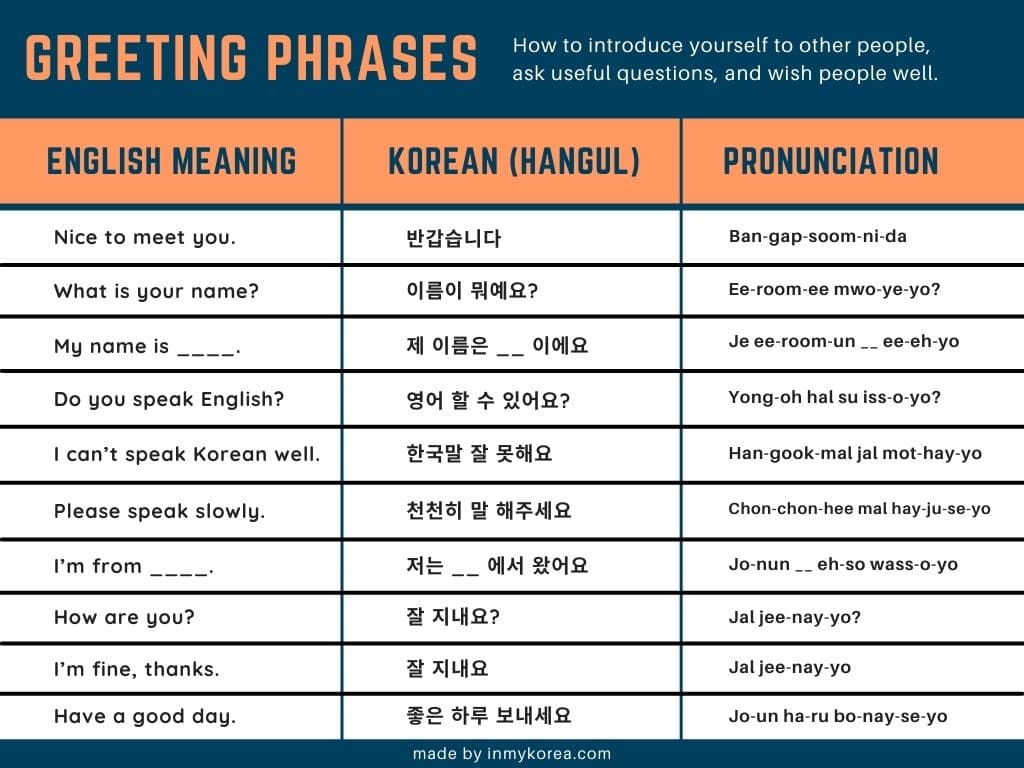
Vocabulary List
| English | Korean (Hangul) | Romanization |
|---|---|---|
| Hello (Polite) | 안녕하세요 | annyeonghaseyo |
| Goodbye (to one leaving) | 안녕히 가세요 | annyeonghi gaseyo |
| Nice to meet you | 만나서 반갑습니다 | mannaseo bangapseumnida |
| It's an honor to meet you | 만나 뵙게 되어 영광입니다 | manna boepge doeeo yeonggwang-imnida |
| Thank you | 감사합니다 | gamsahamnida |
| I'm sorry | 죄송합니다 | joesonghamnida |
| Excuse me | 실례합니다 | sillyehamnida |
| It's okay / Are you okay? | 괜찮아요? | gwaenchanayo? |
| How are you? | 어떻게 지내세요? | eotteoke jinaeseyo? |
| I'm doing well | 잘 지내요 | jal jinaeyo |
| Have a good day | 좋은 하루 되세요 | joeun haru doeseyo |
| You worked hard | 수고하셨습니다 | sugohasyeotseumnida |
| Get home safely | 조심해서 가요 | josimhaeseo gayo |
| Did you sleep well? | 어제 잘 잤어요? | eoje jal jasseoyo? |
| Good night / Sleep well | 잘 자요 | jal jayo |
| Have you eaten? | 밥 먹었어요? | bap meogeosseoyo? |
| Fighting! (Encouragement) | 화이팅! | hwaiting! |
| I've heard a lot about you | 말씀 많이 들었어요 | malsseum mani deureosseoyo |
| Good morning | 좋은 아침이에요 | joeun achimieyo |
| Don't get sick | 아프지 마세요 | apeuji maseyo |
Let's Practice!
Imagine you are a journalist meeting a K-pop group's leader for a short interview. How would you use today's phrases?
- Greeting: You walk in and greet the artist. What would you say? (Hint: Use a polite "Hello" and the phrase for "It's an honor to meet you.")
- Closing: The interview is over. You want to thank them for their time and acknowledge their hard work. What two phrases would you use?
- Parting: As you leave, what would you say for "Goodbye"?
Sample Answers:
- Greeting: 안녕하세요. 만나 뵙게 되어 영광입니다.
- Closing: 감사합니다. 수고하셨습니다.
- Parting: 안녕히 계세요. (While we learned "안녕히 가세요" for someone leaving, if you are the one leaving, you say "안녕히 계세요" - "Stay peacefully.") This is a small distinction we will cover more later! For now, knowing both greetings is a great start.
Conclusion
In this lesson, you’ve learned a set of foundational greetings and courtesy phrases that are essential for any polite conversation in Korean. You also touched on the critical cultural concept of using different speech levels depending on the social context. These phrases are your entry ticket to communication, and using them correctly will show respect and cultural awareness in your future professional interactions.
In our next lesson, we will move from set phrases to sentence building. You'll learn how to construct basic Korean sentences using the Subject-Object-Verb (SOV) word order, which is a core grammatical feature of the language. This will open the door to expressing your own unique thoughts.