Hello! Welcome to your third lesson in the Strategic Measurement Frameworks module.
In our last session, we built a framework for evaluating data quality. We established that for any metric to be trustworthy, the underlying data must be accurate, complete, consistent, and timely. This principle is the bedrock for today's topic. Flawed data leads to flawed metrics, which in turn leads to flawed strategic decisions.
Today, we will build directly on that foundation to interpret advanced performance metrics in a strategic context, focusing on the LTV/CAC ratio, payback period, and unit economics. These are not just marketing KPIs; they are fundamental measures of your business's health and scalability. For a leader transitioning into a strategic role, mastering these concepts is non-negotiable. They are the language you will use to justify budgets, evaluate channel performance, and communicate marketing's contribution to the bottom line.
1. The Foundation: Unit Economics
Before we dive into specific ratios, we need to start with the foundational concept that governs them: unit economics. At its core, unit economics answers a simple question: "For a single 'unit' of our business—typically one customer—are we making more money than we spend to get them?"
If the answer is no, your business has a fundamental flaw that no amount of marketing volume can fix. If the answer is yes, you have a potentially scalable growth engine.
CAC/LTV: The Unit Economics That Matter
To grasp this concept, let's start with a simple analogy from the article 'CAC/LTV: The Unit Economics That Matter' by the PM Toolkit Team. This will frame the entire lesson.
Please read the short introductory section titled 'Start Here: Unit Economics in Plain English'. It uses a lemonade stand example to make the concept of LTV and CAC immediately intuitive.
Now let's apply this to a real-world e-commerce scenario. Understanding the breakdown of costs associated with a single sale is crucial. This helps you calculate what is left over to spend on acquiring a customer in the first place.
Unit Economics of Ecommerce Growth
This video, 'Unit Economics of Ecommerce Growth' from Common Thread Collective, provides an excellent visual breakdown of all the costs that go into a single product sale. It introduces the idea of 'fuel profit'—the money available to fund your marketing.
Watch from 0:51 to 9:20. Pay close attention to how the presenter subtracts various costs (COGS, shipping, fees, returns) from the retail price to arrive at 'fuel profit'. Then, see how he uses this 'fuel profit' to determine a target Customer Acquisition Cost (CAC).
The key takeaway is that before you even think about marketing spend, the inherent profitability of your product or service sets the "rules of the game," as the video puts it. The margin you have after all non-marketing costs are covered is the maximum you could spend to acquire a customer and break even. This is the starting point for all strategic budget decisions.
2. The Core Components: LTV and CAC
Unit economics are most powerfully expressed through the relationship between two key metrics: Customer Lifetime Value (LTV) and Customer Acquisition Cost (CAC).
Customer Lifetime Value (LTV)
LTV represents the total profit (not revenue!) that you expect to earn from an average customer over the entire duration of their relationship with your business.
A high LTV indicates a healthy business with strong customer retention and monetization. A low LTV might signal issues with product-market fit, customer satisfaction, or pricing.
SaaS Metrics: LTV, CAC, CAC Payback Periods, and More
Let's examine how LTV is calculated, particularly in a subscription-based business model. This video on SaaS metrics provides a detailed breakdown of the components. While the context is SaaS, the principles are universal.
Watch from 5:38 to 13:35. Focus on understanding the core concepts: How churn rate (cancellation rate) is used to estimate customer lifetime. Why you must multiply by the gross margin, not just use revenue. The idea of a discount rate for early-stage companies (a more advanced concept, but good to know). Don't worry about memorizing the exact Excel functions; focus on the 'why' behind each component.
Customer Acquisition Cost (CAC)
CAC is the fully-loaded cost to acquire one new paying customer. This is one of the most frequently miscalculated metrics in business.
A common mistake is to only include direct ad spend. As a leader, you must insist on a "fully-loaded" CAC that includes all associated costs.
Customer Acquisition Cost (CAC): Why This Metric Can ...
The article 'Customer Acquisition Cost (CAC): Why This Metric Can Make or Break Your Growth' provides a clear definition and, crucially, lists the essential components to include in your calculation.
Please read the sections 'Understanding Customer Acquisition Cost: The Foundation of Profitable Growth' and 'Common CAC Mistakes That Cost Millions'. Pay special attention to the lists of what costs to include and the common error of 'Incomplete Cost Attribution'.
Understanding your true, fully-loaded CAC is critical. An understated CAC gives a false sense of security and can lead to overspending on unprofitable channels.
3. The Strategic Compass: LTV:CAC Ratio and Payback Period
Calculating LTV and CAC in isolation is useful, but their real strategic power is unlocked when you use them together.
LTV:CAC Ratio
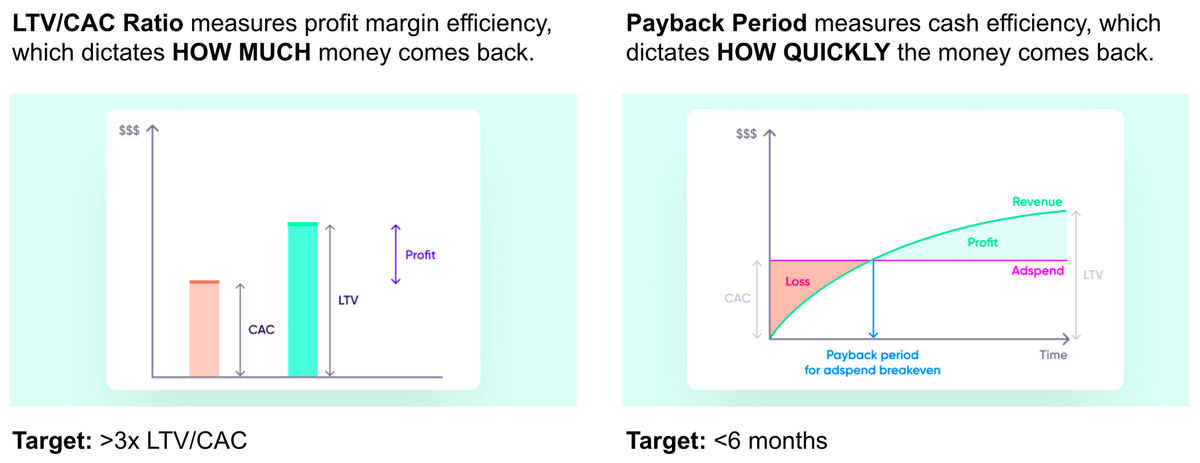
This ratio measures the return on your customer acquisition investment. It tells you: "For every dollar we spend to acquire a customer, how many dollars of profit do we get back over their lifetime?"

A widely accepted benchmark for a healthy LTV:CAC ratio is 3:1 or higher.
- < 1:1: You are losing money on every customer. This is a five-alarm fire.
- 1:1: You are breaking even. This is not sustainable, as it doesn't cover overhead or generate profit.
- 3:1: You have a solid, profitable growth engine.
- > 5:1: You might actually be underinvesting in marketing and leaving profitable growth on the table.
CAC Payback Period
While LTV:CAC tells you about long-term profitability, the Payback Period tells you about cash flow and efficiency. It answers the question: "How many months does it take to earn back the money we spent to acquire a customer?"
Even a business with a fantastic 5:1 LTV:CAC ratio can fail if its payback period is too long (e.g., 36 months), because it might run out of cash before it can realize those long-term profits. A common benchmark for a healthy payback period is under 12 months.
Test your understanding!
Your team presents the following data for two different marketing channels:
- Channel A (Google Ads): CAC = $300, LTV = $1,500. It takes 15 months to earn back the CAC.
- Channel B (Content Marketing): CAC = $400, LTV = $1,600. It takes 8 months to earn back the CAC.
Which channel is more attractive and why? What are the strategic trade-offs?
Show answer
-
LTV:CAC Ratio:
- Channel A: $1500 / $300 = 5:1
- Channel B: $1600 / $400 = 4:1
-
Payback Period:
- Channel A: 15 months
- Channel B: 8 months
Analysis:
Channel A is more profitable in the long run (5:1 vs. 4:1), but Channel B is more cash-efficient, returning the initial investment much faster (8 vs. 15 months).
Strategic Decision:
The "better" channel depends on the company's financial situation.
- A well-funded company focused on long-term value might favor Channel A.
- A bootstrapped or cash-constrained company would heavily favor Channel B, as the faster payback period allows them to reinvest in growth more quickly.
This illustrates why you need to look at both metrics together to make a sound strategic decision.
4. Putting It Into Practice: From Analyst to Strategist
As a leader, your role is not just to know these definitions but to use them to probe, question, and guide your team's strategy.
CAC/LTV: The Unit Economics That Matter
Let's return to the 'CAC/LTV: The Unit Economics That Matter' article. This time, focus on the sections that provide actionable advice for leaders.
Read the sections 'Common Scenarios', 'Industry Benchmarks', 'Troubleshooting Guide', and 'Common Pitfalls'. These sections are directly applicable to your role, helping you interpret numbers in context and ask the right questions of your analytics and marketing teams.
When your team presents a blended CAC, you should immediately ask for the breakdown by channel, customer segment, and geography. A profitable blended average can hide deeply unprofitable segments that are draining your budget. Your job is to uncover these truths and redirect resources to the most efficient areas of the business.
Conclusion
Today, we've unpacked the core financial metrics that underpin any sustainable marketing strategy. Moving beyond vanity metrics like clicks and leads to focus on LTV, CAC, and payback period is what separates tactical execution from strategic leadership.
Key Takeaways:
- Unit Economics is the foundation: Are you making more from customers than you spend to get them?
- LTV is the total profit from a customer, while CAC is the fully-loaded cost to acquire them. Getting these definitions right is critical.
- The LTV:CAC ratio measures long-term profitability (aim for >3:1), while the Payback Period measures cash efficiency (aim for <12 months). You need both.
- As a leader, your primary role is to scrutinize these metrics. Always ask for segmented data, question the inputs (is CAC truly fully-loaded?), and use these numbers to drive decisions about budget, strategy, and investment.
Preview of the Next Lesson:
Now that we have a framework for measuring the efficiency of our customer acquisition, a new question arises: how do we know which marketing touchpoints are actually responsible for that acquisition? In our next lesson, we will evaluate the trade-offs between different measurement methodologies, specifically attribution and incrementality, to better understand the true, causal impact of our marketing efforts.