Introduction
In our last lesson, you built your 30-second pitch—a tool to articulate the value of a UX audit as a business diagnosis. You learned to frame it as an "MRI for your product" that finds expensive leaks in a client's revenue funnel.
Today, we move from the why to the what. A successful consultant must be surgical with their scope. When a client says "fix my UX," they could mean anything from a quick look-over to a full-scale rebuild. Your job is to guide them to the right engagement, protect your time, and set up future work.
By the end of this 60-minute lesson, you will be able to clearly differentiate between a heuristic evaluation, a UX audit, and a redesign. This will enable you to confidently scope your $3k-$5k audit package, manage client expectations, and strategically position the audit as the necessary first step before a larger, more lucrative redesign project.
1. The Three Tiers of Engagement
When you talk to a potential client, you are not just selling one thing. You are diagnosing their needs and prescribing one of three levels of engagement. Understanding these tiers allows you to control the conversation and demonstrate expertise.
The article "Custom UX Audit vs Heuristic Evaluation" provides an excellent breakdown of the first two tiers.
Custom UX Audit vs Heuristic Evaluation: What You Need
This article clearly separates a fast, expert-based review from a deep, data-driven analysis. Pay close attention to the limitations of each approach, as this is key to justifying your audit's price.
Read the sections 'Heuristic Evaluation in UX Design' and 'Custom UX Audit'. Focus on what each one delivers and what it doesn't cover.
Let's distill this into a framework you can use in a sales call, using a simple analogy from the "ultimate guide to UX audits."
Tier 1: Heuristic Evaluation (The Quick Check-Up)
- What it is: An expert review against a checklist of usability principles (like Nielsen's Heuristics). It's you, the expert, walking through the interface and pointing out obvious flaws.
- Analogy: "Looking under the hood." It's quick and can spot visible problems, but it doesn't tell you how the car performs in real-world traffic.
- When to pitch it: Almost never as your main service. You can mention it to show you know the landscape, but frame it as insufficient. "We could do a quick heuristic review, but it's based on my expertise alone and won't tell us why your users are churning."
Tier 2: The UX Audit (The Full Diagnosis)
- What it is: This is your core $3k-$5k product. It's a systematic evaluation that combines expert review with quantitative data (analytics, heatmaps) and qualitative insights (session recordings, user feedback). It connects usability problems to business metrics.
- Analogy: "The full inspection." It includes the test drive (user behavior data), diagnostics (analytics), and a prioritized maintenance plan (your report).
- When to pitch it: This is your default offering. It's the answer when a client has symptoms (low conversion, high churn) but doesn't know the root cause. It provides the data-backed roadmap for any future work.
Tier 3: The Redesign (The Surgery)
- What it is: This is the implementation phase that follows a successful audit. It involves creating wireframes, high-fidelity mockups, prototypes, and a new design system based on the audit's findings.
- Analogy: "The operation." You don't perform surgery without an MRI. The audit is the MRI; the redesign is the targeted procedure to fix the diagnosed problem.
- When to pitch it: As the logical next step after the audit. Frame it as Phase 2. "The audit delivers the action plan. Once you approve it, we can scope a separate project to execute the redesign."
This tiered structure positions your audit not as an expense, but as a crucial investment to de-risk the much larger expense of a redesign.
2. Visualizing the Difference
To solidify your understanding, let's look at a few resources that visually and textually compare these concepts. Having these distinctions clear is critical for client conversations.
First, an article that offers a great analogy and clear definitions.
The ultimate guide to UX audits [2025]
Let's read a short section from 'The ultimate guide to UX audits' which offers a memorable analogy to distinguish these services.
Read the section 'UX Audit vs. Usability Testing vs. Heuristic Evaluation'. Focus on the car analogy—it's a powerful and simple way to explain the difference to a non-designer.
Now, let's watch a segment of a video that walks through the comprehensive process of a full audit. As you watch, notice how many steps go beyond a simple expert review. This is the value you're providing.
UI UX Audit Process - How to Stop Skipping Them [Free UX Audit Checklist]
This video from Headway provides a great overview of what a full, professional audit entails. Note the emphasis on user interviews, data analysis, and creating an action plan—all components that are absent in a simple heuristic evaluation.
Watch the sections from 06:21 to 12:07 and 13:41 to 17:10. Focus on the variety of activities involved (mapping, interviews, screenshots, reporting, action planning). This is the 'full inspection' you're selling.
Finally, a direct visual comparison is often the most effective tool.
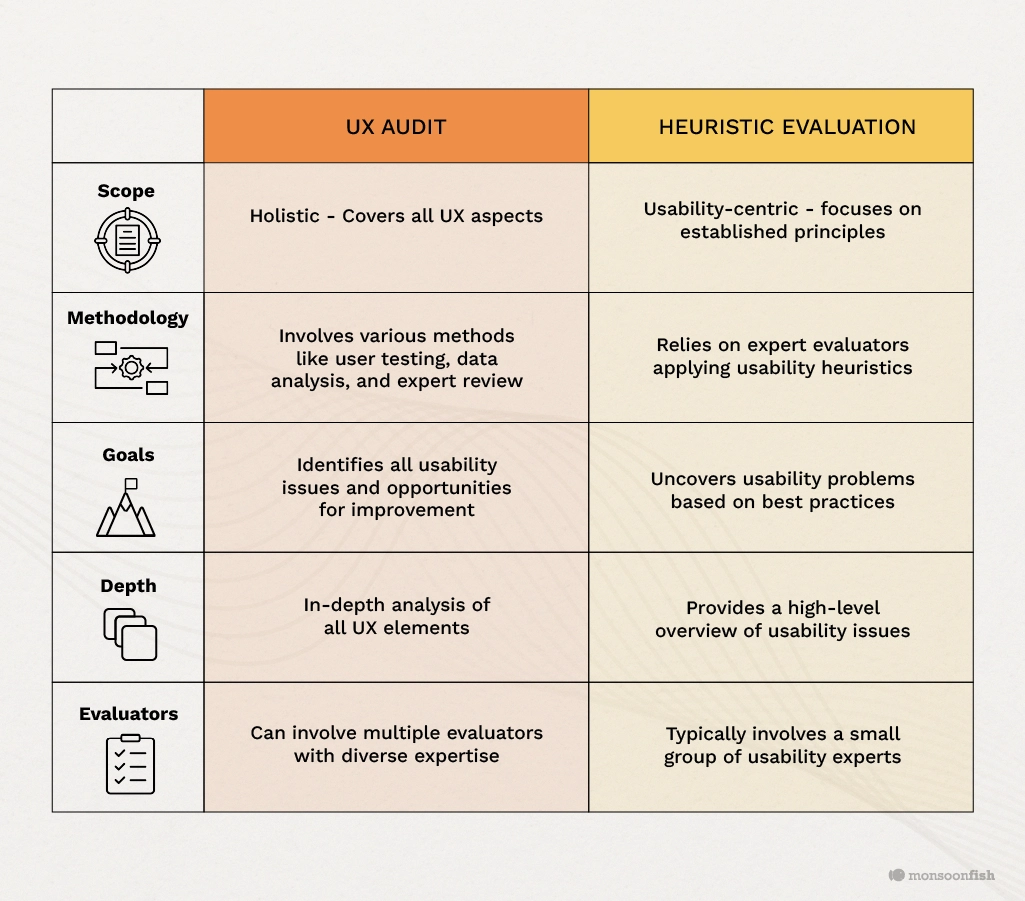
This distinction is the core of your scoping ability. You are selling the comprehensive analysis on the left, not just the quick review on the right.
Your Deliverable: The Scoping Framework
Your task is to create a practical, reusable script for guiding a client conversation about scope. This framework will help you handle common client requests ("Can you do a quick review?" or "Just give me a price for a redesign") and steer them toward your high-value audit.
Open a text editor or a new Figma file and create a document titled "Client Scoping Framework." Structure it with the following scenarios and responses. Write them in your own voice.
Scenario 1: The client asks for a "quick review" or mentions a "small budget."
- Acknowledge and Define: "I can definitely do a quick expert review—in the industry, we call that a heuristic evaluation. It's a fast way to spot common usability issues based on best practices. It's like a mechanic glancing under the hood."
- State the Limitation (Crucial Step): "However, a heuristic review won't tell us why your users are dropping off. It's based on my expertise alone, not your actual user data. We'd be guessing at the root cause of your business problem."
- Introduce the Better Solution (Your Audit): "For a small amount more, we can do a proper UX audit. That's where I dig into your analytics and user behavior to find the real friction points that are costing you money. Think of it as an MRI for your product—it gives us a data-backed roadmap for what to fix. This is my standard offering for new clients because it delivers real business value."
Scenario 2: The client asks for a "full redesign" upfront.
- Acknowledge and Reframe: "A redesign is a great goal, and I'd be happy to discuss that. My process ensures we invest your redesign budget with maximum impact. To do that, we need to know exactly what problems we're solving."
- Introduce the "Diagnose Before You Prescribe" Principle: "Jumping straight to a redesign is like a doctor prescribing surgery without an MRI. We might be fixing the wrong thing. That's why I always start with a rapid but intensive UX audit."
- Position the Audit as Phase 1: "The audit is Phase 1. For a fixed price of [$X], you get a prioritized action plan detailing the highest-impact issues. You'll know exactly where you're losing money and what to do about it. Then, with that data in hand, we can scope Phase 2—the redesign—with complete confidence that we're solving the right problems. This approach de-risks the entire project and ensures a higher ROI."
Spend about 20 minutes crafting these scripts. This document is now a key asset for your sales calls, helping you maintain control, demonstrate expertise, and sell your audit effectively.
Conclusion
Today you've moved beyond simply pitching an audit to strategically defining and scoping it. You now have a clear framework to differentiate your services, manage client expectations, and position your core offering as an indispensable diagnostic tool.
Key Takeaways:
- Heuristic Evaluation: A quick, low-cost expert review. Useful to know, but not what you're selling.
- UX Audit: Your core $3k-$5k product. A data-driven diagnosis that connects UX friction to business problems.
- Redesign: The implementation phase that follows the audit. It is your primary upsell opportunity.
- The "Diagnose Before You Prescribe" principle is your most powerful tool for selling the audit as a necessary prerequisite to any redesign, ensuring you solve the right problems and maximize client ROI.
Preview of the Next Lesson:
Now that you can verbally define the scope of your audit, our next lesson will formalize it. We will tackle the learning outcome: "Define strict audit boundaries for a SaaS product using a formal scope template." You will create another critical deliverable: a template that clearly outlines what's included in your audit package, what's not, and what the client needs to provide. This will become part of your professional proposal.