Hello! Welcome to the next lesson in our journey through the theory of computation.
In our last session, we proved a remarkable result: for any Nondeterministic Turing Machine, there exists an equivalent Deterministic Turing Machine. We did this by constructing a DTM that systematically simulates every possible computation path of the NTM. This idea of one machine simulating another is profoundly powerful. It leads us to a natural and fascinating question: can we take this concept to its ultimate conclusion? Can we design one single, fixed "master" TM that is capable of simulating any Turing Machine we describe to it?
The answer is yes, and this master machine is the subject of today's lesson. Our learning outcome is to explain the concept and significance of a Universal Turing Machine (UTM). The UTM is not just a theoretical curiosity; it's the formal abstraction of a modern stored-program computer and a cornerstone of computability theory.
1. The Core Concept: A Programmable Machine
At its heart, a Universal Turing Machine is a programmable machine. Think about your own experience as a developer. You don't need a different physical computer to run a web server, a machine learning model, or a blockchain node. You use the same general-purpose hardware for all these tasks. The hardware (the CPU) executes instructions from different programs (the software) that you provide.
The Universal Turing Machine, first conceived by Alan Turing, is the formal mathematical model of this idea. It is a single, fixed Turing Machine, U, which takes two inputs:
- The "Program": A description of another Turing Machine,
M. - The "Data": An input string,
w, for the machineM.
The UTM U then simulates the execution of M on input w. The final outcome of U's computation—accept, reject, or loop forever—will be identical to the outcome of M's computation on w.
This introductory video provides an excellent high-level overview of this concept and its parallels to modern computing.
This short video from Neso Academy provides an excellent introduction to the Universal Turing Machine. It draws the crucial analogy to a general-purpose computer and introduces the language associated with it.
Watch from the beginning up to 07:12. Focus on the core concept: what are the inputs to a UTM, and how does its behavior relate to the machine it's simulating? Pay attention to the comparison with a general-purpose computer.
2. How Does a UTM Work?
For a single machine U to be able to simulate any arbitrary machine M, two key mechanisms are required: a standardized way to describe M and a systematic process to simulate M's steps.
2.1. Encoding: Describing a Machine as a String
Just as you write a Python program as a text file that the Python interpreter can read, we need to represent a Turing Machine's definition as a string that the UTM can read from its tape. This process is called encoding.
Every component of a TM—its states, alphabet, and, most importantly, its transition function δ—must be converted into a string using a fixed set of symbols. For example, we could decide to represent states q0, q1, q2,... as binary numbers 0, 1, 10,.... A transition like δ(q1, a) = (q2, b, →) could be encoded as a string like (encoded_q1, encoded_a, encoded_q2, encoded_b, encoded_→).
The exact encoding scheme isn't what's important; the crucial point is that such a scheme exists. Any TM can be uniquely represented as a finite-length string.
The following video gives a simple, visual example of how such an encoding can be constructed.
Universal Turing Machine || Binary encoding of Turing machine || TOC || FLAT || Automata Theory
To simulate a machine, we first need a standardized way to describe it as a string. This video provides a clear, conceptual walkthrough of how a TM's components (states, transitions) can be encoded.
Watch the section from 06:12 to 10:20. Don't worry about memorizing the specific encoding scheme; focus on the principle that every part of a TM's definition can be translated into a symbolic string.
2.2. Simulation: The Multi-Tape Model
Once we have the encoded description of M, the UTM can begin the simulation. The easiest way to visualize this is by using a multi-tape Turing Machine model (which we know is equivalent to a single-tape TM). A common construction for a UTM uses three tapes:
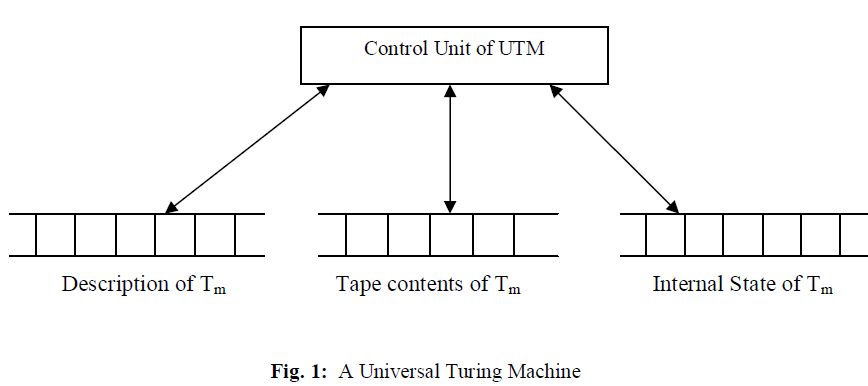
- Tape 1 (Description Tape): Stores the string encoding
<M>, the description of the machine to be simulated. This tape is read-only during the simulation. - Tape 2 (Working Tape): This tape simulates the tape of
M. The UTM will read from and write to this tape exactly asMwould. It starts with the input stringw. - Tape 3 (State Tape): This tape stores the current state of
M. For instance, ifMis in stateq_i, the encoding ofq_iwill be on this tape.
The UTM then enters a simulation loop:
- Read: Look at the current state on Tape 3 and the current symbol under the head on Tape 2.
- Find Rule: Scan through the description of
Mon Tape 1 to find the transition rule that matches the current state and symbol. - Execute Rule:
a. Update the state on Tape 3 to the new state from the rule.
b. Write the new symbol onto Tape 2.
c. Move the head on Tape 2 left or right as specified by the rule. - Repeat: Continue this loop until
Mwould enter an accept or reject state.
The following document provides a more formal and detailed construction of a UTM, which aligns with your preference for rigorous descriptions.
Now let's look at the mechanics of the simulation. These notes from a Cornell University course provide a formal description of how a multi-tape UTM is constructed and operates.
Please read Sections 3.1 ('Describing Turing machines using strings'), 3.3 ('Multi-tape Turing machines'), and 3.4 ('Construction of a universal Turing machine'). Section 3.1 formalizes the encoding idea. Section 3.3 justifies our use of a multi-tape model. Section 3.4 is the key part: it describes the roles of the different tapes and the simulation loop. You don't need to trace the pseudocode line-by-line, but you should understand the purpose of each phase of the simulation.
3. The Language of the UTM:
The existence of a UTM allows us to define a very important formal language. This language, often denoted as , is the set of all valid inputs that the UTM accepts.
An input to the UTM is a single string that encodes both the machine M and its input w. is the language consisting of all strings <M, w> for which the machine M would accept the input w.
Now, consider the behavior of the UTM U when given an input <M, w>:
- If
Macceptsw,Uwill simulateMand eventually halt and accept. - If
Mrejectsw,Uwill simulateMand eventually halt and reject. - If
Mloops forever onw,U, being a faithful simulator, will also loop forever. It will never halt.
Because the UTM can loop, it cannot decide the language . A decider must halt on all inputs. The UTM is only a recognizer for . This distinction is critical: is our first canonical example of a language that is Turing-recognizable but not decidable.
Let's revisit the first video to reinforce this crucial point.
Let's revisit the final point from the first video, which is crucial for understanding the UTM's significance.
Watch the concluding section from 07:12 to 07:59. This segment explicitly states why the UTM is a recognizer but not a decider for its language, A_{TM}.
Test your understanding!
You are given a UTM, U. You feed it the input string <M, w>. The UTM runs for one million steps and is still running. What can you conclude about whether the string <M, w> is in the language ?
Show answer
You can conclude nothing for certain. There are two possibilities:
- The machine
Mwill eventually halt and acceptwafter more than one million steps. In this case,<M, w>is in . - The machine
Mwill loop forever onw. In this case,<M, w>is not in .
Since the UTM U simply simulates M, we cannot distinguish between a very long computation and an infinite one just by waiting. This is the essence of why is not decidable.
4. The Significance of the Universal Turing Machine
The UTM is one of the most important concepts in computer science for several reasons:
- Theoretical Foundation of Computing: The UTM proves that you don't need infinitely many different machines to solve infinitely many different problems. A single, sufficiently complex machine can perform any computation, given the right "program." This powerful idea is at the core of the Church-Turing Thesis, which posits that any function that can be intuitively "computed" can be computed by a Turing Machine.
- Blueprint for Modern Computers: The UTM is the theoretical ancestor of the stored-program computer. The idea of treating a program (the description
<M>) as data that can be read and manipulated by another program (the UTM) is fundamental to everything from operating systems and compilers to the APIs and complex systems you've built. The hardware is fixed; its behavior is determined by the software it runs. - Gateway to Undecidability: The existence of the UTM and its associated language provides a concrete, natural example of a problem that is computationally recognizable but not decidable. This lays the groundwork for proving that other problems are also undecidable, most famously the Halting Problem.
Conclusion
In this lesson, we have explored the concept of the Universal Turing Machine. It stands as a testament to the idea that computation itself is a formal process that can be automated.
Key Takeaways:
- A Universal Turing Machine (UTM) is a fixed TM that can simulate any other TM.
- It operates on an input consisting of an encoded description of a target machine
Mand an input stringw. - The UTM faithfully simulates
Monw, producing the same result (accept, reject, or loop). - The language of the UTM, , is the set of all pairs
<M, w>whereMacceptsw. - is Turing-recognizable but not decidable, providing a foundational example of an undecidable problem.
- The UTM is the theoretical model for the stored-program computer, making it one of the most significant ideas in the history of computing.
Preview of the Next Lesson:
The fact that the UTM loops whenever its target machine loops leads directly to the most famous question in computability theory: can we create an algorithm that determines, for any given machine M and input w, whether M will halt or loop forever? This is the Halting Problem. In our next lesson, we will formally define this problem and prove that it is undecidable, marking a major milestone in our understanding of the limits of computation.