Hello! Welcome to the next lesson in our exploration of computability.
In our last session, we investigated the closure properties of recursive and recursively enumerable (RE) languages. We solidified our understanding that RE languages, also known as Turing-recognizable languages, are the set of all languages for which a Turing Machine can halt and accept. This represents the most general class of languages that can be positively identified by an algorithmic process.
Today, we will find the grammatical equivalent of the Turing Machine. This will complete the top level of the Chomsky Hierarchy and bridge the gap between the machine-based and grammar-based views of computation. This lesson directly addresses the learning outcome: Define unrestricted grammars and explain their equivalence to Turing Machines.
The Peak of the Hierarchy
We have explored regular grammars (equivalent to Finite Automata) and context-free grammars (equivalent to Pushdown Automata). Now, we ascend to the most powerful class of grammars.
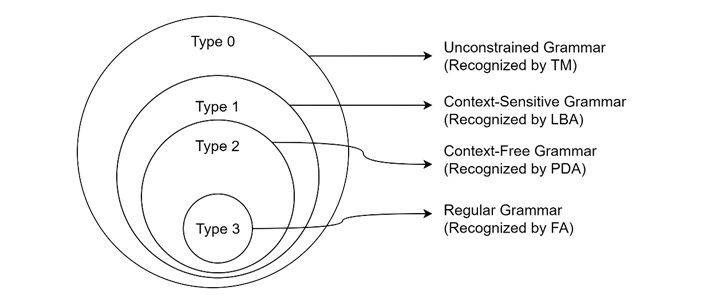
As the diagram shows, Type-0 grammars correspond to Turing Machines. Let's formally define them.
1. Unrestricted Grammars (Type-0)
An unrestricted grammar is the most general form of grammar in the Chomsky Hierarchy, with the fewest constraints on its production rules.
To understand the definition, let's watch a short video that introduces the concept.
Chomsky Classification of Grammar || GATECSE || TOC
This video from THE GATEHUB introduces the Chomsky classification and provides a clear definition of Type-0 (unrestricted) grammars, explaining their production rule format and connecting them to Recursively Enumerable languages and Turing Machines.
Watch the video from the beginning to 06:41. Focus on how the production rules for Type-0 grammars are defined and why they are called 'unrestricted'.
As the video explained, an unrestricted grammar (UG) is a 4-tuple where:
- is a finite set of variables (or non-terminals, often denoted ).
- is a finite set of terminals (disjoint from , often denoted ).
- is the start symbol.
- is a finite set of production rules of the form:
where and .
Let's break down the rule format:
- The condition on simply means that the left-hand side (LHS) of the rule must contain at least one non-terminal.
- The right-hand side (RHS), , can be any string of variables and terminals, including the empty string .
This is why they are called "unrestricted." Unlike Context-Free Grammars where the LHS must be a single non-terminal, here the LHS can be a mixed string. This allows rules to operate based on the context of a non-terminal. For example, a rule like aB -> ba could swap the order of a terminal a and a non-terminal B.
Example: Generating a Non-Context-Free Language
Consider the language , which we know is not context-free. An unrestricted grammar can generate it.

Let's trace the derivation for aabbcc using a slightly simplified but equivalent set of rules to the one in the image:
S -> aSBC(Generate anaand the non-terminalsBandC)S -> aBC(Base case for recursion)CB -> BC(SwapCandBto group them)aB -> ab(ConvertBtobwhen preceded bya)bB -> bb(ConvertBtobwhen preceded byb)bC -> bc(ConvertCtocwhen preceded byb)cC -> cc(ConvertCtocwhen preceded byc)
Derivation of aabbcc:S aSBC
a aBC BC (using rule 1, then rule 2)
aaB BCC (rule 3: CB -> BC)
aa BB CC (rule 3 again)
a ab B CC (rule 4: aB -> ab)
a abb C C (rule 5: bB -> bb)
a ab bc C (rule 6: bC -> bc)
a abb cc (rule 7: cC -> cc)
The rule CB -> BC is not context-free and is crucial for sorting the symbols into the correct a...b...c... order.
Test your understanding!
Consider the following production rules. For each rule, determine if it could be part of a Context-Free Grammar (CFG) and if it could be part of an Unrestricted Grammar (UG). Assume A, B are non-terminals and a, b are terminals.
A -> aAbaB -> baAB -> εa -> A
Show answer
A -> aAb: Valid for both CFG and UG. The left-hand side (LHS) is a single non-terminal, which is the rule for CFGs. All valid CFG rules are also valid UG rules.aB -> ba: Valid for UG only. The LHS contains a terminal (a), which is not allowed in a CFG. However, the LHS (aB) does contain a non-terminal, making it valid for a UG. This type of rule is powerful; it allows symbols to be reordered based on their context.AB -> ε: Valid for UG only. The LHS has more than one symbol, so it cannot be a CFG rule. It's a valid UG rule. This kind of "shrinking" rule (where ) is a hallmark of grammars more powerful than context-sensitive ones.a -> A: Invalid for both. The LHS consists only of a terminal. For any grammar type in the Chomsky Hierarchy, the LHS of a production must contain at least one non-terminal to enable derivation. A terminal cannot derive anything.
2. Equivalence of Unrestricted Grammars and Turing Machines
The most important result concerning unrestricted grammars is their equivalence to Turing Machines.
Theorem: A language is recursively enumerable if and only if is generated by an unrestricted grammar.
This means that for any TM, there's a UG that generates the same language, and for any UG, there's a TM that recognizes the language it generates. This establishes that UGs and TMs are equal in computational power.
To prove this, we must show two directions:
Grammar -> TM: For any UGG, we can construct a TMMsuch thatL(M) = L(G).TM -> Grammar: For any TMM, we can construct a UGGsuch thatL(G) = L(M).
The following reading provides a concise but complete overview of the proofs for both directions.
These lecture notes from the University of Texas at Austin, titled 'Grammars and Turing Machines', formally state the equivalence theorem and outline the proof constructions for both directions.
Please read pages 2 and 3 of the handout. Page 2 outlines the proof for 'Grammar -> Turing Machine'. Page 3 begins the proof for 'Turing Machine -> Grammar'. Focus on understanding the high-level strategy for each construction.
Let's unpack the logic behind these two constructions.
Part 1: Constructing a TM from a Grammar
Goal: Given an unrestricted grammar G, construct a Turing Machine M that recognizes L(G).
The TM M must take an input string w and determine if S =>* w. The challenge is that a blind search through all possible derivations could go on forever. The key is to use nondeterminism, which perfectly suits the nature of a recognizer (a machine for an RE language).
The construction, as described in the reading, uses a 2-tape non-deterministic Turing Machine (NTM):
- Tape 1: Contains the input string
w. This tape is read-only. - Tape 2: The "work tape". It is initialized with the start symbol
S.
The NTM M works as follows:
- Initialize Tape 2 with
S. - Repeatedly perform the following steps:
a. Nondeterministically choose one ofG's production rules,α -> β.
b. Nondeterministically choose a location on Tape 2.
c. Check if the stringαappears at the chosen location on Tape 2.
d. If it does, replaceαwithβ. This may require shifting the rest of the string on Tape 2 if|α| ≠ |β|.
e. After applying a rule, compare the entire string on Tape 2 with the inputwon Tape 1.
f. If they match, accept.
Why this works: If w ∈ L(G), then there exists a finite sequence of rule applications (a derivation) that transforms S into w. By the definition of nondeterminism, there is a computational branch in our NTM that will correctly guess this exact sequence of rules and locations, leading to acceptance. If w ∉ L(G), no such derivation exists, so no branch will ever produce w on Tape 2 and accept. The machine may loop, which is the expected behavior for a recognizer on a non-member string.
Since any multi-tape NTM has an equivalent single-tape DTM, this construction proves that L(G) is recursively enumerable.
Part 2: Constructing a Grammar from a TM
Goal: Given a TM M, construct an unrestricted grammar G that generates L(M).
This direction is more intricate. The core idea is to make the grammar simulate the TM's computation in reverse.
-
Representing TM Configurations as Strings: A complete state of a TM's computation (its configuration) can be captured by a single string. If the TM is in state
qwith tape contentuavand its head is scanninga, we can represent this asuaqv. The state symbol is embedded in the tape string to mark the head's position. -
Reverse Simulation: The grammar will start by generating a string that represents a final, accepting configuration of the TM. Then, using its production rules, it will work backward, step by step, until it reaches an initial configuration. Finally, it will clean up the extra symbols to leave only the original input string.
The grammar G is constructed as follows:
- Variables: The variables of
Gwill include the states ofM() and the tape alphabet ofM(). - Start Rule:
Ghas a rule that generates a generic accepting configuration. For example,S -> u_1 q_{accept} u_2, whereq_{accept}is an accepting state. - Simulation Rules: For every transition
δinM,Ghas a rule that reverses it.- If
δ(p, a) = (q, b, R)(a right move), this corresponds to the TM computation...pa... => ...bq.... The grammar rule will bebq -> pa. - If
δ(p, a) = (q, b, L)(a left move), this is...cpa... => ...qcb.... The grammar rule (for all tape symbolsc) will beqcb -> cpa.
- If
- Clean-up Rules: Once the derivation reaches an initial configuration like
q_0 w, special rules are used to erase the state symbolq_0and any tape markers, leaving just the stringw, which is composed of terminals.
A derivation S =>* w exists in G if and only if the TM M has a valid computation q_0w =>* ... => ...q_{accept}.... Therefore, L(G) is exactly L(M).
The formal construction in the resources LINK and LINK lays out these rules precisely. Given your background in system design, you can think of this as defining a formal system (the grammar) whose state transitions (derivations) perfectly mirror the reverse state transitions of another formal system (the Turing Machine).
Conclusion
Today, we've reached the top of the Chomsky Hierarchy and found the grammatical counterpart to the all-powerful Turing Machine.
Key Takeaways:
- Unrestricted Grammars (Type-0) are defined by production rules of the form
α -> β, where the only constraint is that the left-hand sideαmust contain at least one non-terminal. - This simple format allows for context-dependent and length-decreasing rules, making UGs powerful enough to generate languages that are not context-free, such as
{aⁿbⁿcⁿ}. - The class of languages generated by unrestricted grammars is exactly the class of recursively enumerable languages.
- This equivalence is proven by showing how to construct a non-deterministic TM to simulate a grammar's derivations and, conversely, how to construct a grammar whose reverse derivations simulate a TM's computations.
Preview of the Next Lesson:
We have now examined the bottom (Regular, CFG) and top (Unrestricted) levels of the Chomsky Hierarchy. In our next lesson, we will fill in the missing piece: Context-Sensitive Grammars (CSGs) and their corresponding automaton, the Linear Bounded Automaton (LBA). This will allow us to present the full, ordered hierarchy and understand the proper containment relationships between these fundamental language classes.