Hello! Welcome back to our course on the Theory of Computation.
In our last lesson, we saw how robust the class of regular languages is by proving they are closed under operations like union, intersection, and concatenation. However, some of the constructions we used, particularly the subset construction for converting an NFA to a DFA and the product construction, can lead to DFAs with a large number of states. This raises an important engineering question: can we do better? Is there a way to create the smallest possible DFA for a given language?
Today, we will answer that question by focusing on DFA minimization. This lesson directly addresses the learning outcome: Apply the table-filling algorithm to identify and merge indistinguishable states in a DFA. We will develop a rigorous method for finding and eliminating redundant states in any given DFA, paving the way to constructing its unique, minimal equivalent.
1. The Concept of Distinguishable States
The core idea behind DFA minimization is to identify states that are functionally identical and merge them. But what does it mean for two states to be "identical"?
We define two states, and , as indistinguishable if, for any input string , the machine's behavior starting from state is the same as its behavior starting from state . That is, if you start at and process , you end up in a final state if and only if you also end up in a final state when starting from . If two states are indistinguishable, they are redundant, and we can merge them.
Conversely, states and are distinguishable if there exists at least one string that "reveals" their difference. This string is a distinguishing string if processing it from one state leads to acceptance, while processing it from the other leads to rejection.
For a formal definition of this concept, let's turn to these lecture notes from MIT.
Please read the slides from 'Distinguishing states with strings' up to the slide defining the equivalence relation '∼' (slides 10-18). This will give you the formal groundwork for what it means for states to be distinguishable or indistinguishable.
Finding a distinguishing string for every pair of states by testing all possible strings is impossible. Instead, we can define distinguishability recursively. This provides the basis for an efficient algorithm.
Two states and are distinguishable if:
- Base Case: One of them is a final state and the other is not. The empty string distinguishes them.
- Recursive Step: There exists some input symbol such that the states they transition to, and , are themselves already known to be distinguishable.
The video below gives an excellent intuitive explanation of this recursive idea.
DFA Minimization Algorithm + Example
This clip from Easy Theory explains the recursive logic behind finding distinguishable states, which is the heart of the minimization algorithm.
Watch from 06:54 to 09:16. The presenter clearly lays out the three conditions under which two states are considered distinguishable, which directly correspond to the base case and recursive step of our algorithm.
2. The Table-Filling Algorithm
The table-filling algorithm is a systematic, dynamic programming approach to apply this recursive definition and find all pairs of distinguishable states in a DFA. Any pair of states that is not marked as distinguishable by the end of the algorithm is, by definition, indistinguishable.
The algorithm proceeds as follows:
- Setup: Create a table listing all unique pairs of states . We can visualize this as a lower-triangular grid where rows and columns are labeled with the states of the DFA.
- Pass 0 (Base Case): Mark all pairs where one state is in the set of final states and the other is not. These are distinguished by the empty string .
- Iterative Passes (Recursive Step): Repeatedly iterate through the unmarked pairs. For each unmarked pair , check for every symbol in the alphabet. If the pair of states they transition to, , is already marked in the table, then mark .
- Termination: Continue making passes until a full pass over the table results in no new marks. The pairs that remain unmarked are indistinguishable.
The following video provides a complete walkthrough of applying this algorithm to an example DFA.
Myhill Nerode Theorem - Table Filling Method
This Neso Academy video gives a clear, step-by-step demonstration of the table-filling algorithm in action. It's a perfect guide to see how the abstract steps translate into practice.
Watch from 00:39 to 14:58. This segment explains the four steps of the algorithm and then applies them to a concrete DFA. Pay close attention to how unmarked pairs are checked and how a new mark is propagated based on the transitions to an already-marked pair.
3. Applying the Algorithm
Now it's your turn to apply what you've learned. Given your background in building complex systems, you can think of this as a dependency analysis algorithm: a pair of states is "bad" (distinguishable) if it depends on another "bad" pair.
Consider the following DFA. Your task is to use the table-filling algorithm to find all pairs of distinguishable states.
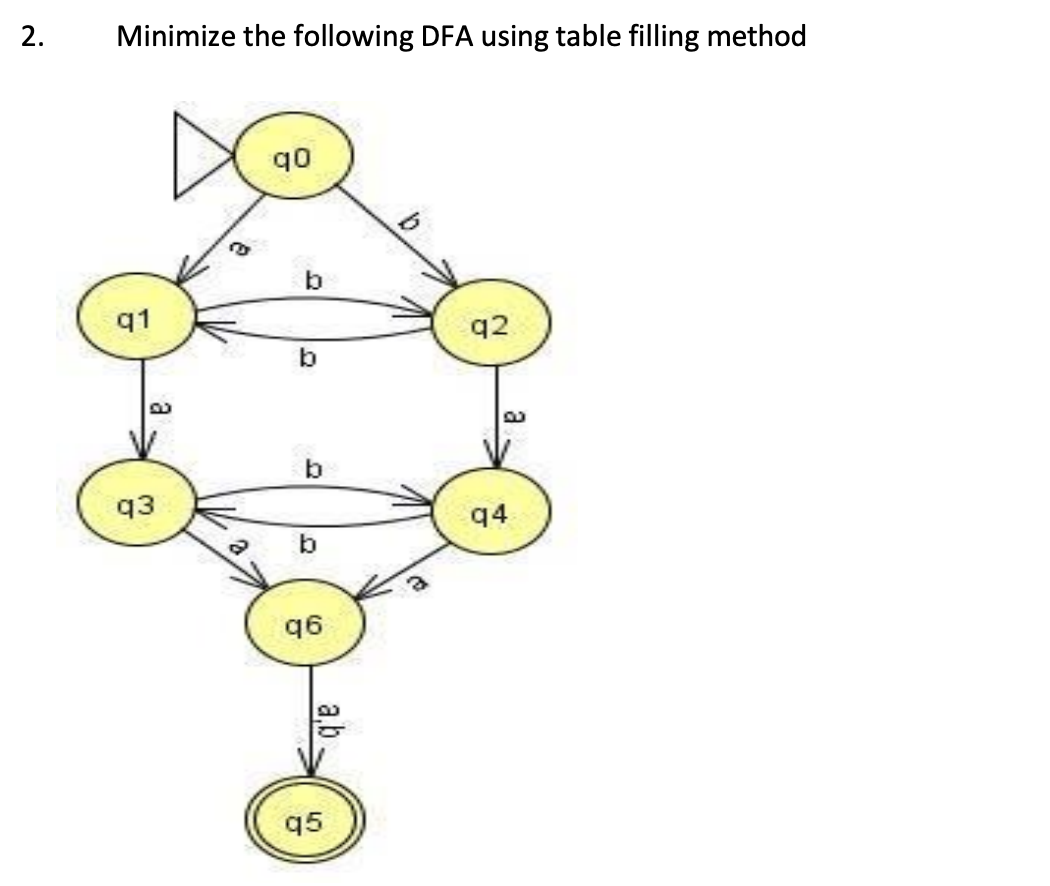
Test your understanding!
Apply the table-filling algorithm to the DFA shown above. Create a table for all pairs of states and fill it in according to the algorithm. Which pairs of states remain unmarked at the end?
Show answer
Let's walk through the algorithm step-by-step.
1. Setup
We create a table for pairs of states from to .
2. Pass 0 (Base Case)
The only final state is . We mark every pair containing and a non-final state.
- Marked: .
3. Pass 1
We check unmarked pairs to see if they transition to a marked pair.
- : On 'a', transitions to , which is marked. So, we mark .
- : On 'b', transitions to , which is marked. So, we mark .
- : On 'a', transitions to , which is marked. So, we mark .
- : On 'b', transitions to , which is marked. So, we mark .
- : On 'b', transitions to , which is marked. So, we mark .
- : On 'a', transitions to , which is marked. So, we mark .
- : On 'a', transitions to , which is marked. So, we mark .
- : On 'b', transitions to , which is marked. So, we mark .
At the end of Pass 1, the following pairs are still unmarked: .
4. Pass 2
We re-scan the remaining unmarked pairs.
- : On 'a', transitions to , which we marked in Pass 1. So, we mark .
- : On 'b', transitions to , which we marked in Pass 1. So, we mark .
At the end of Pass 2, the unmarked pairs are: . Let's recheck these.
- : on 'a' (now marked); on 'b' (now marked). So, we mark .
5. Final Pass
The only remaining unmarked pair is . Let's check it again.
- On 'a': . This pair is not marked.
- On 'b': . This pair is not marked.
Since neither transition leads to a marked pair, remains unmarked.
No new marks were made in this pass, so the algorithm terminates.
Conclusion:
The only pair that remains unmarked is . This is the only pair of indistinguishable states in this DFA. All other pairs are distinguishable.
Merging Indistinguishable States
After the table-filling algorithm terminates, all unmarked pairs represent sets of indistinguishable states. These sets form equivalence classes. In our example, we found two such classes with more than one state: and . The remaining states are in classes of their own: .
The core idea of minimization is to merge the states within each equivalence class into a single new state.
- The class becomes a single state, let's call it .
- The class becomes a single state, .
- The other states become , , and .
This reduces our original 7-state DFA to a new 5-state machine.
Conclusion
In this lesson, we delved into the logic and mechanics of DFA minimization. We established a formal basis for identifying redundant states and mastered an algorithm to find them.
Key Takeaways:
- Indistinguishable States: Two states are indistinguishable if their behavior is identical for all possible future inputs. These states are redundant and can be merged.
- Table-Filling Algorithm: This is a dynamic programming algorithm that systematically finds all pairs of distinguishable states.
- Base Case: A final state and a non-final state are always distinguishable.
- Recursive Step: Two states are distinguishable if they transition to an already distinguishable pair on some input symbol.
- Equivalence Classes: The states that are not distinguished from each other form equivalence classes, which will become the states of the minimized DFA.
Preview of the Next Lesson:
We've successfully identified which states to merge. In our next lesson, we will complete the process by formally constructing the unique minimal DFA. We will define the new set of states, the new start state, the new final states, and, most importantly, the new transition function for this smaller, more efficient machine.